
 info@thoroughbredbhc.com
Many people delay mental health care because they worry about the bill.
If you are considering cognitive behavioral therapy, you can expect to pay anywhere from $100 to $300 per session without insurance, though sliding-scale clinics and nonprofit networks offer sessions as low as $40.
This article breaks down what drives CBT therapy cost, what your insurance will likely cover, and how to find affordable care that fits your budget.
What is the Average Cost of CBT Therapy?
The cost of cognitive behavioral therapy varies widely by location, provider credentials, and whether you use insurance.
In major metropolitan areas like New York City, Los Angeles, and San Francisco, private practice therapists commonly charge $200 to $350 per hour for individual CBT sessions. Smaller cities and interior markets typically see rates between $120 and $180 per session.
A specialty CBT practice in St. Louis, for example, charges $205 for a 45-minute session, $255 for 60 minutes, and $305 for 75 minutes.
Meanwhile, a Beverly Hills psychologist lists individual sessions at $100 with a sliding scale, and a Los Angeles CBT for Insomnia specialist charges $280 for an initial 60-minute session with prorated follow-ups around $140.
These posted prices reflect the cash-pay market. Your actual out-of-pocket cost will depend on your insurance plan design, whether your therapist is in-network, and which billing code your session uses.
How Insurance Affects CBT Therapy Cost?
In-Network Coverage and Copays
If you have employer-sponsored health insurance and see an in-network therapist, your plan’s negotiated rate will be lower than the posted cash price. Most HMO, PPO, and POS plans charge a flat copay for behavioral health office visits, typically $25 to $50 per session.
Many of these plans cover mental health office visits before you meet your deductible, making each session predictable and affordable.
For example, an Aetna Silver HMO plan covers certain office visits before the deductible, and a Keystone HMO Silver plan explicitly states that primary and specialist office visits are covered pre-deductible.
If your plan follows this structure, you will pay only your copay for each CBT session, regardless of how many visits you need.
High-Deductible Health Plans and Coinsurance
High-deductible health plans (HDHPs) work differently. In 2025, 29% of covered workers were enrolled in HSA-qualified HDHPs, and these plans typically require you to pay the full negotiated rate until you meet your deductible. After that, you pay coinsurance, often 20% to 40% of the allowed amount.
If your plan’s in-network allowed amount for a 45-minute psychotherapy session is $140, you would pay $140 per session until your deductible is met, then $28 per session (at 20% coinsurance) for the rest of the year.
For a short course of CBT, this can add up quickly. However, new federal guidance under the One, Big, Beautiful Bill Act made permanent a safe harbor allowing HDHPs to cover telehealth pre-deductible without jeopardizing HSA eligibility.
If your plan adopts this safe harbor, you may pay only a copay for tele-mental health sessions, even before meeting your deductible.
Out-of-Network Reimbursement
Seeing an out-of-network therapist means you will likely pay the full session fee upfront and submit a claim for partial reimbursement.
Plans calculate out-of-network payments as the lesser of the provider’s billed charge or the plan’s usual, customary, and reasonable (UCR) amount.
Transparency data from a large employer plan showed out-of-network allowed amounts for 45-minute psychotherapy ranging from $350 to $460 in high-cost markets, even when providers billed higher amounts.
Most plans cover few out-of-network services, and the No Surprises Act has reduced the value of relying on out-of-network care for many services.
Out-of-network CBT can make financial sense if your employer plan has generous UCR rates, manageable out-of-network deductibles, and your provider sets charges at or below UCR. For most people, however, in-network care or sliding-scale options will be more affordable.
Low-Cost and Sliding-Scale CBT Options
Open Path Psychotherapy Collective
Open Path is a nonprofit network that connects clients with licensed therapists at reduced rates. After a one-time $65 membership fee, sessions cost $40 to $70 for individuals, and supervised student-intern sessions are available for $30.
Open Path is intended for people who are uninsured, underinsured, or facing financial hardship. If you can afford to use insurance, the network asks that you do so.
Community Clinics and Sliding-Fee Scales
Many community mental health centers offer sliding-fee schedules based on household income. A community clinic in 2024 published a sliding scale for psychotherapy with usual and customary rates of $203 for a 45-minute session and $299 for 60 minutes.
Patients in lower income tiers paid as little as $20 to $30 per session, making CBT accessible even without insurance.
Online Therapy Platforms
Subscription-based platforms bundle messaging and live video sessions into monthly plans charging $260 to $436 per month depending on the plan.
What Determines the Cost of a CBT Session?
Session Length and Billing Codes
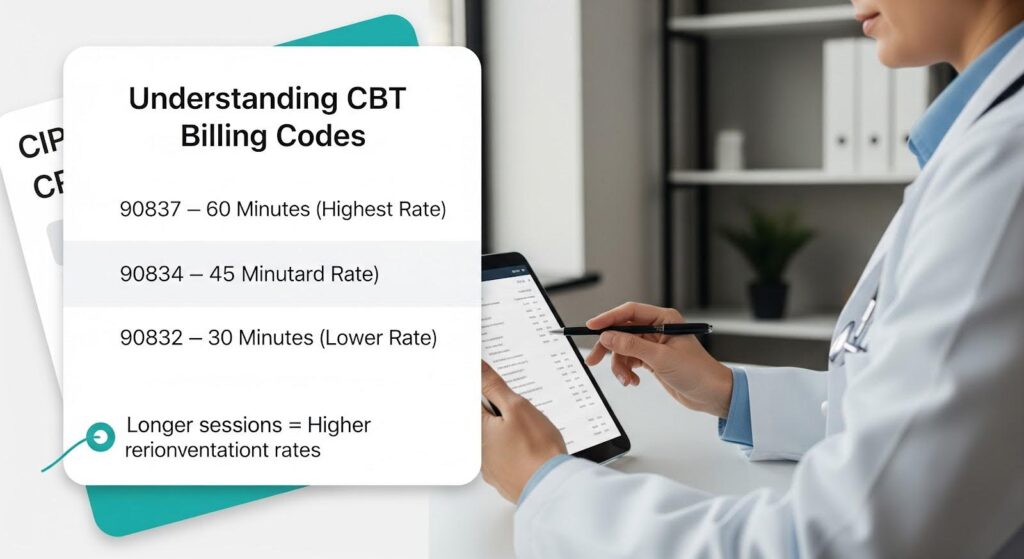
Therapists bill psychotherapy using Current Procedural Terminology (CPT) codes based on session length. The most common codes are:
- 90834: 45-minute session (38 to 52 minutes documented time)
- 90837: 60-minute session (53+ minutes)
- 90832: 30-minute session (16 to 37 minutes)
Longer sessions reimburse at higher rates. Medicare’s national nonfacility payment for 90837 is estimated at $167 in 2026, compared to $114 for 90834.
Private insurers typically pay more than Medicare, but the relative difference between codes remains. If your therapist extends sessions past 53 minutes, you may see higher charges or copays.
Group CBT and Lower Per-Patient Costs
Group cognitive behavioral therapy uses CPT code 90853 and delivers psychoeducation and skills training to multiple participants at once.
Medicare pays approximately $30 per patient for group therapy in 2026, far less than individual psychotherapy. Private plans scale from this baseline, making group CBT one of the most cost-effective modalities when clinically appropriate.
Group sessions typically run 45 to 60 minutes with six to ten participants. If your condition is well-suited to group work, such as anxiety disorders, panic, or depression, group CBT can deliver strong outcomes at a fraction of the cost of individual therapy.
Geographic Variation
Location drives significant price differences. Therapists in New York City, San Francisco, and Los Angeles routinely charge $200 to $350 per session to cover higher rent, wages, and operating costs.
In contrast, practices in Colorado Springs, Madison, and other interior markets post rates around $120 to $165 per session.
A statewide California directory snapshot showed an average posted price of $175, illustrating the wide range even within one state.
Provider Credentials and Specialization
Psychiatrists, psychologists, and licensed clinical social workers all deliver CBT effectively, but fee schedules often differ by credential.
Psychiatrists typically command higher rates than psychologists, who in turn charge more than LCSWs or licensed professional counselors. Specialty training in protocols like CBT for Insomnia or trauma-focused CBT may also justify premium pricing.
Cost-Effectiveness of Different CBT Formats
Guided Internet-Delivered CBT
Guided internet-delivered cognitive behavioral therapy (iCBT) combines self-paced online modules with therapist feedback via messaging or brief video check-ins.
A comprehensive health technology assessment in Ontario found that guided iCBT had an incremental cost-effectiveness ratio of approximately $31,575 per quality-adjusted life year for major depression, well within common willingness-to-pay thresholds.
In the same analysis, individual in-person CBT was dominated by guided iCBT in the base case, meaning it cost more and delivered fewer benefits over a 12-month horizon.
For anxiety disorders, guided iCBT showed an ICER around $43,250 per QALY, again more favorable than group or individual CBT in short-term models.
Real-world implementation studies confirm that guided iCBT maintains strong outcomes in routine care when programs invest in training and infrastructure.
Group CBT
Group therapy can be highly cost-effective for appropriate diagnoses, but economic models often show it is less favorable than guided iCBT within a 12-month horizon unless delivery costs are very low.
The Ontario HTA found group CBT had ICERs exceeding $65,000 per QALY in some scenarios. However, group CBT remains a valuable option when digital interventions are not suitable or when group process itself is therapeutic.
Individual In-Person CBT
Traditional individual CBT is the most expensive modality per patient hour. While it delivers strong outcomes, especially for complex cases, economic models suggest that starting with lower-intensity options like guided iCBT or group CBT and stepping up to individual therapy for nonresponders can maximize value.
This stepped-care approach reduces total costs while preserving or improving population-level outcomes.
How to Estimate Your CBT Therapy Cost?
Use Your Insurer’s Cost Estimator
Many health plans now offer online tools that show in-network negotiated rates for psychotherapy codes. These tools are often powered by Transparency in Coverage machine-readable files, which insurers must publish under federal rules.
Before scheduling, search for CPT codes 90834 or 90837 in your ZIP code to see what your plan pays and what your copay or coinsurance will be.
Check Your Summary of Benefits and Coverage
Your plan’s Summary of Benefits and Coverage (SBC) document explains whether office visits are covered before the deductible and whether you pay a copay or coinsurance.
Look for the section titled “Are there services covered before you meet your deductible?” Many HMOs and PPOs cover behavioral health office visits pre-deductible, which can save you hundreds of dollars if you need ongoing CBT.
Be careful not to confuse separate deductibles for prescription drugs or pediatric dental with the medical deductible that governs outpatient psychotherapy. These are distinct line items in your SBC.
Ask About Telehealth Coverage in HDHPs
If you have a high-deductible health plan with a health savings account, confirm whether your plan covers tele-mental health pre-deductible under the permanent safe harbor.
If yes, you may pay only a copay for video or phone CBT sessions, even early in the year before your deductible is met. This can make a significant difference in affordability.
Compare Cash-Pay and Sliding-Scale Options
If your copay exceeds $70 or you face a high deductible, compare your insurance cost to Open Path’s $40 to $70 sessions or local sliding-fee clinics. For a short course of CBT, paying out of pocket through a nonprofit network may be less expensive than using insurance.
What a Full Course of CBT Costs Under Different Scenarios?
A typical acute course of CBT runs 10 to 12 sessions over 12 weeks. CBT for Insomnia is shorter, often four to six sessions. Here are illustrative total costs under common coverage pathways:
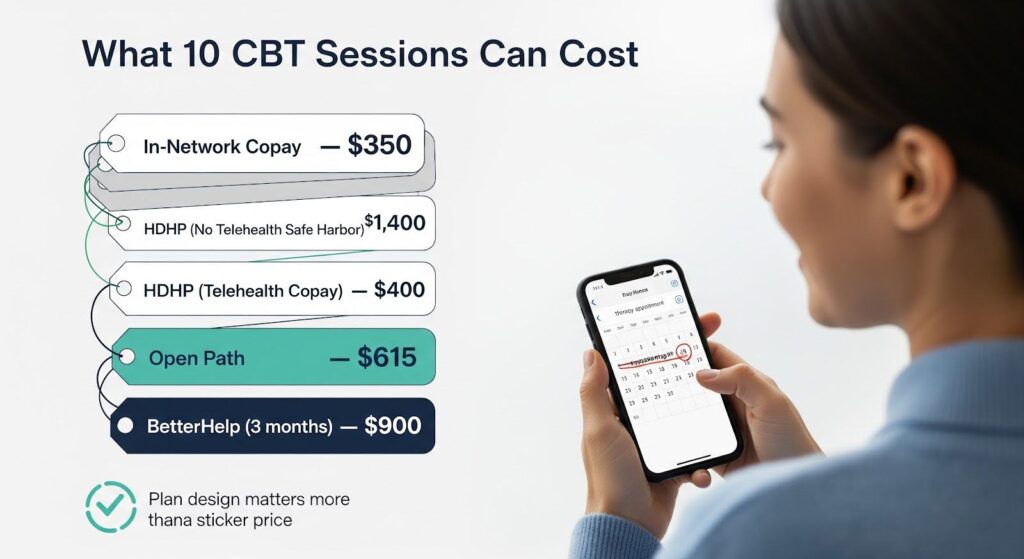
- In-network copay plan ($35 copay, office visits covered pre-deductible): 10 sessions × $35 = $350
- HDHP without telehealth safe harbor (allowed amount $140, deductible not met): 10 sessions × $140 = $1,400
- HDHP with telehealth safe harbor ($40 copay for tele-CBT pre-deductible): 10 sessions × $40 = $400
- Out-of-network (UCR $350, $1,000 OON deductible, 30% coinsurance): Approximately $1,050 to meet deductible plus 30% of remaining sessions, total around $1,995 for 12 sessions
- Open Path ($55 per session, $65 membership): $65 + (10 × $55) = $615
- BetterHelp cash-pay ($300/month for 3 months): $900
These examples show that plan design and modality choice have a larger impact on total cost than the posted session price alone.
The most affordable pathways for most people are in-network copay plans or legitimate sliding-scale networks.
Macro Trends Affecting CBT Therapy Cost
Rising Employer Premiums and Cost Sharing
Employer-sponsored family premiums rose 7% to $25,572 in 2024, following a 7% increase in 2023. This sustained premium growth pressures employers to shift more costs to employees through higher deductibles and coinsurance.
Even as medical care services inflation runs around 3.2% to 3.3% year-over-year, outpacing overall CPI, the combination of premium increases and benefit design changes raises out-of-pocket exposure for many patients.
Telehealth Policy Stability
Medicare has permanently allowed the patient’s home as an originating site for tele-mental health, removing historical rural and facility location limits. The 2026 Medicare Physician Fee Schedule simplifies telehealth service review, supporting continued coverage of psychotherapy by video and phone.
For commercial plans, the permanent HDHP telehealth safe harbor ensures that tele-mental health can be covered pre-deductible without jeopardizing HSA eligibility, smoothing early-year cost barriers.
Mental Health Parity and Network Adequacy
New Mental Health Parity and Addiction Equity Act rules finalized in 2024 emphasize nonquantitative treatment limitations, including provider reimbursement rates and network adequacy.
Over time, parity scrutiny should improve in-network access to CBT and reduce reliance on out-of-network care. Price transparency files also enable employers and patients to benchmark contracted rates and negotiate better terms.
Why Does It Matter?
Understanding CBT therapy cost empowers you to make informed decisions about your mental health care. Whether you pay $40 through a nonprofit network, $165 at a community clinic, or $350 in a major metro private practice, knowing your options and how insurance works can save you hundreds or thousands of dollars over a course of treatment.
The evidence shows that guided internet-delivered CBT and group therapy deliver strong outcomes at lower costs than traditional individual sessions, making stepped-care models a smart choice for many people.
If you are struggling with anxiety, depression, or trauma and cost is holding you back, explore in-network telehealth benefits, sliding-fee clinics, and nonprofit access programs. Effective, affordable CBT is within reach when you know where to look.
If you or a loved one needs support for co-occurring mental health and substance use challenges, Thoroughbred’s dual diagnosis treatment can provide integrated care that addresses both conditions together. Reach out today to learn how personalized, evidence-based therapy can help you find lasting freedom.


 Give Us A Call


