
 info@thoroughbredbhc.com
Wondering whether your cocaine use or a loved one’s has crossed a line can feel confusing and isolating.
About 1 million Americans met criteria for cocaine use disorder in a single recent year, and the clearest warning sign is not how much someone uses but whether cocaine has started to control their behavior, mood, and daily choices.
This article breaks down every major symptom category so you can spot the problem early and take action.
Recognizing Cocaine Addiction Symptoms
Cocaine addiction, clinically called cocaine use disorder, is defined by compulsive use despite medical, psychological, and social harm.
A 2022 clinical review found that about 2.2 million people in the United States use cocaine regularly, and roughly 20% of U.S. drug overdose deaths in 2017 involved the drug.
Many people assume cocaine addiction always looks dramatic. They picture someone who has lost everything. The truth is more subtle.
Cocaine addiction symptoms often show up as shifts in mood, sleep, finances, relationships, and decision making long before a crisis hits. Others assume cocaine is less dangerous than substances with obvious physical withdrawal.
That assumption is also wrong. Cocaine intoxication can cause arrhythmias, heart attack, stroke, seizures, and sudden death.
The most reliable way to identify a problem is to look across several areas of a person’s life rather than waiting for a single unmistakable sign.
How Cocaine Use Disorder is Defined?
The clinical term “cocaine use disorder” shifts attention away from how much or how often someone uses. Instead, it focuses on whether cocaine has become behaviorally dominant. Diagnostic criteria cluster into four groups:
- Physiologic features such as craving, tolerance, and withdrawal
- Loss of control over cocaine use
- Cocaine taking priority over responsibilities and activities
- Continued use despite negative consequences
Severity depends on how many criteria a person meets. Two to three symptoms point to a mild disorder, four to five suggest moderate, and six or more indicate severe substance use disorder.
This means a person does not need to hit rock bottom to have a real, diagnosable problem.
Psychological and Emotional Signs of Cocaine Addiction
Cocaine initially produces euphoria, energy, and confidence. Over time, though, emotional instability becomes one of the strongest signs of cocaine addiction.
Common psychological symptoms include irritability, restlessness, anxiety, panic, paranoia, mood swings, and depression between uses.
These are not minor side effects. Among U.S. survey respondents, 45% of cocaine users reported a lifetime mood disorder and 31% reported a lifetime anxiety disorder.
Current cocaine use was linked to nearly triple the risk of depression and more than double the risk of anxiety disorders compared with people who had never used.
A key shift happens when someone starts using cocaine not just to feel good but to escape feeling bad. Once the drug becomes a way to manage low mood, emptiness, or exhaustion, addiction risk deepens significantly.
Behavioral Warning Signs
Behavioral change is often the most visible category for friends and family. These signs of cocaine use turning into a disorder include:
- Using more cocaine or for longer than planned
- Repeated failed attempts to cut down or stop
- Spending large amounts of time getting, using, or recovering from cocaine
- Binge episodes that last hours or days
- Neglecting work, school, or family duties
- Increasing secrecy, lying, or defensiveness
- Borrowing or stealing money
- Abandoning hobbies and social activities unrelated to cocaine
- Legal or financial trouble tied to use
- Continuing to use despite clear harm
A 2025 study on cocaine use metrics found that frequency alone does not capture the full picture. Amount spent, weekday patterns, variability, and trajectory of use also matter for outcomes.
Someone who binges only on weekends can still have a serious use disorder if the pattern is escalating, financially damaging, or functionally destabilizing.
The clearest behavioral red flag is compulsion. If a person repeatedly uses despite promises not to, structures their schedule around access, or sacrifices ordinary responsibilities to keep using, cocaine has become a problem regardless of outward appearances.
Cognitive Signs
Cocaine addiction often impairs thinking in ways that are easy to overlook. Signs include difficulty concentrating, slowed thinking after binges, poor judgment, memory problems, and mental fog during withdrawal or early abstinence.
Research on sleep and cognition found that chronic cocaine users experience sleep disturbances during abstinence that parallel cognitive performance deficits. These deficits can undermine treatment retention and promote relapse.
A person may not look intoxicated all the time yet still be impaired by the cocaine cycle. Post binge mental slowing, impulsive decisions, and narrowed attention toward getting the drug can quietly erode work performance and relationship stability.
Physical Signs of Cocaine Use
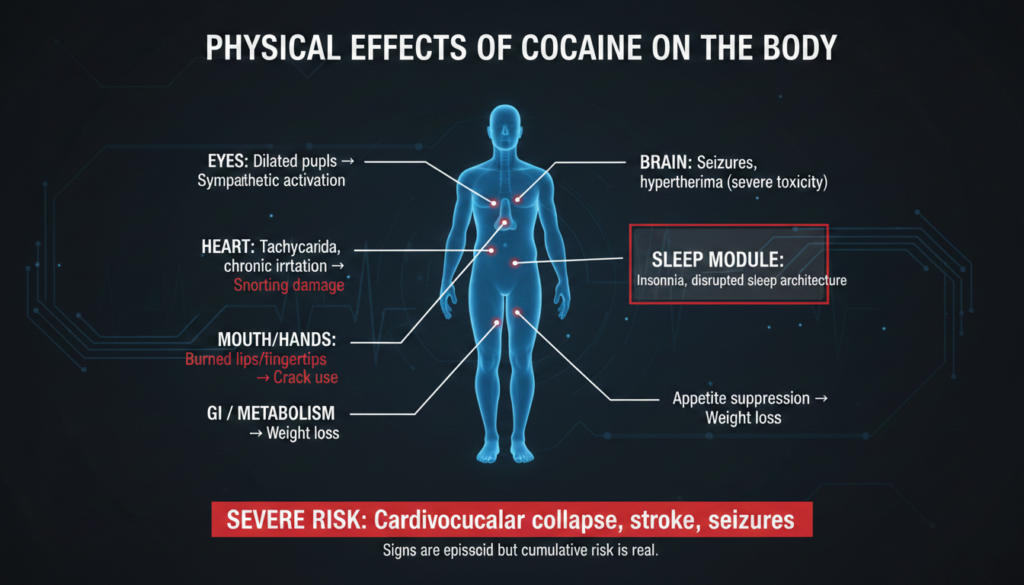
Although cocaine addiction is especially behavioral and psychiatric in presentation, physical signs are common and sometimes route specific.
| Physical Sign | What It Suggests |
|---|---|
| Dilated pupils | Sympathetic nervous system activation from recent use |
| Rapid heart rate and high blood pressure | Catecholamine excess during intoxication |
| Nosebleeds or chronic runny nose | Damage from snorting powder cocaine |
| Burned lips or fingertips | Smoking crack cocaine |
| Decreased appetite during use, rebound hunger after | Stimulant effect followed by crash |
| Insomnia or erratic sleep | Disrupted sleep architecture from repeated use |
| Chest pain or palpitations | Possible coronary vasospasm or arrhythmia |
| Elevated body temperature | Severe intoxication or toxicity risk |
| Weight loss over time | Chronic appetite suppression |
StatPearls notes that excess norepinephrine and dopamine can produce mydriasis, tachycardia, hypertension, seizures, hyperthermia, rhabdomyolysis, and cardiovascular collapse in severe cases.
Physical signs are often episodic. A person may deny a problem because they “only use on weekends,” but if those weekends repeatedly involve palpitations, overheating, insomnia, or nasal injury, the medical risk is already real.
Signs of Crack Cocaine Addiction
Crack cocaine is the smokable freebase form of cocaine. It reaches the brain within seconds, produces a brief but intense high, and wears off quickly.
That rapid cycle of reward and crash makes crack especially tied to compulsive redosing and binge patterns.
The signs of crack cocaine addiction overlap with powder cocaine addiction but tend to be more intense and faster to develop. The most distinctive pattern is the binge crash cycle: smoke, brief high, craving, redose, repeat until resources or physical endurance run out, then crash into fatigue, depression, and intense craving.
Research on crack users found they “rarely stop with one hit” and often consume as much as resources allow before crashing.
What Makes Crack Addiction Different?
Route of use is one of the strongest practical distinctions. Smokers and injectors are more likely to become dependent than people using slower routes. Crack’s smoked delivery intensifies both reward and the speed of dependence progression.
The short duration of the high means the person cycles between stimulation and crash far more often in a single session. This amplifies agitation, suspiciousness, impulsivity, emotional swings, and depression during withdrawal.
It also shifts motivation from positive reinforcement (“to get high”) toward negative reinforcement (“to escape the crash”), which is a hallmark of severe addiction.
The Withdrawal and Crash Pattern
One reason cocaine addiction gets underestimated is that withdrawal looks different from what people expect. There is usually no vomiting, shaking, or seizure risk the way there can be with alcohol.
MedlinePlus notes that cocaine withdrawal often lacks visible physical signs but includes strong craving, fatigue, lack of pleasure, anxiety, irritability, sleepiness, agitation, and paranoid thinking.
StatPearls adds that stimulant withdrawal typically involves marked depression, excessive sleep, hunger, dysphoria, and severe psychomotor slowing while vital signs stay mostly stable. Recovery can be slow, and depression may last weeks.
Why This Still Matters?
The absence of dramatic physical withdrawal does not mean cocaine addiction is mild. Psychiatric danger remains real. During the first one to two weeks of stimulant withdrawal, some patients experience suicidality and need close monitoring.
Protracted withdrawal can involve persistent depression, inability to feel pleasure, and breakthrough craving for months.
If someone repeatedly crashes after use, sleeping excessively, becoming depressed, hungry, irritable, and craving more, that pattern strongly suggests the brain has adapted to cocaine. At that point, use has moved well past casual experimentation.
Psychiatric Conditions That Travel With Cocaine Addiction
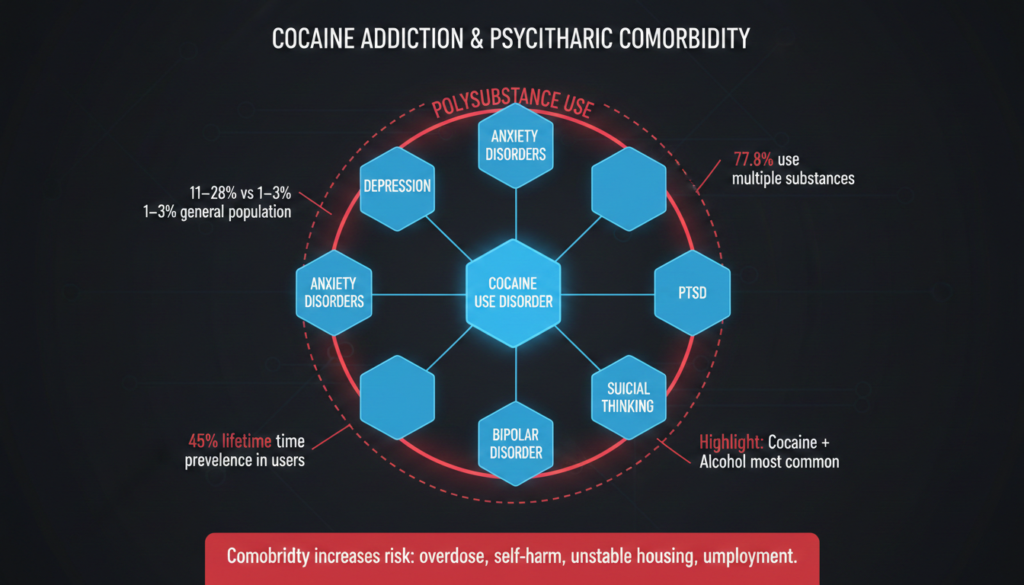
Cocaine addiction rarely exists alone. It often overlaps with depression, anxiety, PTSD, bipolar disorder, and suicidal thinking.
The 2022 clinical review reports a striking finding: the lifetime prevalence of bipolar disorder among people with cocaine use disorder ranges from 11% to 28%, compared with about 1% to 3% in the general population. Polysubstance use is also extremely common.
In one study, 77.8% of cocaine users reported using multiple substances at the same time, with cocaine and alcohol being the most frequent combination.
A 2023 observational study found that people with high polysubstance use were at elevated risk of unstable housing, unemployment, depression, anxiety, PTSD, self harm, and overdose events.
If cocaine use is accompanied by deepening depression, panic, paranoia, trauma related distress, or suicidal thoughts, the situation should be treated as a serious clinical problem.
The question is no longer whether it “counts” as addiction but how urgently evaluation and treatment are needed.
When Cocaine Use Becomes an Emergency?
Some symptoms go beyond warning signs and demand immediate medical attention. These include chest pain, irregular heartbeat, seizure, stroke symptoms such as sudden weakness or speech difficulty, severe confusion, hallucinations, extreme agitation, high fever, difficulty breathing, and loss of consciousness.
Cocaine related overdose deaths in the United States rose from 1.3 per 100,000 in 2001 to 7.3 per 100,000 in 2021. These numbers make it clear that acute toxicity is not rare.
For crisis support, SAMHSA directs people to the 988 Suicide and Crisis Lifeline and the National Helpline at 1 800 662 HELP.
Why Early Recognition Changes Outcomes?
Waiting for overdose, psychosis, or total collapse before calling it addiction is not supported by the evidence.
Mild and moderate cocaine use disorder are still clinically important because early action leads to better results, while chronic use and psychiatric comorbidity make recovery harder over time.
Cocaine use should be considered a genuine problem as soon as it begins to reorganize a person’s life around craving, binge and crash cycles, concealment, missed obligations, or continued use despite mood, cardiovascular, cognitive, legal, or relational damage.
That threshold can be reached earlier than most people think. A person does not need to use every day, lose a job, or end up in the emergency room to have a real disorder.
The most defensible clinical dividing line is functional and compulsive, not cosmetic. If cocaine repeatedly causes someone to chase the drug, recover from the drug, hide the drug, spend beyond their means, or reorganize mood and daily life around the drug, then cocaine use has already become a meaningful problem, even if the person still appears employed, social, or outwardly composed.
If you or someone you care about is showing these signs, reaching out for professional support is the most important next step.
Contact Thoroughbred Wellness & Recovery to speak with a team that treats both addiction and the mental health conditions that often come with it.


 Give Us A Call


