
 info@thoroughbredbhc.com
If you are wondering whether mixing kratom and Adderall is safe, the short answer is no!
Poison center data show that taking kratom with another substance nearly triples the odds of hospital admission compared to kratom alone, and the combination creates overlapping cardiovascular, neuropsychiatric, and metabolic risks that are hard to predict.
This article breaks down the evidence so you can understand exactly why kratom and Adderall interactions are dangerous and what to do instead.
Why Are Kratom and Adderall a Risky Mix?
Kratom (Mitragyna speciosa) is a plant from Southeast Asia that contains the alkaloid mitragynine. At lower doses it can produce stimulant effects, and at higher doses it can produce opioid-like effects.
Adderall is a prescription stimulant made of mixed amphetamine salts, FDA approved for ADHD and narcolepsy. Its label warns of high abuse potential and notes that misuse may cause sudden death and serious cardiovascular adverse reactions.
Both substances independently raise heart rate, blood pressure, and arousal. Both can trigger anxiety, agitation, and insomnia.
Stacking them does not cancel out side effects. Instead, it layers one set of risks on top of another while adding a wild card: kratom products are unregulated, vary widely in potency, and sometimes contain adulterants that make the outcome even less predictable.
How Kratom Works in the Body?
Kratom is often described as “stimulating at low doses, sedating at high doses,” but that framing is too simple.
Recent clinical pharmacology reviews stress that kratom has complex receptor activity spanning opioid, adrenergic, and serotonergic systems. Stimulatory and opioid effects can actually co-occur, and a 2024 review notes that kratom’s adrenergic effects may be synergistic with amphetamine derivatives and other stimulants.
Kratom also affects drug metabolism. Research shows it can inhibit cytochrome P450 enzymes, especially CYP2D6 and CYP3A pathways. A 2022 case report described potential pharmacokinetic kratom drug interactions that led to toxicity, highlighting that this concern is not just theoretical but has shown up in real patients.
That enzyme inhibition matters because many Adderall users also take antidepressants, anxiolytics, or sleep medications. If kratom slows the breakdown of those drugs, the total side effect burden goes up even if the amphetamine itself is not the only affected medication.
What Poison Center Data Tell Us About Mixing Kratom and Adderall?
No large clinical trial has tested the exact kratom and Adderall combination. But poison center surveillance gives us the next best thing: real world outcome data on kratom exposures, including what happens when people take kratom alongside other substances.
A CDC analysis of U.S. poison center calls from 2010 to 2015 found 660 kratom exposure reports. The most common symptoms were tachycardia (25%), agitation or irritability (24%), drowsiness (19%), and hypertension (12%). Those overlap almost perfectly with known Adderall side effects.
A broader study covering 2011 to 2017 documented over 1,800 kratom calls. More than half resulted in a serious medical outcome. Taking kratom with another substance increased the odds of hospital admission by a factor of 2.8 and the odds of a serious outcome by 2.25. Eleven deaths were reported, most involving multiple substances.
That last point is the strongest indirect argument against mixing Adderall and kratom. Adderall would count as a meaningful coexposure, and the data consistently show that adding other substances to kratom makes outcomes worse, not better.
Specific Risks of Mixing Adderall and Kratom
Cardiovascular Strain
Both kratom and Adderall independently raise heart rate and blood pressure. Together they create additive cardiovascular burden. Kratom has also been linked to hERG potassium channel inhibition in lab studies, a mechanism tied to dangerous heart rhythm changes. Case literature includes reports of ventricular fibrillation and cardiac complications in kratom users.
For someone already on a prescription stimulant, even a modest extra push on the cardiovascular system can tip the balance toward palpitations, chest pain, or a hypertensive spike.
Anxiety, Panic, and Psychiatric Instability
Adderall can cause severe anxiety, agitation, and in some cases stimulant psychosis. Kratom has its own psychiatric signal.
A 2021 case report described psychosis and insomnia thought to be secondary to acute kratom intoxication. A 2024 report linked kratom to paranoid delusions in a patient with schizoaffective disorder.
Mixing the two can worsen restlessness, panic, irritability, and sleep disruption. Sleep loss alone can destabilize mood, lower seizure threshold, and impair judgment, creating a cycle that encourages redosing.
Seizure Risk
Seizures appear repeatedly in kratom toxicity literature. An early case report documented seizure and coma after kratom exposure.
Adderall overdose or misuse can also lower the seizure threshold. Combining a seizure associated botanical with a prescription stimulant that carries its own seizure risk is a poor bet, especially for anyone with a seizure history, sleep deprivation, or dehydration.
The “Push Pull” Masking Problem
Because kratom can act as both a stimulant and a sedative depending on dose and product, it can mask the warning signs of toxicity from either direction. A person might use Adderall to stay awake after taking too much kratom, not realizing that delayed respiratory depression is still possible.
Or they might use kratom to “smooth out” Adderall jitters, then take more Adderall once the sedation wears off. This push pull pattern encourages escalation and makes it harder to recognize when something is going wrong.
How the Kratom Product Variability Makes the Combination Less Predictable?
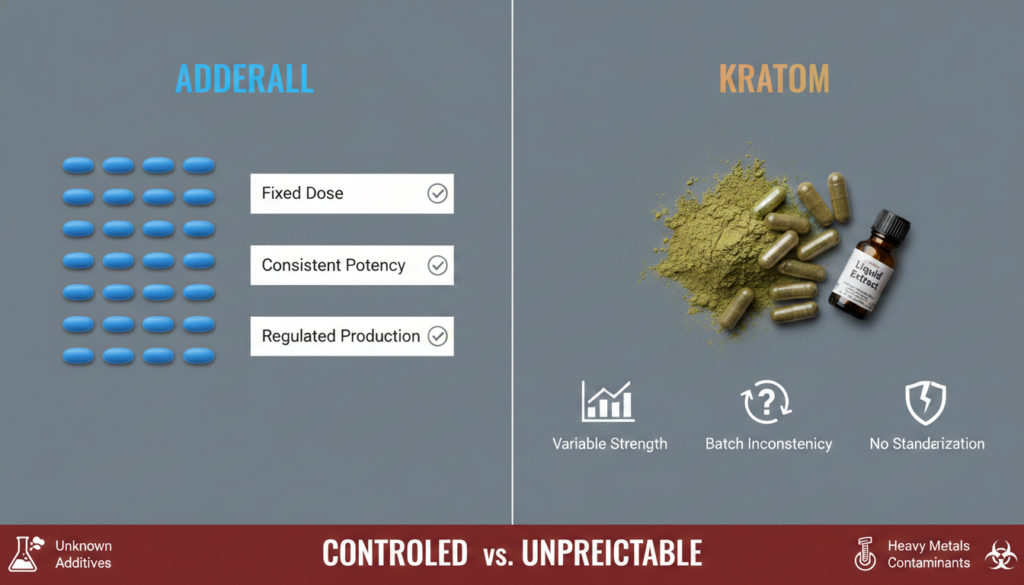
Unlike Adderall, which is a standardized pharmaceutical, kratom products have no consistent quality control. Potency varies between brands, batches, and product types.
Some products are plain leaf powder while others are concentrated extracts with much higher alkaloid levels.
Worse, some kratom products have been found to contain adulterants. A 2019 toxicology report described a patient who suffered a large hemorrhagic stroke after using kratom that turned out to be adulterated with phenylethylamine, a compound structurally similar to amphetamine. The FDA has also flagged kratom products containing unsafe levels of lead and nickel.
When you mix Adderall with kratom, you may not actually be mixing Adderall with kratom alone. You could be mixing it with an unknown concentration of alkaloids, an undisclosed stimulant, or a contaminant. That turns an already risky combination into one you cannot plan for at all.
Who Faces the Highest Risk?
Some people face greater danger from kratom and Adderall interactions than others:
- Anyone with high blood pressure, arrhythmia, or structural heart disease
- People with anxiety disorders, bipolar spectrum conditions, or a history of psychosis
- Those with a seizure history or who are sleep deprived
- People taking antidepressants, antipsychotics, or other psychiatric medications
- Individuals with a substance use disorder history who may escalate doses
- Anyone using concentrated kratom extracts or synthetic 7 hydroxymitragynine products
- Pregnant individuals, since kratom has been linked to neonatal withdrawal syndromes
What the Mortality Data Show?
A CDC analysis of overdose deaths from 27 states found that 152 out of 27,338 decedents tested positive for kratom.
Medical examiners judged kratom to be a cause of death in about 60% of those cases. Among kratom positive decedents, 65% also had fentanyl listed as a cause of death, and roughly 80% had a history of substance misuse.
These numbers tell two stories at once. First, kratom related mortality is usually a polysubstance event, not an isolated one.
Second, the people most likely to die with kratom in their system are those already mixing multiple substances. Adding Adderall to kratom places a person squarely in that higher risk category.
Why “I’ve Done It Before and Was Fine” Is Not Reassuring?
Some people report combining kratom and Adderall without obvious harm. That does not mean the combination is safe. Variable kratom products mean the next batch could be stronger.
Individual differences in metabolism, heart health, psychiatric vulnerability, and co-medications mean one person’s uneventful experience says nothing about another’s risk.
And stimulant side effects like elevated blood pressure or subtle heart rhythm changes can cause damage without producing obvious symptoms until something goes seriously wrong.
What to Do Instead?
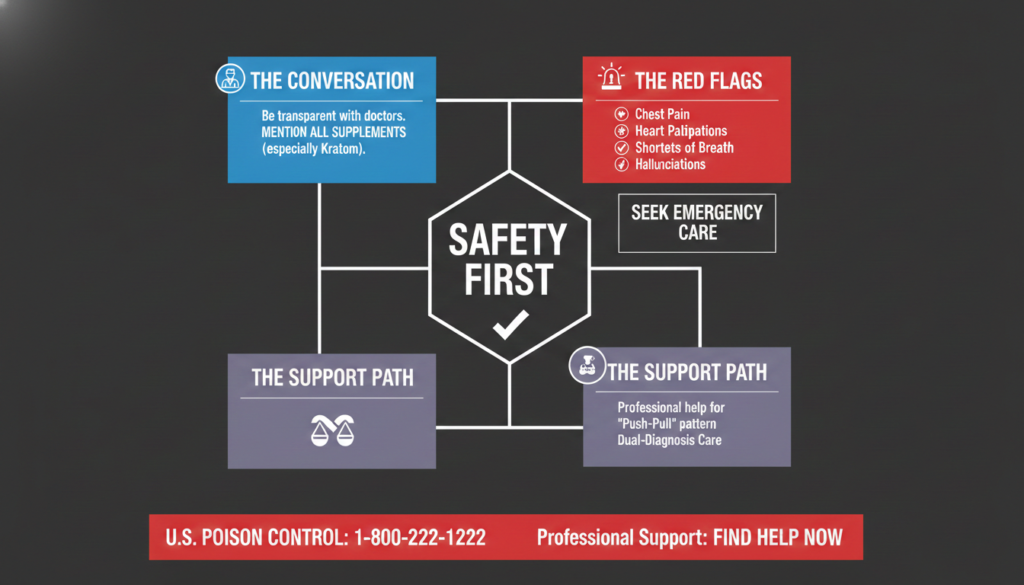
If you take prescribed Adderall and are thinking about adding kratom for energy, pain, mood, or focus, talk to your prescriber first.
Many patients do not mention supplements, but in this case you should. Your doctor can help you find safer options for whatever kratom is meant to address.
If you have already taken both and notice chest pain, severe palpitations, shortness of breath, confusion, hallucinations, seizures, or extreme sleepiness, seek emergency care. The U.S. Poison Control number is 1 800 222 1222.
If kratom or Adderall use has become hard to control, or if you find yourself balancing one substance against the other, that pattern may point toward a deeper issue worth addressing with professional support.
Why Does This Matter?
Mixing kratom and Adderall is not a harmless experiment. The evidence from poison centers, clinical pharmacology, case reports, and mortality surveillance all points in the same direction: combining a potent prescription stimulant with an unregulated, pharmacologically complex botanical raises the risk of cardiovascular events, psychiatric crises, seizures, masked toxicity, and unpredictable drug interactions.
The absence of a direct clinical trial on this exact pair does not mean it is safe. It means the combination has not been studied enough to know how bad it can get, and what we do know is already concerning.
You deserve support that does not depend on guesswork or risky self-medication. If substance use or mental health challenges are driving the urge to mix these substances, reaching out for our professional guidance is the safest next step. Don’t worry, Thoroughbred’s dual diagnosis treatment in Atlanta, can address both sides of the problem at once. Call today!


 Give Us A Call


