
 info@thoroughbredbhc.com
Substance use disorders can derail even the most promising legal career. If you’re a Georgia attorney facing bar complaints linked to addiction, or a client wondering whether your lawyer’s behavior crosses the line, you need to understand how the State Bar of Georgia treats impairment-related misconduct.
The Bar operates a dual-track system: confidential evaluation and support through the Lawyer Assistance Program on one side, and formal disciplinary action, including emergency suspension and disbarment, on the other.
This article explains when substance use becomes a regulatory threat, how Georgia’s disciplinary process works, and what outcomes you can expect based on recent case law and official procedures.
Georgia’s Regulatory Framework for Lawyer Impairment
The Supreme Court of Georgia holds ultimate authority over attorney discipline, while the State Bar administers investigations and prosecutions.
Georgia’s approach to substance use is neither purely punitive nor entirely rehabilitative. Instead, the system recognizes addiction as both a treatable health condition and a potential public-protection risk.
Rule 4-104: Mental Incapacity and Substance Abuse
Bar Rule 4-104 allows the State Disciplinary Board to refer a lawyer for medical or mental health evaluation when signs of mental illness, cognitive impairment, alcohol abuse, or substance abuse appear during an investigation.
The referral is confidential, and the Board may pause disciplinary proceedings to obtain the evaluation. If the lawyer refuses to cooperate, the Board may take further action as it deems appropriate.
This rule is significant because it treats impairment as a distinct regulatory category, not merely a mitigating factor. Georgia does not wait for client harm to occur before addressing fitness concerns.
The confidential evaluation process creates space for diagnosis and treatment planning while protecting the lawyer’s privacy during the early stages.
Rule 4-108: Emergency Suspension for Threat of Harm
When a lawyer poses a substantial threat of harm to clients or the public, the Board can seek emergency suspension under Rule 4-108.
This mechanism bypasses the usual disciplinary timeline and provides immediate protection. The rule applies when impairment has progressed beyond a private health issue and now endangers those the lawyer serves.
Emergency suspension is not theoretical. The State Bar’s recent discipline page shows multiple interim suspensions in 2025 and 2026, confirming that Georgia actively uses this protective measure when circumstances warrant.
How Substance Use Complaints Enter the System?
Most substance-related discipline cases begin as ordinary client complaints. A client contacts the Client Assistance Program reporting missed deadlines, failure to communicate, abandoned cases, or mishandled funds.
Substance use often emerges later during investigation, either through the lawyer’s own disclosure, witness accounts, or behavioral patterns that suggest impairment.
The early stages of Georgia’s disciplinary process are completely confidential. Complaints that appear frivolous or insufficient may be screened out without full investigation.
This confidentiality serves multiple purposes: it protects lawyers from reputational harm based on weak allegations, conserves disciplinary resources, and creates space for the Board to assess whether the issue is treatable without public proceedings.
Once a grievance alleges a potential rule violation, the Office of the General Counsel forwards it to the Investigative Panel for preliminary investigation.
At this stage, the Board may invoke Rule 4-104 if signs of impairment appear. The lawyer may be referred for evaluation, and proceedings may be held while the Board determines whether the attorney can practice safely.
When Substance Use Threatens a Georgia Law License?
Addiction does not automatically trigger discipline, but it becomes a serious licensing threat under specific circumstances.
Noncooperation with Evaluation or Investigation
The clearest escalation trigger is refusal to participate in a Rule 4-104 evaluation. When the Board cannot assess a lawyer’s fitness, it must assume higher risk. Noncooperation also signals that the lawyer may not be willing to engage in the remediation necessary to protect clients.
Recent case examples reinforce this pattern. In the Arrington matter, the attorney’s failure to respond to the Bar’s investigation was cited as an independent reason supporting disbarment after allegations of trust-account misuse.
Similarly, default in disciplinary proceedings appeared as part of the progression toward disbarment in the Singleton case.
Client Neglect and Abandonment
Substance use frequently manifests as missed deadlines, failure to communicate, and abandoned client matters. While these violations may begin as malpractice-style negligence, persistent neglect triggers disciplinary exposure.
Georgia’s Rules of Professional Conduct require competence, diligence, and communication. When addiction impairs a lawyer’s ability to meet these obligations, the Bar will intervene.
In *In re Nevada Michael Tuggle*, the Georgia Supreme Court addressed misconduct in two client matters involving violations of competence, diligence, communication, and duties upon termination. The Special Master recommended a one-month suspension, reasoning that the lawyer’s substance-use disorders largely caused the misconduct and that he had been substantially rehabilitated.
However, the State Bar challenged this mitigation, arguing that the lawyer had not clearly connected impairment to all misconduct and that a psychiatrist found relapse risk because the lawyer was not completely abstinent or participating in psychotherapy.
This case illustrates Georgia’s conditional mitigation model. Substance use can reduce sanction severity, but only when recovery is genuine, documented, and not outweighed by client harm or dishonesty.
Trust-Account Violations and Financial Misconduct
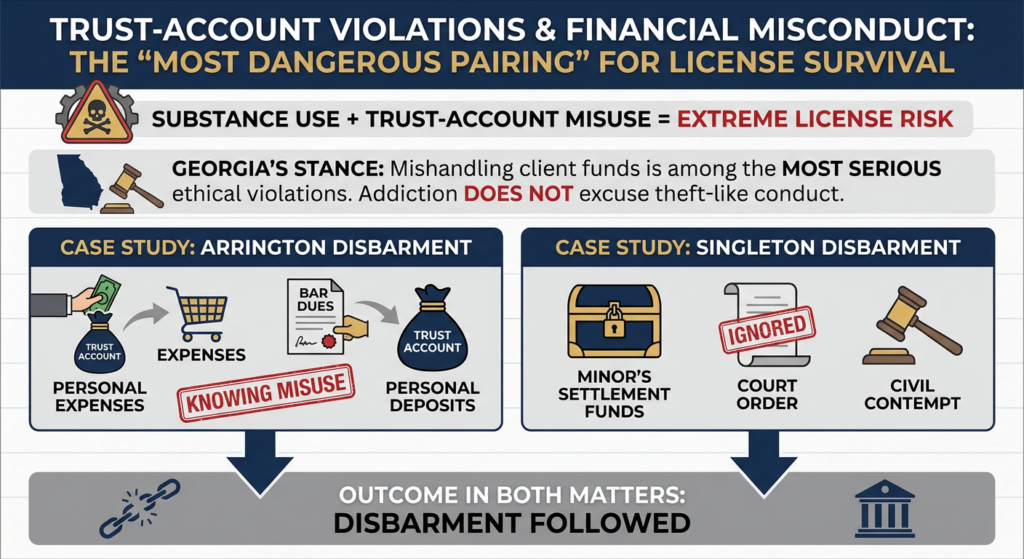
The most dangerous pairing for license survival is substance use combined with trust-account misuse or conversion. Georgia treats mishandling client funds as among the most serious ethical violations. Addiction does not excuse theft-like conduct.
The Arrington disbarment involved allegations that the attorney knowingly used trust-account funds for personal expenses, paid Bar dues from the trust account, and made personal deposits into the account.
The Singleton case included failure to release a minor’s settlement funds despite court orders, resulting in civil contempt. In both matters, disbarment followed.
Dishonesty, Crime, and Contempt
When substance use is linked to forgery, fraud, criminal conduct, or contempt of court, the license is in severe jeopardy. The York matter involved a forged court order, leading to pretrial diversion conditions that included abstinence, random drug testing, counseling, support-group attendance, and not practicing until reinstated.
The Georgia Supreme Court later accepted voluntary surrender of the license, an outcome tantamount to disbarment.
Georgia’s Confidential Support Infrastructure
Georgia does not treat every impaired lawyer as a disciplinary violator by default. The State Bar provides robust confidential resources designed to help attorneys address substance use before it escalates into misconduct.
Lawyer Assistance Program
The Lawyer Assistance Program is a confidential service for State Bar members, administered through SupportLinc/CuraLinc Healthcare. It covers stress, anxiety, depression, substance abuse, family issues, workplace conflicts, and other psychological concerns.
Members are entitled to six prepaid clinical sessions per calendar year and can access the program by phone at 800-327-9631, by email, or through the SupportLinc digital platform.
LAP is not available to the general public and is not a lawyer referral service. It is a member benefit designed for early intervention and prevention.
Georgia Lawyers Helping Lawyers
This confidential peer-to-peer program connects lawyers suffering from stress, depression, addiction, or other personal issues with a fellow Bar member who can listen and provide support.
Peer support can be especially valuable in addiction-related matters because lawyers may be more willing to disclose struggles to colleagues than to regulators or formal treatment providers.
Referral from Disciplinary Proceedings
The State Disciplinary Board may refer respondent lawyers to the Lawyer Assistance Program, Client Assistance Program, Fee Arbitration Program, or Law Practice Management Program even while managing a regulatory case.
This cross-branch connection shows that Georgia’s disciplinary authorities are not confined to choosing between punishment and inaction. They can connect lawyers with support resources while protecting the public.
The Disciplinary Process: From Complaint to Sanction
Understanding the procedural stages helps clarify when and how substance use affects outcomes.
| Stage | Confidential or Public | Key Function in Substance-Abuse Matters |
|---|---|---|
| Intake/screening | Confidential | Screens out frivolous complaints; identifies allegations suggesting misconduct or impairment |
| Preliminary investigation | Confidential | Gathers facts; may detect signs of substance abuse; may refer under Rule 4-104 |
| Rule 4-104 evaluation | Confidential | Medical or mental health evaluation for signs of impairment |
| Proceeding hold | Confidential | Pauses discipline while evaluation occurs |
| Resource referral | Usually confidential | Referral to LAP, law practice management, or other support |
| Emergency suspension | Public judicial process | Triggered when lawyer poses substantial threat of harm |
| Formal prosecution | Public | Complaint filed in Supreme Court after probable cause; impairment may appear as issue, aggravator, or mitigator |
| Supreme Court judgment | Public | Public reprimand, suspension, disbarment, or no discipline |
Once probable cause is found and the matter is prosecuted before a special master, proceedings become public. Supreme Court discipline orders are posted on the Bar’s website and accessible through the member directory.
Substance Use as Mitigation: When It Helps and When It Doesn’t?
Substance abuse is not an automatic defense to misconduct. Georgia’s disciplinary system focuses on protection of clients and the public, not sympathy for the lawyer’s personal struggles.
When Mitigation May Apply?
Impairment can reduce sanction severity when:
- The lawyer credibly establishes a causal link between addiction and misconduct
- Recovery is genuine, documented, and current
- The lawyer cooperates fully with evaluation and disciplinary processes
- Client harm is limited
- No dishonesty, conversion, or financial misconduct is present
- The lawyer demonstrates remorse and has made restitution where appropriate
The Tuggle case shows that rehabilitation can influence sanction recommendations. The Special Master’s reasoning explicitly relied on the lawyer’s substance-use disorders and substantial rehabilitation.
However, the State Bar challenged the mitigation, and the Supreme Court emphasized that discipline protects the public and public confidence in the profession.
When Mitigation Fails?
Substance use does not excuse misconduct when:
- Trust-account misuse or conversion is involved
- Dishonesty, fraud, or crime is present
- Multiple client matters are affected
- The lawyer refuses evaluation or treatment
- Relapse risk remains high due to lack of abstinence or treatment engagement
- The lawyer defaults in disciplinary proceedings
- Serious actual or potential injury to clients has occurred
The Singleton disbarment illustrates this principle. The lawyer’s personal and emotional difficulties, including a mental health condition and major life stressors, were identified as mitigating factors.
Yet disbarment was still imposed because the misconduct, especially the failure to release a minor’s settlement funds, was too serious.
Recent Discipline Outcomes: What the Data Shows?
The State Bar’s recent attorney discipline page provides a snapshot of current enforcement activity. Between late 2025 and early 2026, Georgia imposed multiple disbarments and voluntary surrender/disbarments, including:
- Leonard Richard Medley III – Voluntary Surrender of License/Disbarment (April 21, 2026)
- Charles Bruce Singleton Jr. – Disbarred (March 17, 2026)
- Joseph William Cloud – Disbarment (March 3, 2026)
- Bryan Matthew Pritchett – Disbarment (February 17, 2026)
- Paul Jason York – Voluntary Surrender of License/Disbarment (February 3, 2026)
The same period saw multiple interim suspensions, including Angela Mary Kinley, Kenneth Dewayne Teal, and Michael Carestia. Carestia was reinstated within days, showing that Georgia’s system can restore practice status when conditions are satisfied.
While the public discipline page does not label which cases involved substance abuse, the data confirms three important points:
- Georgia actively uses disbarment and interim suspension
- Emergency-type measures are part of regular practice
- Reinstatement can occur, but only after formal action and demonstrated fitness
Reinstatement and Readmission After License Loss
Losing a license due to substance-related misconduct is not necessarily permanent, but the path back is demanding.
Suspended Lawyers
An applicant for reinstatement following administrative suspension for failing to pay dues for less than five years, or after voluntary resignation within five years, must request a reinstatement letter and proceed through fitness certification. Applicants whose membership has been terminated rather than suspended must seek readmission instead.
Disbarred Lawyers
For disbarred lawyers, readmission requires first seeking certification of fitness and establishing rehabilitation by clear and convincing evidence to the satisfaction of the Fitness Board and the Supreme Court of Georgia.
Positive evidence of rehabilitation may include occupation, religion, community service, employers, community leaders, and members of the Bar. Once certified, the applicant may apply to take the bar examination.
This standard means Georgia is not merely asking whether the addiction is under control. The state requires proof that the person has reestablished the moral and professional fitness necessary to practice law. Recovery alone is not enough; clients are entitled to evidence of restored trustworthiness.
Practical Guidance for Georgia Attorneys
If you are a Georgia attorney struggling with substance use, the evidence strongly suggests that early intervention is critical. The best time to seek help is before a client complaint, not after.
Seek Confidential Help Immediately
Georgia provides immediate confidential help through the Lawyer Assistance Program at 800-327-9631. You are entitled to six prepaid clinical sessions per calendar year. You can also access confidential peer support through Georgia Lawyers Helping Lawyers.
Given the disciplinary consequences shown in recent cases, delay is dangerous. The system may be supportive, but once client harm or dishonesty emerges, mitigation becomes much harder.

Cooperate Fully with Any Evaluation or Investigation
If the State Disciplinary Board refers you for a Rule 4-104 evaluation, participate fully. Noncooperation is one of the most consistently dangerous escalation triggers in the Georgia system. When the Board cannot assess your fitness, it must assume higher risk, and emergency suspension becomes more likely.
Avoid Trust-Account and Financial Misconduct at All Costs
The combination of impairment and trust-account misuse is especially likely to result in disbarment. If you are struggling with addiction, implement additional safeguards for client funds, consider bringing in a practice monitor, or temporarily withdraw from cases involving fiduciary responsibilities.
Document Your Recovery
If you are in treatment or recovery, document it thoroughly. Georgia’s conditional mitigation model rewards genuine, verifiable recovery. Keep records of counseling sessions, support-group attendance, abstinence, and any other evidence of rehabilitation. This documentation may be critical if a disciplinary matter arises.
Why Does This Matter?
Georgia’s approach to substance use in attorney discipline reflects a broader shift in how professional regulators balance public protection with recognition of addiction as a treatable health condition. The system is neither purely punitive nor entirely rehabilitative. It is protective.
The State Bar and the Supreme Court have built a framework that offers confidential support and evaluation first, but escalates quickly when impairment manifests as danger, client harm, or noncooperation. This design respects treatment and confidentiality but does not allow those values to override public protection.
For attorneys, the message is clear: addiction is not a career-ending diagnosis, but it becomes a licensing threat when it compromises safe, honest, competent, and cooperative law practice. The lawyers who survive disciplinary scrutiny are those who engage early, cooperate fully, avoid client harm, and demonstrate genuine recovery.
For clients and the public, Georgia’s system provides meaningful protection. The confidential early stages allow the Bar to assess impairment without unnecessary publicity, but the emergency suspension and public discipline mechanisms ensure that dangerous lawyers are removed from practice.
If you or someone you know is facing the intersection of addiction and professional discipline, understanding Georgia’s dual-track system is the first step toward navigating it successfully. The Bar offers real support, but it demands real accountability. The choice to engage with that system, early, honestly, and fully, may determine whether a legal career can be saved.
If you’re struggling with substance use and need compassionate, evidence-based support, reach out to Thoroughbred Wellness and Recovery for help today. Recovery is possible, and your career may depend on taking that first step now!


 Give Us A Call


