
 info@thoroughbredbhc.com
Impaired attorneys face severe professional consequences that extend far beyond personal health concerns.
When substance abuse or mental health issues affect a lawyer’s ability to practice, the risks multiply quickly: missed deadlines can trigger malpractice claims, neglected clients can file bar complaints, and attempts to conceal errors often escalate into career-ending discipline.
Georgia law firms are responding with a layered prevention strategy that combines confidential early intervention, peer support networks, clinical counseling, and stronger supervisory accountability to protect both clients and attorneys before crises occur.
The Dual Risk: Malpractice Exposure and Disciplinary Action
Impaired attorneys operate under the same professional obligations as all lawyers, but substance abuse directly undermines the capacities those rules protect. Georgia malpractice law requires attorneys to exercise ordinary care, skill, and diligence.
When addiction degrades concentration, memory, or judgment, the likelihood of breaching that standard increases sharply. A federal court applying Georgia law recently restated the three elements plaintiffs must prove: an attorney-client relationship, failure to exercise ordinary care and skill, and proximate causation of damages.
Substance abuse threatens each component. Ordinary care declines when attention falters. Skill erodes when preparation becomes inconsistent. Diligence suffers when deadlines slip. Causation becomes straightforward in the classic impairment scenario: a missed statute of limitations, an unanswered motion, or a lapsed appeal.
At the same time, Georgia’s ethics framework imposes parallel duties. The Georgia Rules of Professional Conduct govern competence under Rule 1.1, diligence under Rule 1.3, and communication under Rule 1.4. Rule 4-104 specifically addresses mental incapacity and substance abuse as a formal disciplinary matter.
The State Bar’s disciplinary process allows the State Disciplinary Board to refer lawyers for medical or mental health evaluations when signs of impairment appear, and noncooperation can trigger further action.
This dual exposure creates a dangerous feedback loop. The same impairment that causes a malpractice-level error often produces the secondary misconduct that converts a negligence case into a disciplinary disaster.
How Substance Abuse Increases Malpractice Risk?
The Operational Chain from Impairment to Client Harm
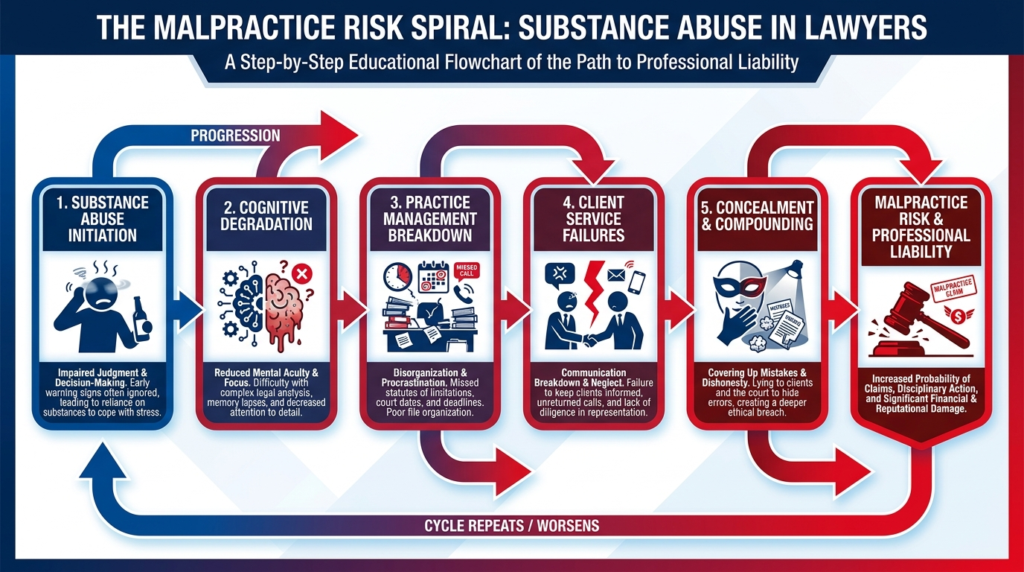
Substance abuse increases malpractice risk through a recurring sequence. First, cognitive degradation reduces concentration, judgment, and memory. Second, practice management breaks down as calendaring errors, missed deadlines, and disorganized files accumulate.
Third, client service failures mount when communication slows and advice becomes unreliable. Fourth, a loss event occurs: a statute expires, a motion goes unanswered, or trust funds are mishandled. Finally, concealment or dissembling often follows as the lawyer blames others, creates false records, or disappears.
At steps one through four, the case resembles ordinary malpractice. At step five, it becomes an ethics catastrophe.
The Malpractice Data is Striking
A national ethics analysis reported that an ABA survey found 50% to 70% of malpractice cases from California and New York involved an alcohol-impaired attorney.
Even allowing for jurisdictional variation, that range is too high to dismiss. The mechanisms are not state-specific. Memory lapses, missed deadlines, and poor judgment produce similar exposure in Georgia.
This statistic supports a critical insight: wellness programs are not merely benevolent. They are risk controls.
Missed Deadlines Are the Paradigmatic Impairment Claim
A missed statutory or court deadline is the most recognizable bridge between addiction and malpractice. Deadlines are unforgiving, objective, and causally potent. They are also especially vulnerable to lawyers whose impairment produces avoidance, disorganization, or distorted confidence.
A 2024 Georgia Supreme Court disbarment reportedly involved a lawyer who missed a statutory filing deadline and then fabricated communications to cover it up. The escalation occurred because concealment converted a competence failure into dishonesty.
This pattern is especially consistent with impairment-linked practice failures, where shame, denial, and secrecy increase the probability that a lawyer will hide an error rather than report it.
Ethical Violations Substance Abuse Commonly Triggers
Core Rules Most Frequently Implicated
Impaired attorneys most commonly violate duties of competence, diligence, and communication. The Georgia Rules of Professional Conduct make clear that impairment does not lessen these obligations.
Rule 1.1 requires competence even when a lawyer struggles with addiction. Rule 1.3 demands diligence regardless of personal challenges. Rule 1.4 mandates communication even when a lawyer is avoiding difficult conversations.
When impairment affects trust accounting, safekeeping of property, or the ability to continue representation safely, client protection concerns intensify.
Rule 1.15 governs safekeeping, and Rule 1.16 becomes critical where a lawyer’s condition requires withdrawal or transition planning.
Supervisory Liability: An Often Underappreciated Risk
One of the most strategically important findings in the research is that supervisory lawyers face affirmative ethical duties under Rule 5.1. A national ethics analysis explains that if partners or supervisors know of a lawyer’s mental impairment, they must take steps reasonably designed to ensure the impairment does not lead to rule violations.
This is not merely a human resources matter. Once supervisors know of impairment, they have an ethical obligation to respond.
In practice, that means a Georgia firm with knowledge of obvious substance-related decline can face serious ethics consequences if it does nothing, especially where the impaired lawyer continues handling deadlines, trust money, court appearances, or unsupervised client contact.
A reasonable response may include reducing or suspending the impaired lawyer’s active caseload, reassigning deadlines, adding supervisory review, auditing trust and calendar systems, requiring fitness or treatment engagement, restricting solo client contact, and documenting interventions.
When Negligence Becomes Severe Misconduct
The most dangerous escalation occurs when impairment leads to secondary misconduct. Rule 8.4 governs misconduct generally, and when impairment produces dishonesty, fabrication, misrepresentation, or conduct prejudicial to the administration of justice, the issue moves beyond diminished performance into direct misconduct.
The Georgia disbarment case involving fabricated communications demonstrates this escalation. A single negligence event might support malpractice, but once the lawyer falsifies records or lies, separate duties are violated. These secondary violations are often more dangerous than the original performance failure because they destroy trust and obstruct remediation.
How Georgia Firms Are Trying to Prevent Negative Outcomes?
A Layered Prevention Model
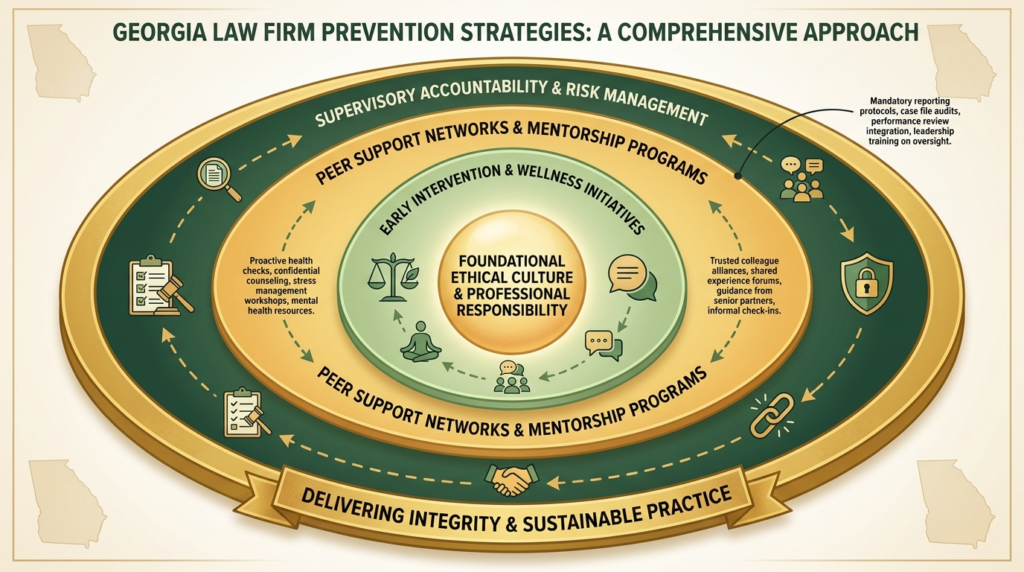
Georgia firms appear to be trying to prevent impairment-linked malpractice and ethical violations through a layered model consisting of early identification, confidential support referral, peer support, supervisor intervention, workload and file management controls, education and culture change, and formal reassignment or protective action where needed.
This conclusion is supported by the combination of formal Bar assistance programs, supervisory duties under Rule 5.1, law practice management support, wellness-focused CLE topics, and event programming specifically addressing attorneys with mental health or addiction issues.
Referral to LAP as a First-Line Firm Response
The most concrete prevention mechanism available to firms is referral to the State Bar’s confidential LAP. Because it offers six prepaid clinical sessions and multiple care modalities, firms can direct struggling lawyers to an existing statewide resource instead of improvising ad hoc support.
This reduces several practical barriers for firms. They do not need to build a clinical treatment system internally. They can refer without publicizing the lawyer’s condition broadly. They can take action before a grievance arises. They can tie referral to a broader risk management plan.
Supervisor Accountability is Reshaping Firm Obligations
The national ethics analysis of Rule 5.1 implies that Georgia firms cannot treat substance abuse as solely a human resources matter. Once supervisors know of impairment, they have an ethical obligation to take steps reasonably designed to prevent violations.
In practice, that means firms trying to prevent harm must do more than “be supportive.” A reasonable response may include reducing or suspending the impaired lawyer’s active caseload, reassigning deadlines, adding supervisory review, auditing trust and calendar systems, requiring fitness or treatment engagement, restricting solo client contact, and documenting interventions.
This is where wellbeing and governance intersect. A partner who notices obvious impairment and merely hopes it resolves is not being compassionate. That partner may be failing a supervisory duty.
Law Practice Management as a Prevention Tool
Georgia’s Law Practice Management Program is not substance abuse treatment, but it is part of prevention.
Impairment-related errors often surface first through system failures: disorganized files, inconsistent calendaring, poor technology use, financial disarray, and staff confusion. A firm that strengthens systems may catch problems earlier and reduce the chance that a struggling lawyer can silently drift into major harm.
This is an underappreciated point. Not every prevention strategy must directly target addiction. Some of the most effective controls are organizational: centralized docketing, dual deadline review, trust account reconciliation oversight, mandatory matter status reporting, staffing redundancy, and documentation standards. These controls reduce the damage potential of impairment even before the firm fully understands its cause.
CLE and Training-Based Prevention
Georgia’s CLE programming increasingly integrates wellness into professional competency discussions. For example, the 2026 Beginning Lawyers Program includes a “Lawyer Wellness” segment and a “Law Practice Management and Ethics” segment, alongside a “Malpractice Panel.” This sequencing strongly suggests the Bar views these issues as interrelated rather than separate.
The 2026 Family Law Institute included a session titled “From Spellbound to Steady Ground: Litigating With Parties and Attorneys With Mental Health and / or Addiction Issues,” featuring an assistant general counsel from the State Bar, a judge, a psychologist, and a psychiatrist. That is significant evidence that the Georgia bar community is openly addressing addiction-related legal practice concerns in advanced practice settings.
The 2024 Wellness Institute offered ethics credit and focused on attorney wellbeing, management, and boundaries. The title itself is revealing: Georgia is increasingly framing wellness as a business and risk issue, not only a humane one.
This evolution matters because firms often respond to what the profession legitimizes publicly. When the Bar offers ethics-credit CLEs on wellness and firm management, it signals that prevention is a core professional responsibility.
Georgia’s Institutional Prevention Infrastructure
A Layered System, Not Just a Hotline
Georgia has built a prevention architecture that extends across multiple State Bar systems. The State Bar’s programs overview lists the Lawyer Assistance Program as a confidential service outsourced to SupportLinc, while separately listing Lawyer Wellbeing and Law Practice Management as formal member services.
This layering is significant. Malpractice and discipline prevention require a system, not a slogan. Georgia’s prevention architecture includes:
- Lawyer Assistance Program (LAP)
- Georgia Lawyers Helping Lawyers (LHL)
- Center for Lawyer Wellbeing
- Attorney Wellness standing committee
- Mental wellbeing resources and hotline
- Law Practice Management services
- CLE programming that integrates wellness, management, and ethics
These resources together indicate a deliberate strategy to intervene before crises occur.
The Lawyer Assistance Program: Clinical Support at Scale
The State Bar’s Lawyer Assistance Program is a confidential service provided through SupportLinc, administered by CuraLinc Healthcare, to help Bar members with stress, anxiety, depression, substance abuse, family problems, workplace conflicts, psychological issues, and related difficulties.
Members are entitled to six prepaid clinical sessions per calendar year and can access help 24/7 at 800-327-9631.
The program provides multiple modalities beyond hotline counseling:
- 24/7 trained counselor hotline
- Real-time scheduling
- Mental Health Navigator assessment
- Text therapy with licensed clinicians
- Digital cognitive behavioral therapy
- Virtual anonymous group support
- “Mindstream” proactive mental fitness tools
This range is significant. Substance abuse prevention is more effective when lawyers can access help in low-friction, low-stigma formats. A lawyer who will not walk into a public recovery setting may still use text therapy, digital CBT, or anonymous group support.
Confidentiality is especially important in the substance abuse context because fear of reputational harm is one of the main barriers to early help-seeking. By structuring LAP as a confidential member service with prepaid sessions, Georgia lowers two key barriers simultaneously: economic friction and professional stigma.
Peer Support Through Georgia Lawyers Helping Lawyers
Georgia also supports a confidential peer-to-peer program, Georgia Lawyers Helping Lawyers, available through www.GeorgiaLHL.org. The State Bar’s mental wellbeing pages describe it as a peer support network for lawyers dealing with stress, depression, addiction, and other personal issues.
Peer support matters because addiction recovery often turns on credibility and relatability. Lawyers are more likely to disclose honestly to someone who understands firm culture, billable pressure, courtroom shame, and professional fear.
Institutional Commitment Through the Center for Lawyer Wellbeing
The State Bar’s homepage identifies the Center for Lawyer Wellbeing as promoting holistic wellness for legal professionals through resources, networking, and member benefits.
Separately, the Attorney Wellness standing committee oversees the “Lawyers Living Well” initiative and is tasked with promoting wellness, identifying factors affecting physical and emotional wellbeing, developing work/life balance CLEs, and increasing awareness of existing Bar programs.
This institutional layering is important because it expands the frame from “help impaired lawyers once they are in trouble” to “change professional conditions that predict trouble.”
The Relationship Between Wellness, Discipline, and Malpractice
These Are Not Separate Branches
A major synthesis point from the research is that malpractice, discipline, and wellness should not be treated as separate silos. They are better understood as stages or lenses applied to the same underlying professional risk system.
The wellness lens identifies vulnerability, burnout, substance use, depression, and stress. The malpractice lens asks whether client harm resulted from substandard professional performance. The ethics lens asks whether the lawyer breached professional rules or supervisory obligations. The regulatory lens determines whether intervention, evaluation, suspension, or disbarment is necessary to protect the public.
Georgia’s structure supports this integrated understanding. The same Bar that enforces discipline also maintains ethics guidance, LAP, law practice management resources, and wellbeing initiatives.
Why Concealment is the Inflection Point
The research strongly suggests that concealment is the inflection point between treatable impairment and career-threatening misconduct. A lawyer who discloses an error, seeks help, and permits supervision may still face consequences, but the system can work. A lawyer who fabricates emails, misleads clients, or hides file status invites the harshest outcomes.
That pattern is visible in the reported Georgia disbarment example concerning fabricated communications after a missed deadline. Substance abuse increases the risk of concealment because addiction often rewards immediate avoidance over long-term accountability. This is why prevention systems must reduce shame and create safe reporting channels before dishonesty begins.
Why Supervisor Passivity is Dangerous
The national ethics analysis of supervisory duty reveals another inflection point: not only individual concealment, but managerial denial. A firm can often tolerate a surprising amount of dysfunction around a respected partner or productive associate before acting. That tolerance is ethically dangerous.
In objective terms, a firm that knows of impairment and continues to allow full unsupervised practice is effectively externalizing risk onto clients, courts, and opposing parties.
Concrete Scenarios Illustrating the Risk Pathways
Scenario 1: Missed Statute of Limitations Due to Alcohol Dependence
A partner handling plaintiff-side personal injury matters begins drinking heavily. The lawyer misses a limitations deadline, avoids the client’s calls, and blames a staff member. The client loses the claim.
Malpractice risk: Clear breach and causation if attorney-client relationship is undisputed.
Ethics risk: Rule 1.1, 1.3, 1.4, possibly 8.4 if false statements are made.
Firm risk: Supervisory issues if the partner’s decline was obvious and unmanaged.
Prevention path that should have occurred: Early LAP referral, case reassignment, centralized docket review, peer support, workload reduction.
Scenario 2: Associate in Insurance Defense With Escalating Stimulant Misuse
An associate begins misusing stimulants to sustain billable hours. The lawyer becomes erratic, turns in rushed work, misses discovery deadlines, and gives inaccurate status reports. The insurer’s standing to sue for malpractice may be doctrinally uncertain in Georgia depending on relationship facts, but the insured client is exposed and the lawyer’s conduct is still disciplinarily significant.
Malpractice side: Standing may depend on who is the client, but negligence exposure remains real.
Ethics side: Competence, diligence, communication, supervision.
Firm response: Rule 5.1-driven intervention is required if supervisors know.
Scenario 3: Solo Practitioner With Opioid Misuse and Trust Account Irregularities
A solo lawyer using opioids for chronic pain begins borrowing mentally from retainer balances and delaying reconciliations. Files stagnate.
Malpractice risk: Client loss through neglect and mishandled funds.
Ethics risk: Rule 1.15 becomes central, alongside competence, diligence, and misconduct rules.
Bar response: Potential Rule 4-104 evaluation, grievance investigation, and discipline.
Prevention limit: Solos are hardest to protect because no internal supervisor exists. For them, Bar-based resources like LAP and peer support are especially important.
Key Takeaways for Georgia Attorneys and Firms
| Risk Category | Description | Potential Consequences |
|---|---|---|
| Ethical rule violations | Competence, diligence, communication, candor, safekeeping, misconduct | Bar complaint, reprimand, suspension, disbarment |
| Criminal exposure | DUI, possession, distribution, violent conduct, fraud, theft | Prosecution, felony consequences, reciprocal discipline |
| Civil liability | Malpractice, fiduciary breach, fee disputes | Damages, insurance issues, reputational harm |
| Employment consequences | Supervision, reassignment, leave, separation | Lost income, stalled advancement, termination |
| Court sanctions | Contempt, referral to bar, practice restrictions | Monetary sanctions, public reprimand, loss of panel appointments |
| Reputational harm | Public discipline, client distrust, peer stigma | Client loss, lateral difficulties, diminished standing |
| Reinstatement barriers | Need for proof of treatment and abstinence | Delayed readmission, monitoring conditions |
Conclusion: The Case for Early Intervention and Structural Safeguards
Substance abuse increases malpractice risk and ethical violations for attorneys because it directly impairs the cognitive and organizational capacities required to exercise ordinary care, skill, and diligence under Georgia malpractice law.
The same impairment that causes negligence often causes violations of competence, diligence, communication, safekeeping, withdrawal, and supervision duties under the Georgia Rules of Professional Conduct.
The highest-risk transition occurs when impairment is concealed or ignored. A missed deadline may begin as malpractice, but fabrication, false explanations, abandonment, or repeated misconduct can lead to suspension or disbarment.
Supervisory lawyers play a decisive role. Under Rule 5.1 principles, known impairment requires affirmative response. Passive tolerance creates separate ethics exposure.
Georgia has built a substantial prevention infrastructure through confidential clinical support, peer support, institutional wellbeing structures, management support, ethics guidance, and integrated CLE programming. The remaining challenge is whether firms use those tools early, candidly, and systematically.
Substance abuse should be treated by Georgia firms as a professional capacity and client protection risk on par with trust accounting and conflicts control.
The evidence is too strong to treat addiction as merely a private wellness concern. It is a predictable source of malpractice and discipline because it attacks the exact functions the profession depends on: competent analysis, deadline reliability, honest communication, and accountable supervision.
Firms that wait for a grievance, missed statute, or court sanction before acting are failing at preventable risk management. Supervisors who know of impairment and do nothing are not neutral. They are increasing client risk and potentially their own ethics exposure.
Referral to LAP is necessary but insufficient unless paired with workload controls, supervision, and file protection. The profession’s most effective strategy is early intervention plus structural safeguards, not heroic individual endurance.
If you or someone at your firm is struggling with substance abuse or mental health challenges that may be affecting professional performance, confidential help is available right here. Reach out for Thoroughbred Wellness and Recovery’s addiction counseling before a crisis becomes a career-ending event.


 Give Us A Call


