
 info@thoroughbredbhc.com
Bath salts—synthetic cathinones sold as stimulants, can trigger severe agitation, paranoia, and dangerous cardiovascular strain within hours of use.
A 2024 systematic review found that 38% of users develop psychotic symptoms such as hallucinations or delusions, while poison center data show that 82% of acute cases involve agitation and 56% present with tachycardia.
These drugs push the brain and body into simultaneous psychiatric crisis and autonomic overdrive, creating risks that extend far beyond the initial high.
This article breaks down what bath salts do to your body in the short term, what happens with repeated use, and why the dangers are more serious than many people realize.
What Are Bath Salts?
Bath salts are laboratory-made stimulants chemically related to cathinone, a psychoactive compound found in the khat plant. Despite the misleading name, they have nothing to do with bathing products.
The term describes a shifting category of synthetic cathinones marketed to mimic cocaine, MDMA, or amphetamines while evading drug laws through rapid chemical modification.
Common compounds include mephedrone, MDPV, methylone, butylone, ethylone, and newer analogs such as α-PVP and pentylone.
Because the market changes quickly and products are often mislabeled, users frequently do not know which specific drug they are taking. One packet labeled “bath salts” may contain a single cathinone, a mixture of several, or entirely different substances such as caffeine or other adulterants.
This chemical instability is not just a chemistry detail. It directly shapes the clinical picture by increasing unpredictability of onset, intensity, and duration.
It also means that routine toxicology screens often miss exposure, so a negative lab test does not rule out bath salts intoxication.
How Bath Salts Affect the Brain and Body?
Synthetic cathinones exert their effects by disrupting monoamine neurotransmission, especially dopamine, norepinephrine, and serotonin.
Depending on the compound, they may increase release of these neurotransmitters, block their reuptake, or both. This produces two broad domains of harm:
- Central effects: euphoria, increased energy, psychosis, paranoia, hallucinations, aggression, insomnia, compulsive behavior
- Peripheral sympathetic effects: tachycardia, hypertension, vasoconstriction, hyperthermia, diaphoresis, chest pain, arrhythmias, renal and cardiac stress
The same pharmacologic action that creates euphoria also creates danger. Dopamine excess contributes to stimulation, reinforcement, compulsive redosing, and psychosis.
Norepinephrine excess produces autonomic overdrive: tachycardia, hypertension, vasoconstriction, thermogenesis, agitation, and cardiac workload. Serotonin effects may contribute to mood changes, hallucinations, hyperthermia, and in some contexts serotonin toxicity features.
This combined central and peripheral activation is why bath salts can simultaneously affect the mind, heart, kidneys, muscles, and temperature regulation.
Short-Term Effects of Bath Salts
Acute Neuropsychiatric Effects
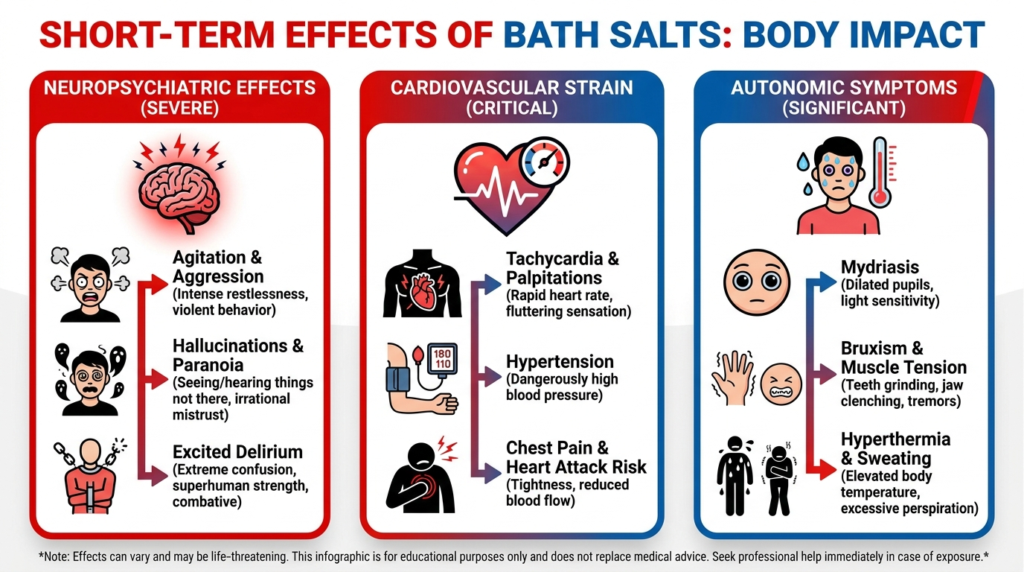
The most visible and dangerous early effects are often psychiatric and behavioral. Across reviews and emergency medicine sources, common early manifestations include agitation, anxiety, paranoia, delusions, hallucinations, psychosis, irritability, violent behavior, bizarre behavior, and disorientation.
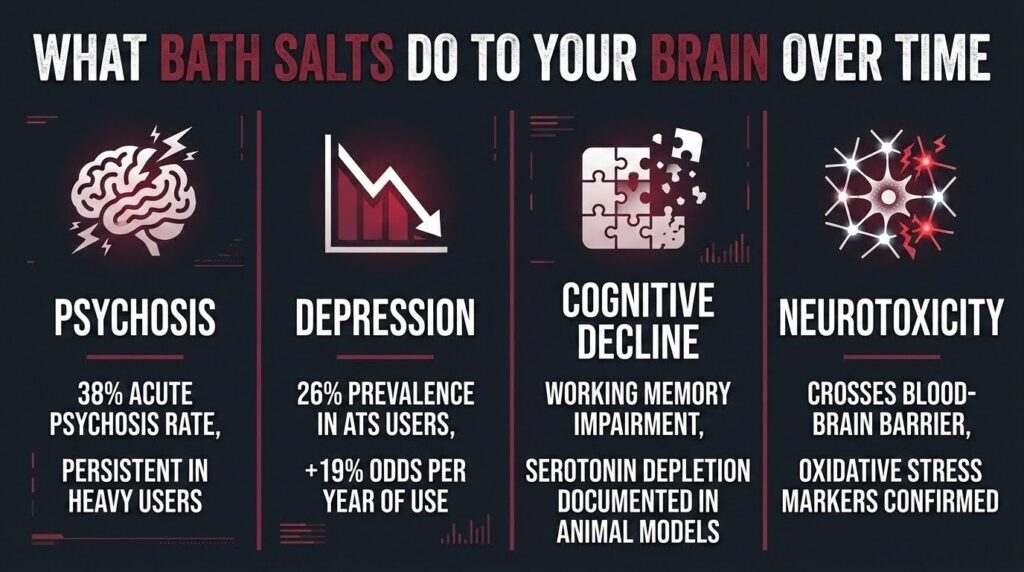
A 2024 systematic review and meta-analysis found psychotic symptoms in an estimated 38% of synthetic cathinone exposure cases, supporting a substantial association between use and hallucinations or delusions.
In acute bath salts intoxication, psychosis usually refers to symptoms such as hearing or seeing things that are not present, fixed false beliefs especially persecutory ones, severe suspiciousness, disorganized thought or behavior, and agitation linked to fear or misinterpretation.
This is not a minor side effect. Psychosis can drive dangerous behavior, self-harm, aggression, police confrontation, dehydration from prolonged agitation, and failure to seek medical care. It can also be difficult to distinguish from primary psychiatric illness when the substance used is unknown.
A Kentucky and Louisiana poison center series covering 236 calls over eight months found that agitation was reported in 82%, combative behavior in 57%, hallucinations in 40%, and paranoia in 36%.
One patient died from a self-inflicted gunshot wound while psychotic. These are extreme examples, but they illustrate the real-world consequence of stimulant-induced psychosis when paired with fear, insomnia, and autonomic arousal.
Cardiovascular and Autonomic Effects
Bath salts commonly produce a sympathomimetic toxidrome, meaning they overstimulate the fight or flight system. Common short-term cardiovascular and autonomic effects include tachycardia, hypertension, diaphoresis, mydriasis, tremor, dysrhythmias, chest pain, and hyperthermia.
The clinical significance is straightforward: these are not just stimulant feelings. They are markers of real cardiovascular strain. A 2024 scoping review identified 40 published cases of severe cardiac complications after synthetic cathinone use, including cardiac arrest in 28 cases, ventricular tachycardia in 4, ST-elevation myocardial infarction in 2, non-ST-elevation myocardial infarction in 2, cardiomyopathy in 1, and myocarditis in 2. Among the severe cardiac cases reviewed, 27 of 35 patients with reported outcomes died, mostly after sudden cardiac arrest.
This is one of the most important findings in the modern literature. It demonstrates that synthetic cathinones do not merely raise the pulse; they can precipitate catastrophic cardiac events. The distinction between psychiatric case and cardiac case is often artificial.
A patient presenting psychotic and combative may already be developing occult myocardial ischemia, dangerous arrhythmia, hyperthermia, severe CK elevation, or renal hypoperfusion.
Neurologic Effects: Seizures and Encephalopathy
Seizures are a recognized acute complication of synthetic cathinone exposure. A 2014 study of pediatric synthetic cathinone exposures identified 1,328 exposures in persons under age 20 from 2010 to early 2013. Seizures occurred in 73 cases, representing 5.5% of exposures. Of those, 50.7% had a single seizure, 39.7% had multiple seizures, and 9.6% developed status epilepticus. Fever and acidosis were associated with seizure activity.
A seizure is not only a dramatic neurologic event; it also signals broader systemic instability. Synthetic cathinone-related seizures may be linked to hyperthermia, acidosis, neurotransmitter excess, sleep deprivation, co-intoxication, and excitotoxic stress. These factors can contribute to secondary brain injury, rhabdomyolysis, kidney injury, and prolonged delirium.
Temperature Dysregulation and Hyperthermia
Hyperthermia is a well-recognized severe effect of sympathomimetic intoxication and is repeatedly reported with synthetic cathinones. It may emerge from increased motor activity, agitation, ambient heat, vasoconstriction, impaired cooling, and serotonergic stimulation.
Hyperthermia is not just another symptom. It is a force multiplier that worsens seizure risk, rhabdomyolysis, kidney injury, coagulopathy, cardiac stress, and multi-organ failure. This is one of the strongest examples of connection between research branches: neurologic, renal, cardiac, and critical care toxicology all converge on hyperthermia as a severity amplifier.
Muscle and Kidney Injury
Severe synthetic cathinone toxicity can lead to rhabdomyolysis, often through a combination of extreme agitation, prolonged muscular activity, hyperthermia, vasoconstriction, and dehydration. A case report of recurrent bath salts intoxication described acute kidney injury, rhabdomyolysis, hyperuricemia, metabolic acidosis, and neurologic and cardiovascular symptoms.
This case matters because it illustrates how stimulant-driven agitation, dehydration, hyperthermia, and muscle breakdown can translate into kidney damage. While a single case report cannot quantify incidence, it confirms a plausible and dangerous pathway of end-organ injury.
Timeline: What Happens in the First Hours and Days?
The immediate timeline of synthetic cathinone intoxication follows a predictable pattern:
- Peak absorption: approximately 1.5 hours after use
- Primary psychological effects: often around 3 to 4 hours
- Physiologic effects: can persist about 6 to 8 hours
- Crash period: often 2 to 4 hours
- Some compounds, especially mephedrone: may produce effects lasting longer than 24 hours in some cases
This timeline is clinically important for three reasons. First, the visible high may end before medical risk does. Hyperthermia, dehydration, arrhythmia risk, organ stress, or emerging psychiatric symptoms can continue after the euphoric phase. Second, the first 24 hours are not always the full story.
Delayed psychiatric or systemic complications can appear after initial stabilization. Third, long-acting or repeatedly dosed exposures create overlap between intoxication and withdrawal or crash. This can blur diagnosis and worsen agitation or suicidality.
Human reviews indicate that some neuropsychiatric harms may emerge after the initial intoxication period. One especially important example is delayed-onset catatonia after synthetic cathinone exposure, underscoring that complications may not present in a simple use then recover sequence.
Likewise, hepatotoxicity and other metabolic injuries may worsen over subsequent days after overdose rather than at the moment of peak intoxication.
Long-Term Effects of Bath Salts
Persistent or Recurrent Psychosis
Among all long-term concerns, psychiatric sequelae, especially psychosis, have the strongest direct relevance. The 2024 systematic review and meta-analysis concluded that synthetic cathinone consumption is associated with psychotic symptoms such as hallucinations and delusions, but available studies often lack enough detail on duration and diagnostic criteria to firmly determine rates of persistent substance-induced psychotic disorder.
Importantly, that same review cites a two-case series reporting persistent psychotic symptoms after long-term heavy mephedrone use, indicating that at least some users can experience psychiatric symptoms extending beyond acute intoxication. It would be inaccurate to claim that bath salts routinely cause permanent psychosis in all users.
The literature does not support that. But it would be equally inaccurate to dismiss persistent psychosis as anecdotal noise. The existence of systematic evidence for acute psychosis plus documented cases of persistent symptoms after heavy use strongly supports the conclusion that synthetic cathinones can precipitate prolonged psychotic illness in a subset of users, especially under heavy and chronic exposure.
Depression and Broader Psychiatric Burden
Direct long-term synthetic cathinone data on depression are limited, but the broader amphetamine-type stimulant literature is informative. A 2026 systematic review and meta-analysis of 70 studies found substantial psychiatric burden among people using amphetamine-type stimulants, including an estimated 26% prevalence of depression.
It also found that each additional year of ATS use was associated with a 19% increase in the odds of depression, though the studies varied in quality.
Synthetic cathinones are part of the stimulant spectrum, and this evidence cannot be translated mechanically into cathinone-specific rates. Still, the broader pattern is important because bath salts share central features with other ATS: dopaminergic overstimulation, repeated crash cycles, insomnia, psychiatric destabilization, and high abuse potential.
The implication is that repeated bath salts use likely contributes to depressive burden through similar mechanisms, even if exact prevalence remains unsettled.
A 2026 longitudinal analysis among people with stimulant use disorder found that sleep disturbance predicted more stimulant use the following week, and greater stimulant use predicted subsequent sleep disturbance.
While not bath salts-specific, this finding is highly relevant because sleep deprivation is both a consequence and a multiplier of stimulant-related psychiatric harm. Over time, recurrent sleeplessness can worsen anxiety, paranoia, depression, and vulnerability to psychotic symptoms.
Cognitive and Memory Effects
The long-term cognitive effects of synthetic cathinones remain under-characterized in humans, but animal studies raise concern.
A 2012 study on methylone and mephedrone found that, two weeks after binge-like dosing, mephedrone reduced working memory performance in mice and methylone produced widespread depletion of serotonin and serotonin transporter levels in rats. Both drugs appeared to have long-term effects on behavioral or biochemical markers of neurotoxicity.
Another animal study found neurocognitive dysfunction after repeated binge-like self-administration of MDPV, suggesting that some synthetic cathinones may impair cognition through prolonged exposure paradigms that better mimic abuse patterns.
This evidence is suggestive, not definitive for humans. Animal models are valuable for mechanistic plausibility and for detecting risks before large human datasets exist, but doses may exceed typical human use, environmental conditions may not match real-world exposures, and species differences limit direct translation.
Still, the convergence between memory effects, serotonergic changes, and repeated-binge models argues that cognitive consequences are plausible and probably under-studied rather than absent.
Neurotoxicity: Real Risk, Uneven Evidence
The question of whether bath salts cause long-term brain injury is one of the most disputed issues in the literature. The best answer is nuanced. The 2023 systematic review on synthetic cathinones and neurotoxicity found broad neurotoxic risk signals, with adverse outcomes extending beyond simple intoxication to include encephalopathy, coma, convulsions, severe psychosis, hyperthermia, and death.
It also concluded that synthetic cathinones can cross the blood-brain barrier and be identified in the brain, demonstrating biological plausibility for direct neural injury.
However, the 2017 neurotoxicology review emphasized that descriptions of synthetic cathinone neurotoxic properties are still not abundant and that classic markers such as DAT or SERT deficits were usually seen only after very high doses, repeated dosing, or aggravating conditions like high ambient temperature.
The mephedrone-specific neurotoxicity review is especially helpful because it captures the conflicting data. It reports that some animal studies found no lasting dopaminergic terminal damage or major monoamine changes, while other studies found persistent serotonergic deficits after binge-like dosing, especially at high ambient temperature.
Oxidative stress markers, including increased lipid peroxidation and altered antioxidant enzymes, were observed in some models. Experimental conditions strongly shape outcomes, making studies difficult to compare.
The most defensible synthesis is this: long-term neurotoxicity is not uniformly demonstrated across all synthetic cathinones or all exposure patterns. But the risk is real enough that it cannot be dismissed, especially under conditions of heavy binge use, overheating, repeated exposure, and polysubstance use.
The most consistent preclinical signals point toward serotonergic disruption, oxidative stress, and cognitive effects, rather than universal catastrophic dopaminergic terminal destruction.
Side Effects of Bath Salts by Body System
Psychiatric and Behavioral
- Euphoria, increased energy, agitation, anxiety
- Paranoia, hallucinations, delusions, psychosis
- Violent behavior, aggression, bizarre behavior
- Insomnia, irritability, confusion
- Recurrent psychosis, persistent psychotic symptoms in some heavy users
- Depression burden, prolonged psychiatric instability
Cardiovascular
- Tachycardia, hypertension, palpitations, chest pain
- Diaphoresis, mydriasis, tremor
- Dysrhythmias, ventricular arrhythmias
- Myocardial infarction, myocarditis, cardiomyopathy
- Cardiac arrest
Neurologic
- Seizures, multiple seizures, status epilepticus
- Encephalopathy, coma, confusion
- Hyperreflexia, tremor
- Possible cognitive impairment, memory deficits
Thermoregulatory
- Hyperthermia, sweating, fever
- Heat-related contribution to neurotoxicity and organ injury
Renal and Metabolic
- Dehydration, acidosis
- Rhabdomyolysis, elevated CK
- Acute kidney injury
- Hyperuricemia
Systemic
- Multi-organ damage
- Disseminated intravascular coagulation
- Hepatic failure
- Death
Risk Factors That Worsen Outcomes
The literature suggests that harm is strongly shaped by several modifiers:
Dose and pattern of use: High-dose and binge-like use are repeatedly associated with more severe toxicity and stronger neurotoxic signals in preclinical work.
Ambient temperature and hyperthermia: High temperature is one of the clearest amplifiers of harm, linked to persistent monoaminergic abnormalities in animal models and to worse human outcomes such as seizures and systemic stress.
Polysubstance use: Co-ingestants are common and can worsen outcomes. In adolescent seizure cases, THC, alcohol, and opioids were frequent co-exposures.
Psychiatric vulnerability: People with preexisting psychosis or schizophrenia are particularly vulnerable to stimulant-induced symptom worsening.
Unknown adulteration: Users may not know they consumed a synthetic cathinone at all, especially when drugs are sold as MDMA or other substances.
Detection limitations: Missed identification can delay treatment, obscure recurrence patterns, and reduce opportunities for preventive counseling.
Why Detection is So Difficult?
Routine toxicology testing often misses synthetic cathinones. A negative standard tox screen does not exclude exposure, because laboratory identification depends on institutional assay capacity and whether the specific compound is included in the test panel. This has two major implications.
First, clinical diagnosis must often be syndromic. Emergency physicians are advised to treat based on clinical suspicion rather than waiting for confirmation. Second, epidemiology likely undercounts true exposure. Missed laboratory detection and unrecognized adulterants distort prevalence and outcome data.
This is not a trivial limitation. It means severe episodes may be misclassified as generic stimulant intoxication, primary psychosis, panic disorder, or unknown overdose, thereby obscuring the true risk profile of bath salts.
Clinical Management and Emergency Response
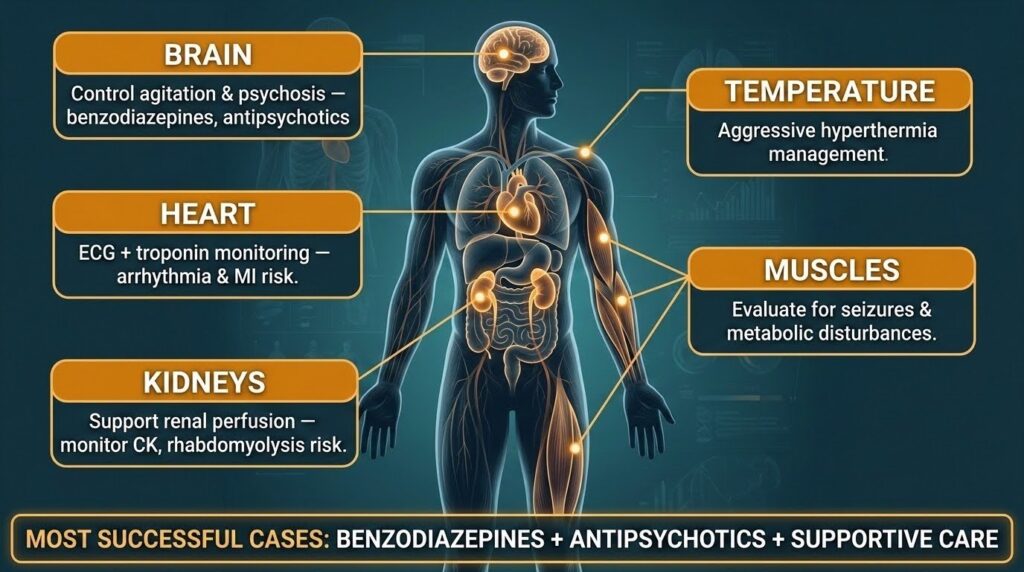
Although this report focuses on effects over time rather than treatment protocols, the literature supports several practical clinical implications. There is no specific antidote for synthetic cathinone intoxication. Management is supportive and targeted at physiologic stabilization.
The most consistently recommended approach includes control of agitation and psychosis, aggressive supportive care, support of renal perfusion, management of hyperthermia, monitoring for cardiac complications, and evaluation for seizures, rhabdomyolysis, and electrolyte or metabolic disturbances. The majority of successfully treated cases used benzodiazepines, antipsychotics, and general supportive care.
Given the evidence, appropriate medical evaluation should consider ECG and cardiac monitoring, troponin if chest pain, palpitations, syncope, or concerning history, temperature monitoring, renal function and CK, acid-base status when severe, toxicology testing when available, and detailed recreational drug history.
Because psychiatric and systemic complications can evolve after initial intoxication, some patients require observation or follow-up beyond the first few hours. Anyone with psychosis, severe paranoia, persistent insomnia, or post-intoxication behavioral change should not be considered resolved solely because the acute stimulant period ended.
Comparing Short-Term and Long-Term Effects
In the short term, bath salts commonly trigger a severe sympathomimetic and hallucinogenic toxidrome. Agitation, paranoia, hallucinations, psychosis, tachycardia, hypertension, hyperthermia, seizures, dysrhythmias, metabolic derangement, and organ stress are all well documented.
These effects typically begin quickly, peak within hours, and can remain medically dangerous after the euphoric phase fades.
In the longer term, the most convincing evidence points to psychiatric harm. Psychosis is common during exposure and can persist beyond intoxication in at least some heavy users. Recurrent stimulant use likely increases depression, sleep disruption, and broader psychiatric burden over time.
Animal and mechanistic studies further suggest that repeated, high-dose, or heat-amplified exposure can produce oxidative stress, serotonergic abnormalities, and cognitive deficits, even if the human long-term neurotoxicity literature remains incomplete and uneven.
The clearest overall answer to what happens to your body over time is this: in the first hours, the body is pushed into dangerous overactivation, brain, heart, temperature regulation, and metabolism all strained at once. In the following days, crash symptoms, insomnia, residual agitation, delayed psychiatric syndromes, hepatic or renal complications may emerge.
Over weeks to years with repeated use, the main risks shift toward recurrent psychosis, depressive burden, sleep dysfunction, possible cognitive problems, and cumulative systemic injury.
Why Bath Salts Are More Dangerous Than Many People Realize?
The public image of bath salts as primarily crazy behavior drugs is scientifically outdated. Acute agitation may dominate the scene, but arrhythmia, myocardial ischemia, cardiomyopathy, and cardiac arrest are not rare oddities; they are core severe complications supported by both modern reviews and poison center data.
The most valid overall conclusion is not merely that bath salts are dangerous, but that they are disproportionately hazardous because they combine high short-term lethality and psychiatric destabilization with uncertain-but-credible longer-term neuropsychiatric fallout that current testing and surveillance still underestimate.
Bath salts should be understood not merely as party stimulants that sometimes cause agitation, but as an unstable class of potent synthetic stimulants whose hallmark danger is simultaneous brain toxicity, autonomic overdrive, and potentially sudden cardiovascular collapse. In clinical and public health terms, the gravest mistake is to treat apparent agitation as the main problem while underestimating occult cardiac injury, hyperthermia, renal stress, and exposure uncertainty.
Conclusion
If you or someone you care about is struggling with synthetic cathinone use or experiencing psychiatric or physical symptoms after exposure, our professional support can make a critical difference.
With Thoroughbred, recovery is possible, and you do not have to face this alone. Reach out to our admissions team and get addiction counseling to begin your path toward with clarity and freedom.


 Give Us A Call


