
 info@thoroughbredbhc.com
Carfentanil and fentanyl are both synthetic opioids, but carfentanil is approximately 30 to 100 times more potent than fentanyl, with recent receptor studies showing about 85-fold greater functional potency.
This extreme difference means tiny amounts of carfentanil can trigger rapid respiratory collapse and death, often faster and more severely than fentanyl alone.
This article explains the pharmacological distinctions, overdose risks, and why carfentanil’s reemergence in the illicit drug supply demands urgent attention.
What is the Difference Between Fentanyl and Carfentanil?
Fentanyl is a powerful synthetic opioid approved for human medical use in severe pain management and anesthesia. Carfentanil, by contrast, was developed exclusively for veterinary sedation of large animals and has no approved human medical use.
The Virginia Department of Health describes carfentanil as an extremely potent fentanyl analog designed for large-animal veterinary use and not approved for use in humans.
While both drugs act on the same µ-opioid receptors in the brain and can cause respiratory depression, sedation, and death, the scale of danger differs profoundly. Fentanyl is commonly cited as 50 to 100 times more potent than morphine.
Carfentanil is generally described as approximately 30 to 100 times more potent than fentanyl itself, placing it roughly 10,000 times more potent than morphine in broad public health estimates.
The most important practical distinction is not simply that carfentanil is stronger. It is that carfentanil has reemerged inside an already fentanyl-saturated illicit drug market.
CDC surveillance shows that deaths with carfentanil detected increased approximately sevenfold, from 29 during January to June 2023 to 238 during January to June 2024, with carfentanil detected in 37 states and IMF codetected in 86.9% of carfentanil-positive deaths. This pattern differs sharply from earlier localized outbreaks, suggesting carfentanil now functions as a hidden adulterant within fentanyl supplies rather than a separate market threat.
How Much More Potent is Carfentanil Compared to Fentanyl?
The exact potency ratio depends on how potency is measured. Public health agencies commonly describe carfentanil as about 100 times more potent than fentanyl, a useful shorthand for emergency awareness.
However, a 2024 peer-reviewed pharmacology review places the range more precisely at approximately 30 to 100 times more potent than fentanyl, acknowledging variability across different endpoints and methodologies.
The most specific recent evidence comes from a 2025 µ-opioid receptor study. Researchers found that carfentanil had about 10-fold higher receptor binding affinity than fentanyl but was approximately 85-fold more potent than fentanyl at inhibiting cAMP through the µ-opioid receptor.
Importantly, when potency was adjusted for receptor occupancy at EC50, carfentanil was still roughly 8-fold more efficient than morphine, fentanyl, or remifentanil. This suggests carfentanil stabilizes unusually efficient receptor conformations, producing outsized physiological effects even relative to how tightly it binds.
Why Potency Differences Matter Clinically?
Potency is not merely a chemical trivia point. It changes real-world overdose risk in several critical ways:
- Dose margin becomes microscopic. Tiny errors in mixing, cutting, or pressing pills can become lethal.
- Adulteration becomes harder to detect. A drug supply already contaminated with fentanyl becomes even more hazardous if carfentanil is added in trace but active amounts.
- Counterfeit pill risk intensifies. Pills sold as oxycodone, Xanax, or Norco may contain fentanyl or fentanyl-related compounds including carfentanil.
- Test-strip limitations become more consequential. CDC warns that fentanyl test strips may not detect more potent fentanyl-like drugs such as carfentanil.
- Clinical reversal may be more complicated. Naloxone remains effective, but repeated doses and prolonged monitoring may be needed.
A 2024 simulation-based clinical trial found that both fentanyl and carfentanil can rapidly depress ventilation, oxygenation, brain oxygen tension, and cardiac output, with simulated cardiac arrest occurring without naloxone.
The study also found that for fentanyl overdose, immediate additional intranasal naloxone doses at 0 minutes reduced modeled cardiac arrest risk more than waiting 2.5 minutes between doses, emphasizing that speed of naloxone delivery matters critically.
Carfentanil Potency Compared to Fentanyl: Receptor-Level Insights
Understanding why carfentanil is so dangerous requires looking beyond simple dose comparisons to how the drug interacts with opioid receptors in the brain.
The 2025 receptor study provides the clearest mechanistic insight available. Carfentanil was not merely a tighter binder. It was much more potent functionally than its affinity alone would predict.
When researchers measured how effectively each opioid inhibited cAMP, a key intracellular signaling molecule, carfentanil demonstrated approximately 85-fold higher potency than fentanyl. Even more striking, when potency was normalized for receptor occupancy at EC50, carfentanil was still about 8-fold more efficient than morphine, fentanyl, or remifentanil at producing downstream effects.
This distinction is crucial. If one only looked at receptor affinity, one might conclude carfentanil is just around 10 times stronger than fentanyl. But functional signaling potency tells a different story, one that aligns closely with the long-cited public health estimate of 100-fold potency.
The danger comes not only from requiring tiny doses to produce effect, but from the fact that carfentanil converts receptor occupancy into physiological depression more efficiently than fentanyl.
Additional pharmacokinetic evidence suggests carfentanil may accumulate nonlinearly at higher doses and may exhibit impaired clearance. If true in relevant exposure scenarios, this could contribute to prolonged or unexpectedly severe toxicity.
Some literature also indicates that carfentanil may have slower receptor dissociation kinetics than fentanyl, which modeling suggests makes it harder to reverse with naloxone.
What’s the Difference Between Fentanyl and Carfentanil in Overdose Presentation?
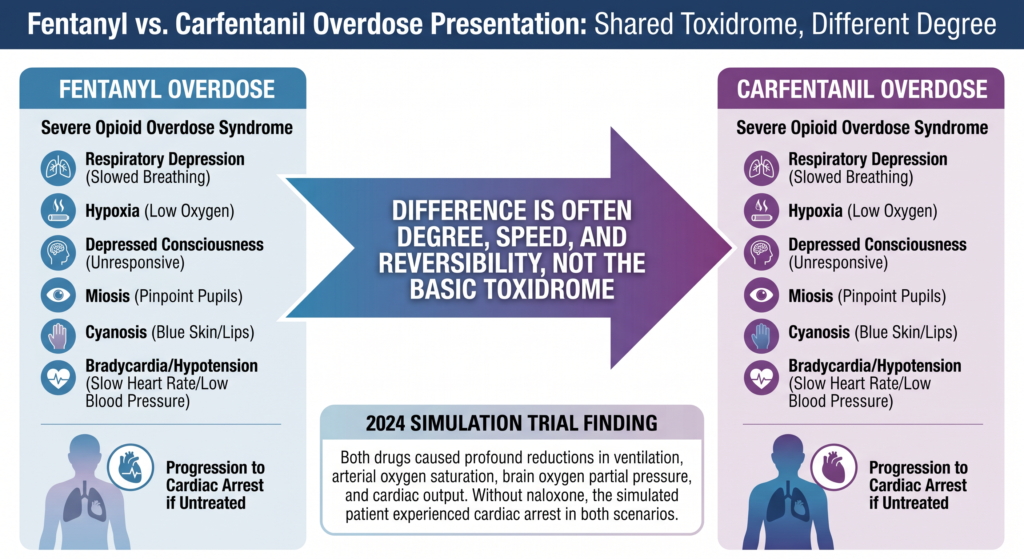
Carfentanil overdose does not create a wholly novel syndrome. It presents as severe opioid overdose: respiratory depression, decreased ventilation, hypoxia, depressed consciousness, miosis, cyanosis, bradycardia or hypotension in severe cases, and progression to arrest if untreated. What differs is often degree, speed, and reversibility, not the basic toxidrome.
The 2024 simulation trial modeled fentanyl and carfentanil overdose in a typical patient and found that both drugs caused profound reductions in ventilation, arterial oxygen saturation, brain oxygen partial pressure, and cardiac output.
Without naloxone, the simulated patient experienced cardiac arrest in both scenarios. This is one of the clearest pieces of evidence linking receptor pharmacology to whole-body physiological collapse.
Signs of Carfentanil or Fentanyl Overdose
| Sign or symptom | Relevance in fentanyl or carfentanil overdose | Immediate implication |
|---|---|---|
| Slow or absent breathing | Most critical sign | Give naloxone; support breathing; call emergency services |
| Unresponsiveness or unconsciousness | Strong sign of severe opioid toxicity | Emergency response needed |
| Pinpoint pupils | Common but not sufficient alone | Support diagnosis; do not rely on this sign alone |
| Cyanosis or blue lips | Sign of hypoxia | Severe emergency |
| Recurrent sedation after improvement | May indicate renarcotization or persistent exposure | Continued observation and repeat naloxone may be needed |
| Delayed deterioration after counterfeit pill ingestion | Reported risk with ingested fentanyl-laced pills | Monitor closely even after initial improvement |
One of the strongest conceptual insights from modeling literature is that timing can matter as much as absolute potency.
Naloxone must achieve sufficient concentrations quickly enough to displace the opioid from the µ receptor before hypoxia progresses to cardiovascular collapse. In practical terms, a modest delay in reversal may turn a survivable overdose into an arrest.
Does Naloxone Work on Carfentanil?
The most accurate answer is yes, naloxone works on carfentanil, but carfentanil overdoses may require more doses and faster administration than many fentanyl overdoses. The evidence does not support claiming carfentanil is categorically naloxone resistant.
A 2024 review on naloxone formulations concluded that most fentanyl overdoses can be reversed with two standard doses of intranasal or intramuscular naloxone, but overdoses involving carfentanil may require three or more doses. The authors did not conclude that high-dose naloxone products are universally necessary; instead, they emphasized that carfentanil is a notable exception where more doses may be required.
Another review notes that modeling based on autopsy-derived lethal dose estimates concluded carfentanil had slower receptor dissociation kinetics than fentanyl, making it harder to reverse. Concentrated intramuscular naloxone with faster uptake performed better than slower uptake strategies, again emphasizing that early effective antagonist levels are decisive.
The simulation trial found that for fentanyl overdose, immediate additional intranasal naloxone doses at 0 minutes reduced modeled cardiac arrest risk more than waiting 2.5 minutes between doses. This finding matters even more when thinking about carfentanil, because the same modeling framework suggests the therapeutic race is against rapidly progressing hypoxia.
Practical Naloxone Strategy for Suspected Carfentanil Exposure
The strongest defensible clinical and public health interpretation is:
1. Carfentanil should be presumed naloxone-responsive, not naloxone-resistant.
2. However, repeat dosing should be anticipated, especially if improvement is partial or transient.
3. Rapid EMS activation and respiratory support remain critical, because even successful initial reversal may not be enough.
4. Speed matters. Delayed repeat dosing may be less useful if the critical window has already narrowed.
This is more scientifically sound than either extreme claim that standard naloxone always works easily or that naloxone does not work on carfentanil.
Carfentanil and Fentanyl: Historical and Current Epidemiology
A 2021 peer-reviewed analysis examined over one million U.S. overdose death records from 1979 through 2019 and compared state overdose trends with DEA carfentanil exhibit data.
The study found that overdose deaths rose by 11,228 in 2016 and 6,605 in 2017, then declined by 2,870 in 2018, the first annual decline since 1990. These changes coincided with carfentanil seizure exhibits rising from 0 in 2015 to 1,292 in 2016 to 5,857 in 2017, then falling to 804 in 2018.
The carfentanil surge was heavily concentrated in five states: Ohio, Florida, Pennsylvania, Kentucky, and Michigan. The combined decline in overdose deaths in these states from 2017 to 2018 was 2,848, accounting for nearly all of the national decline of 2,870.
Ohio provides particularly strong state-level evidence. From 2016 to 2017, Ohio had the largest increase in overdose deaths and carfentanil exhibits. From 2017 to 2018, it had the largest decline in both.
This study does not prove carfentanil alone caused the national rise and fall in overdose deaths. The epidemic is too multifactorial for that. But the association is too strong and geographically specific to dismiss.
The authors concluded that the acceleration in 2016 to 2017 and decline in 2018 was associated with the sudden rise and fall of carfentanil availability, and that reduced carfentanil availability may have contributed to the 2018 decline.
Carfentanil’s Reemergence in 2023 to 2024
The most important recent surveillance source is the CDC’s 2024 MMWR on IMF and carfentanil detection in overdose deaths. It reports that approximately 72,000 U.S. overdose deaths in 2023 involved IMFs, roughly seven in ten overdose deaths.
Deaths with carfentanil detected increased from 29 in January to June 2023 to 238 in January to June 2024, representing a 720.7% increase, with carfentanil detected in 37 states during January 2023 to June 2024.
CDC explicitly notes that the newer pattern differs from the earlier emergence. In 2023 to 2024, there was broader geographic spread across 37 states and 86.9% IMF co-detection. In 2016 to 2017, there were more localized outbreaks and less than 25% fentanyl co-detection.
This is one of the most important insights in the entire evidence base. It means the current carfentanil threat is less a distinct outbreak chemical and more a hidden enhancer or adulterant inside the existing fentanyl market.
Paradoxically, a more integrated carfentanil and fentanyl supply may be more dangerous than a clearly separate one. If people think they are using fentanyl, heroin, counterfeit pills, cocaine, or methamphetamine but the supply contains carfentanil, the exposure is less visible, dose expectations are less reliable, and bystander preparedness may be worse.
CDC notes the concern that carfentanil might be mixed into fentanyl products as an adulterant, analogous to the way fentanyl first infiltrated the heroin supply.
Hidden Exposure: Why Carfentanil Matters Beyond Opioid Users?
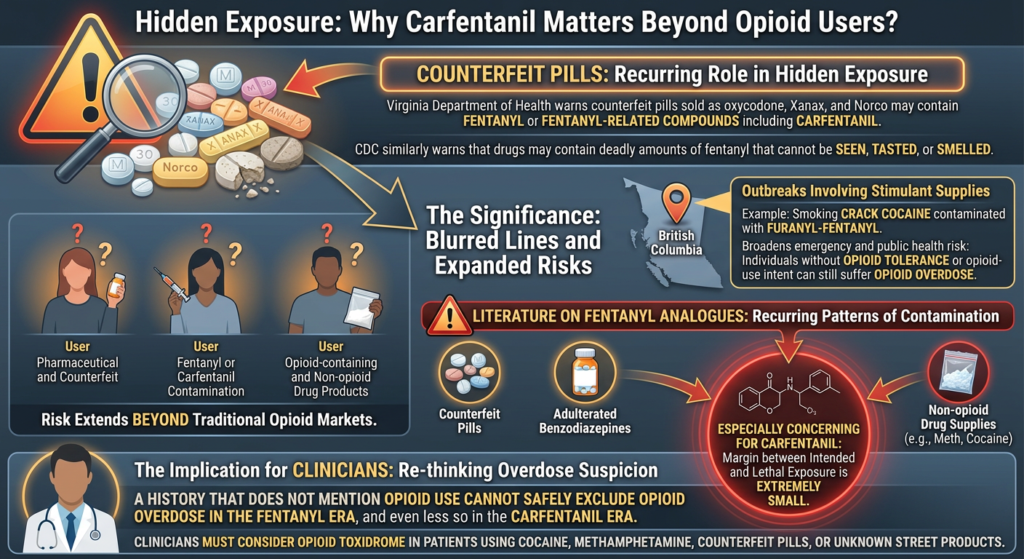
One of the most practically important connections across research is the recurring role of counterfeit pills. The Virginia Department of Health warned that counterfeit pills sold as oxycodone, Xanax, and Norco may contain fentanyl or fentanyl-related compounds including carfentanil. CDC similarly warns that drugs may contain deadly amounts of fentanyl that cannot be seen, tasted, or smelled.
The significance is straightforward. Users often cannot distinguish pharmaceutical from counterfeit pills, fentanyl from carfentanil contamination, or opioid-containing from apparently non-opioid drug products. The risk extends beyond traditional opioid markets.
The literature includes outbreaks involving stimulant supplies, such as smoking crack cocaine contaminated with furanyl-fentanyl in British Columbia. This broadens emergency and public health risk because individuals without opioid tolerance or opioid-use intent can still suffer opioid overdose.
The literature on fentanyl analogues highlights recurring patterns of contamination in counterfeit pills, adulterated benzodiazepines, and non-opioid drug supplies. These patterns are especially concerning for carfentanil because the margin between intended and lethal exposure is so small.
The implication is straightforward. A history that does not mention opioid use cannot safely exclude opioid overdose in the fentanyl era, and even less so in the carfentanil era. Clinicians must consider opioid toxidrome in patients using cocaine, methamphetamine, counterfeit pills, or unknown street products.
Why the Carfentanil vs Fentanyl Difference Matters for Public Health?
The greatest real-world danger today is hidden adulteration, not just raw pharmacological strength. CDC’s finding that 86.9% of recent carfentanil-detected deaths also had IMF co-detected means modern carfentanil risk is chiefly a contamination and adulteration problem inside the fentanyl market. That makes exposure less visible and prevention more difficult.
Carfentanil remains a strategically important drug threat even if it is still rarer than fentanyl. A substance does not need to be common to be epidemiologically decisive. The 2016 to 2018 history shows that concentrated carfentanil availability can strongly shape overdose mortality patterns. The 2023 to 2024 resurgence suggests it can do so again.
Practical Public Health Implications
Recent declines in overall overdose deaths do not eliminate the threat of more potent analogues. CDC explicitly warns that carfentanil and other opioids more potent than fentanyl could threaten progress.
Because the current carfentanil wave is so tightly linked to IMF, prevention efforts focused on IMF broadly will also reduce carfentanil mortality. But response systems should also assume that some IMF exposures may be unusually potent and require faster or repeated naloxone.
If testing does not include carfentanil, local systems may miss a critical shift until deaths accumulate. Standardization gaps likely mean undercounting already. Counterfeit pills and stimulant contamination mean prevention messaging should not be directed only at people who identify as opioid users.
Public messaging should become more scientifically precise. Instead of repeating 100 times stronger than fentanyl as an unquestioned constant, better messaging would say carfentanil is generally about 30 to 100 times more potent than fentanyl, very small amounts can cause severe overdose, it often appears mixed into fentanyl or other drugs, and naloxone works, but multiple doses and rapid response may be needed. That would improve accuracy without weakening urgency.
Carfentanil Compared to Fentanyl: Summary Table
| Dimension | Fentanyl | Carfentanil | Why it matters |
|---|---|---|---|
| Drug class | Synthetic opioid | Synthetic opioid; fentanyl analog | Same broad mechanism, different risk scale |
| Human medical approval | Yes, for severe pain and some surgery or anesthesia settings | No | Regulatory difference signals intended-use gap |
| Typical approved use | Severe pain management; perioperative settings | Veterinary tranquilization or sedation of large animals | Carfentanil has no accepted human therapeutic role |
| Relative potency vs. morphine | Commonly cited as 50 to 100 times | Commonly cited as approximately 10,000 times | Carfentanil has much narrower safety margin |
| Relative potency vs. fentanyl | Baseline comparator | Commonly cited as approximately 100 times, though reviews suggest 30 to 100 times and receptor studies suggest approximately 85-fold functional potency | Exact multiplier uncertain, but far greater potency is clear |
| Overdose crisis role | Dominant driver via illegally manufactured fentanyl | Reemerging high-potency adulterant or analog threat | Fentanyl drives baseline mortality; carfentanil can intensify it |
| Detection with fentanyl test strips | Often detectable | May not be detected | A negative strip does not exclude carfentanil |
Conclusion
The difference between carfentanil and fentanyl is both straightforward and profound. Fentanyl is a powerful synthetic opioid with legitimate human medical uses, but in the contemporary United States overdose crisis, its dominant public health form is illegally manufactured fentanyl, which was implicated in roughly 72,000 overdose deaths in 2023 and remains the leading driver of fatal overdose nationally.
Carfentanil, by contrast, is a veterinary fentanyl analog not approved for human use and is substantially more potent than fentanyl by every credible account. The best evidence supports describing carfentanil as approximately 30 to 100 times more potent than fentanyl, with recent receptor-functional data clustering around approximately 85 times in a biologically meaningful assay.
The shorthand that carfentanil is about 100 times more potent than fentanyl remains acceptable for public communication, but it is better understood as the upper end of a range than as a fixed exact ratio.
The most important insight from deeper research is that carfentanil is not significant simply because it is stronger. It is significant because it has reemerged inside an already fentanyl-dominated illicit market.
CDC’s 2024 data show a sharp increase in carfentanil detection in overdose deaths, broad spread across 37 states, and very high codetection with IMFs, evidence that carfentanil is increasingly appearing alongside fentanyl rather than only in isolated outbreaks.
The overdose consequences are substantial. Simulation studies show that both fentanyl and carfentanil can rapidly suppress ventilation, oxygenation, brain oxygen tension, and cardiac output, with cardiac arrest occurring without naloxone.
Additional modeling and review evidence suggest that carfentanil overdose is harder to reverse than fentanyl overdose and that the speed of naloxone delivery is critical. The evidence supports rapid, repeated naloxone use, not nihilism about reversal.
If the goal is scientific accuracy, carfentanil should be described as roughly 30 to 100 times more potent than fentanyl, with approximately 85-fold functional potency the best current single estimate. If the goal is public warning, about 100 times more potent remains acceptable, but it should no longer be treated as the whole story.
The deeper story is that carfentanil’s lethality emerges from a combination of extreme potency, efficient receptor signaling, difficult reversal dynamics, and hidden distribution within modern illicit drug supplies. That combination makes it one of the most consequential overdose threats in the current synthetic-opioid era.
If you or someone you care about is navigating substance use or facing the risks of fentanyl or carfentanil exposure, you don’t have to face it alone. Reach out to Thoroughbred Wellness and Recovery today to explore our dual diagnosis treatment that addresses both addiction and mental health with compassion and evidence-based care.


 Give Us A Call


