
 info@thoroughbredbhc.com
Dual diagnosis treatment costs vary widely, but most people face a financial reality shaped more by insurance design than by program sticker prices.
In 2026, the expiration of enhanced ACA premium tax credits pushed many Marketplace enrollees into premium increases exceeding 75%, while residential dual diagnosis care commonly ranges from $10,000 to $30,000 per month before insurance.
This article explains what drives those costs, how insurance changes the math, and how to find clinically appropriate care you can actually afford.
What Dual Diagnosis Treatment Includes and Why It Costs More?
Dual diagnosis treatment addresses both a substance use disorder and a mental health condition at the same time. SAMHSA emphasizes that integrating screening and treatment for mental and substance use disorders improves quality of care and health outcomes by treating the whole person.
This integrated approach costs more than addiction-only care because it requires psychiatric assessment, medication management, higher therapy intensity, integrated staffing, and more individualized treatment planning.
Nationally, residential dual diagnosis care is estimated at about $10,000 to $30,000 per month, compared with $6,000 to $20,000 per month for general residential rehab. That premium reflects the added psychiatric services, medication oversight, and coordination that co-occurring disorders demand.
The Hidden Cost of Non-Integrated Care
Not every program advertising dual diagnosis can actually deliver integrated treatment. A peer-reviewed assessment found that only about 18% of addiction treatment programs and 9% of mental health programs met objective criteria for dual diagnosis capability when measured with standardized fidelity tools. Paying less for a program that lacks real co-occurring capability can become more expensive in total if it leads to incomplete treatment, relapse, or repeat episodes.
How the 2026 Insurance Landscape Changed Affordability?
The most consequential change from 2025 to 2026 was not a uniform spike in treatment prices but a collapse in insurance affordability.
Enhanced ACA premium tax credits expired at the end of 2025, and KFF reported that Marketplace premium payments would more than double on average for subsidized enrollees.
Peterson-KFF found that most subsidized enrollees could expect average net premium increases of over 75% in 2026 after expiration.
Commonwealth Fund analysis projected that nearly 5 million people would become uninsured in 2026 if the credits were not restored, with spillover effects including roughly 340,000 job losses and lower state tax revenues.
This insurance crisis directly affects dual diagnosis affordability because even when behavioral health benefits remain covered, higher premiums and weaker cost-sharing protections make treatment harder to finance.
What This Means for Out-of-Pocket Exposure?
When people lose Marketplace coverage or downgrade into plans with tighter networks or higher cost sharing, the affordability of dual diagnosis treatment worsens even if formal benefit categories remain covered.
The same $12,000 intensive outpatient program that was manageable with stable subsidized coverage becomes much less feasible when monthly premiums more than double and the household has less cash flow available for deductibles or coinsurance.
2026 Treatment Cost Ranges by Level of Care
Understanding the cost ladder helps you choose the clinically appropriate lowest effective level of care, which is often the best affordability strategy.
| Level of Care | Typical 2026 Cost | Clinical Use Case |
|---|---|---|
| Standard Outpatient | $1,000–$10,000 total; $30–$300 per session | Lower-acuity maintenance, therapy, medication management |
| Intensive Outpatient Program (IOP) | $3,000–$10,000 per program; $5,000–$7,500 per month in California | Moderate acuity, relapse prevention, co-occurring support without 24/7 supervision |
| Dual Diagnosis IOP | $6,000–$12,000 per month | IOP with added psychiatric complexity and medication management |
| Partial Hospitalization Program (PHP) | $350–$450 per day; $10,500–$13,500 for 30 days | High acuity but safe to sleep at home |
| Residential Dual Diagnosis | $10,000–$30,000 per month; $15,000–$60,000+ in California | Severe instability, unsafe home setting, failed lower levels |
| Medical Detox | $250–$800 per day; $1,000–$2,500 per day in California | Medical stabilization and withdrawal management |
These ranges come from national estimates, California-specific reporting, and dual diagnosis specialty sources. The wide variation reflects differences in location, staffing, psychiatric intensity, and program duration.
Why Does IOP Often Offer the Best Value?
IOP sits at the economic middle ground. It delivers structured treatment without the cost of 24/7 residential care. For many dual diagnosis patients with stable housing and no severe withdrawal risk, IOP can be a clinically appropriate and financially sustainable option.
Cost is strongly driven by frequency and duration: three days per week may run $3,000 to $6,000 per month, while five days per week can reach $5,000 to $10,000 per month. Longer stays are especially common in co-occurring and relapse-prone cases.
How Insurance Changes the Patient’s Bill?
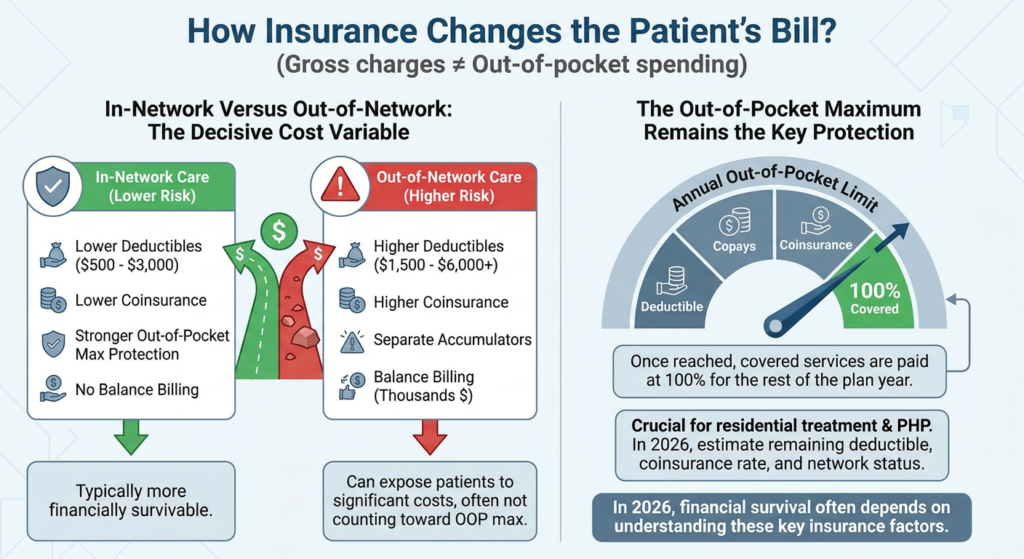
Gross treatment charges and patient out-of-pocket spending are not the same. In 2026, whether dual diagnosis treatment is financially survivable often depends on network status, deductible, coinsurance, out-of-pocket maximum, allowed amount rules, and balance billing exposure.
In-Network Versus Out-of-Network: The Decisive Cost Variable
In-network care typically brings lower deductibles, lower coinsurance, stronger out-of-pocket maximum protection, and no balance billing.
Out-of-network care can expose patients to higher deductibles, higher coinsurance, separate out-of-network accumulators, and thousands in balance billing that usually do not count toward the out-of-pocket maximum.
Trust SoCal reports that in PPO plans, in-network deductibles are usually lower, around $500 to $3,000, while out-of-network deductibles can range from $1,500 to $6,000 or more. Payments toward one typically do not count toward the other.
Balance billing can add thousands of dollars and usually does not count toward the out-of-pocket maximum.
The Out-of-Pocket Maximum Remains the Key Protection
The out-of-pocket maximum is the most important number in benefits for addiction treatment. Once deductible, copays, and coinsurance for covered services reach the annual limit, covered services are paid at 100% for the rest of the plan year.
This is particularly relevant for residential treatment and PHP. In 2026, given higher premiums and more cost-sensitive plan choices, many consumers may be in higher-deductible products, making it even more important to estimate remaining deductible, coinsurance rate, OOP maximum, and whether the facility is in-network.
How to Verify Whether a Program is Truly Worth Its Price?
Because integrated care capability varies so widely, affordability must be evaluated against clinical authenticity. The most effective consumer financial protection is asking a provider for its DDCAT or DDCMHT status.
These are nationally recognized fidelity instruments using a 1-to-5 scale, where 1 reflects single-disorder services, 3 reflects co-occurring capability, and 5 reflects co-occurring-enhanced care.
Seven Dimensions to Ask About
DDCAT assesses seven dimensions: program structure, program milieu, assessment, treatment, continuity of care, staffing, and training. A provider that cannot answer questions in each of these areas may not be providing structured integrated treatment.
Quality checklists from multiple sources converge on several markers: formal dual diagnosis assessment at intake, one unified clinical team, on-site or tightly integrated psychiatric care, medication management, evidence-based therapies for both conditions, individualized treatment plans, and continuum or referral pathways for aftercare.
In 2026, asking a provider for its DDCAT or DDCMHT status is not an academic exercise. It is one of the most effective consumer financial protections available.
If a facility cannot describe its integrated care processes across the seven DDCAT domains, there is a meaningful risk that the consumer is paying a dual-diagnosis premium for non-integrated care.
Practical Steps to Find Affordable Care in 2026
The best affordable-care pathway in 2026 is usually not the cheapest program, but the lowest-total-cost clinically appropriate program that is verifiably co-occurring-capable and in-network.
Start with the Clinically Appropriate Lowest Effective Level of Care
Do not assume residential is always best. For many patients with stable housing and no acute medical danger, integrated IOP or PHP may be adequate and far less expensive than residential care. Use a formal assessment and ask the provider how the level of care was determined.
Questions to ask: Why is this level of care medically necessary? What specific risk factors rule out a lower level? What step-down path is planned?
Restrict the Search to In-Network Options First
Given the documented deductible differences and balance-billing risk, the default search should be in-network whenever possible.
Ask: Are you in-network with my exact plan, not just the insurer generally? Are all clinicians and ancillary services also in-network? Is there any balance-billing risk? Can you provide a written benefits estimate?
Calculate the Real Maximum Exposure
Before admission, get remaining deductible, coinsurance, copays, out-of-pocket maximum, current year amounts already met, separate in-network and out-of-network accumulators, and preauthorization requirements.
If the patient may need multiple phases of care in one plan year, reaching the OOP maximum early can actually improve total affordability of subsequent covered treatment.
Use Public and Nonprofit Pathways When Necessary
For uninsured or underinsured individuals, state-funded treatment programs, Medicaid if eligible, SAMHSA locator tools, grants, nonprofit clinics, community mental health centers, and VA pathways if eligible can be critical.
Medicaid is the largest payer for mental health services, including SUD services, in the U.S., and typically covers screening, therapy, hospitalization, and medications depending on state rules.
Why This Matters: The Real Cost of Delayed or Fragmented Care
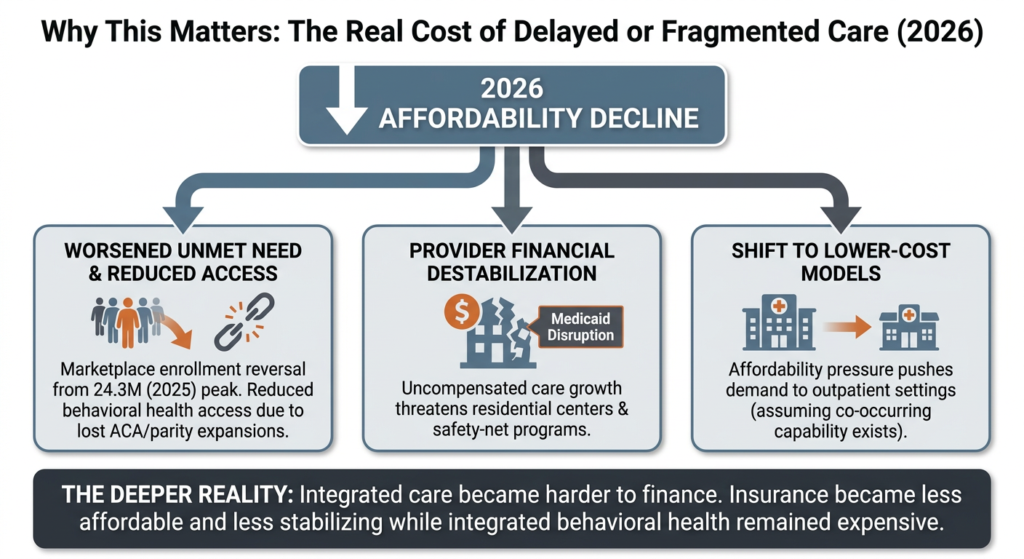
The 2026 affordability decline is likely to worsen unmet need. Marketplace enrollment more than doubled from 11.4 million in 2020 to 24.3 million in 2025 during the enhanced subsidy period. Reversing those gains is likely to reduce behavioral health access because coverage expansions under the ACA and parity protections had materially expanded access to mental health and SUD benefits.
Behavioral health commentary also warns that Medicaid disruption and uncompensated care growth would financially destabilize providers, especially residential treatment centers and safety-net programs. Affordability pressure may push demand toward lower-cost outpatient models, assuming these settings can demonstrate true co-occurring capability and adequate psychiatric support.
The deeper reality is that integrated care became harder to finance in 2026. The most important change was not simply that programs charged more. The deeper and more consequential shift was that insurance became less affordable and less stabilizing at the same time that integrated behavioral health care remained expensive.
What You Should Expect in 2026?
In 2026, affordability in dual diagnosis treatment is determined less by finding the cheapest advertised program and more by securing the cheapest verifiably integrated in-network program that matches the patient’s real clinical needs.
The best evidence does not support a simplistic claim that dual diagnosis programs uniformly became far more expensive in nominal price from 2025 to 2026. Rather, the deeper change was that 2026 made treatment materially less affordable to purchase, chiefly through insurance deterioration and the increased likelihood of underinsurance or uninsurance.
The practical implication is that consumers now need a more rigorous financial strategy: verify network status, estimate out-of-pocket maximum exposure, confirm true dual diagnosis capability using fidelity tools such as DDCAT or DDCMHT, and compare in-network integrated outpatient options before resorting to higher-acuity or out-of-network care.
If you or someone you care about is navigating dual diagnosis treatment in 2026, start by asking the right questions about clinical capability, insurance alignment, and total episode cost. The cheapest program is often not the least expensive care pathway.
Programs that cannot demonstrate integrated capability create a false economy because they increase the risk of relapse, transfer, and duplicated spending.
Ready to explore integrated care that fits your clinical needs and your budget? Contact Thoroughbred Wellness to verify your insurance and discuss your options with our team that understands both the clinical and financial realities of dual diagnosis treatment.


 Give Us A Call


