
 info@thoroughbredbhc.com
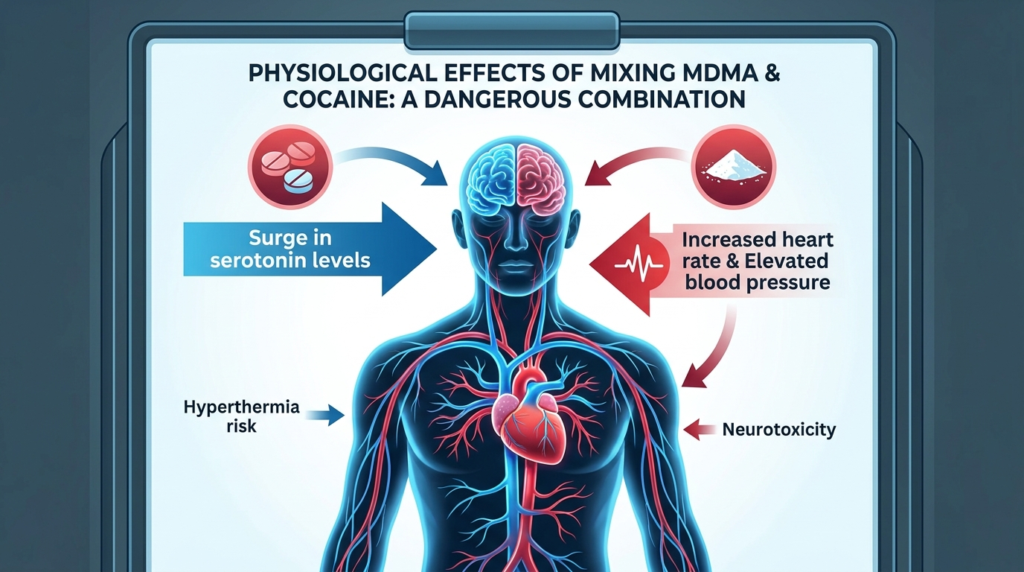
Mixing MDMA and cocaine creates a dangerous stimulant combination that can overwhelm your cardiovascular and nervous systems. Both drugs independently cause rapid heart rate, high blood pressure, and overheating, but together they amplify these risks in unpredictable ways.
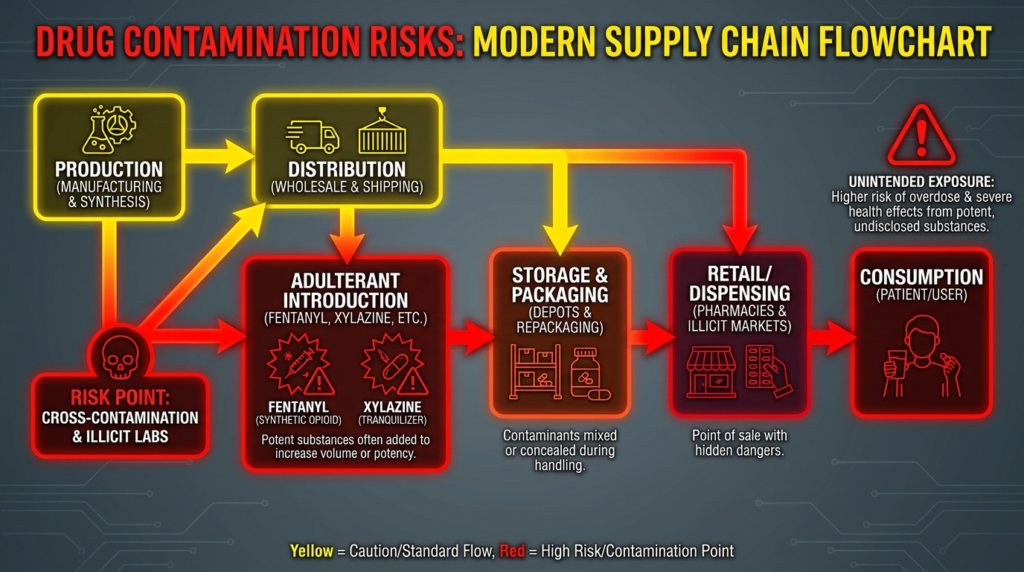
The greatest modern danger is not only the pharmacological interaction but also the contaminated drug supply: what you think is molly or coke may contain fentanyl, xylazine, or other adulterants that turn a risky decision into a life-threatening emergency.
This article explains what happens when you combine these substances, why the risks are higher than ever, and what warning signs require immediate medical attention.
What Are Molly and Cocaine?
MDMA, commonly called molly or ecstasy, is a synthetic psychoactive drug with stimulant and empathogenic properties. It increases serotonin, dopamine, and norepinephrine in the brain, producing feelings of emotional warmth, energy, and sensory enhancement.
Cocaine is a powerful central nervous system stimulant that blocks the reuptake of dopamine, creating intense euphoria, alertness, and confidence. Both drugs are popular in nightlife, festival, and social settings, and both carry serious acute toxicity risks even when used alone.
The critical pharmacological difference is that MDMA acts primarily as a monoamine releaser with especially strong serotonergic effects, while cocaine functions mainly as a reuptake blocker with particularly strong dopaminergic reinforcement.
This means they push the same neurotransmitter systems through different mechanisms, creating an unstable and unpredictable combined effect rather than a simple doubling of stimulation.
Why People Mix MDMA and Cocaine?
Users often combine molly and coke seeking to merge cocaine’s sharp, intense euphoria with MDMA’s prosocial warmth and prolonged energy.
The goal is typically to enhance stamina for dancing, intensify sociability, and extend wakefulness during parties or festivals. Some users believe cocaine will sharpen MDMA’s empathogenic effects, while others think MDMA will soften cocaine’s edginess.
This logic rests on a flawed assumption. The nervous system does not respond to polysubstance stimulant exposure in a predictable, controllable way.
When two drugs act on dopamine, serotonin, and norepinephrine systems through different pathways, the result can be synergistic, state-dependent, and highly variable across dose, timing, and individual physiology. What feels subjectively manageable during the high may mask dangerous physiological strain.
The Modern Drug Supply: Hidden Dangers Beyond Pharmacology
The most important shift in understanding molly and coke risks is recognizing that today’s drug market is fundamentally different from a decade ago.
The Centers for Disease Control and Prevention now emphasizes that polysubstance use can occur intentionally or unintentionally, with or without the person’s knowledge. This reflects the contemporary reality of contamination, substitution, and counterfeit drug products.
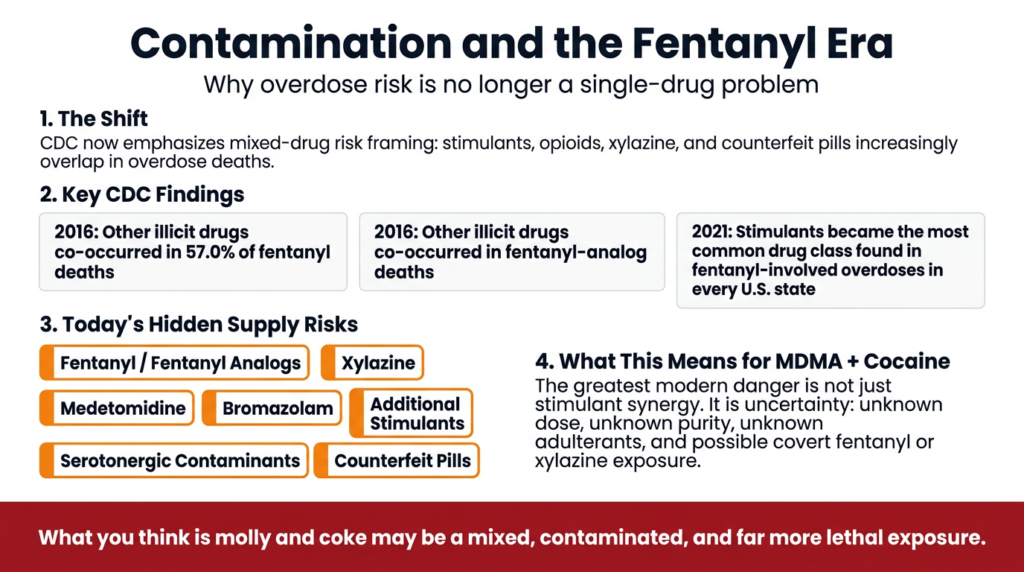
By 2021, stimulants were the most common drug class found in fentanyl-involved overdoses in every U.S. state.
The Substance Abuse and Mental Health Services Administration warns that fake pills marketed as prescription stimulants, opioids, or benzodiazepines may contain fentanyl, and DEA data indicates that 7 in 10 fake pills contain a potentially lethal dose.
This means a person who intends to mix two stimulants may unknowingly consume opioids, xylazine, benzodiazepine analogs, or other adulterants.
The practical implication is stark: the phrase “mixing molly and coke” is chemically too simple for today’s drug market. In many real-world cases, you are not combining two known pharmaceutical-grade substances but ingesting an unstable set of unknowns.
Acute Physical Effects and Toxicity
Overlapping Stimulant Burden
Both MDMA and cocaine increase sympathetic nervous system activation, producing overlapping effects that can reinforce one another:
- Rapid heart rate and elevated blood pressure
- Increased body temperature and sweating
- Agitation, anxiety, and restlessness
- Jaw clenching and muscle tension
- Dilated pupils and tremor
- Reduced appetite and insomnia
- Impaired judgment and increased impulsivity
When taken together, these effects place compounding stress on the cardiovascular, thermoregulatory, and neurologic systems.
The body’s usual feedback mechanisms may become uncoupled from neurotransmitter output, meaning you can feel subjectively stable while physiological strain continues to escalate.
MDMA-Specific Dangers
MDMA toxicity alone can produce a broad and dangerous syndrome. Trusted medical sources describe life-threatening complications including hyperthermia resembling heat stroke, serotonin syndrome, cardiac dysrhythmias, rhabdomyolysis, acute renal failure, hyponatremia, cerebral edema, disseminated intravascular coagulation, aortic dissection, intracranial hemorrhage, seizures, coma, and death.
Serotonin syndrome is especially concerning. This condition can rapidly progress from confusion, tremor, and sweating to cardiovascular instability, seizures, and coma. MDMA can precipitate serotonin syndrome on its own, but the risk increases when combined with other serotonergic agents or in polysubstance contexts where the full exposure set is unknown.
Cocaine-Specific Dangers
Cocaine toxicity is primarily a cardiovascular emergency. It can rapidly produce tachycardia, severe hypertension, coronary vasospasm, acute coronary syndrome, arrhythmias, stroke, and death.
Cocaine also lowers the seizure threshold and can cause agitation, paranoia, and delirium. When cocaine is added to MDMA, several overlapping risks become especially dangerous:
- Hyperthermia: Both drugs increase activity, vasoconstriction, and metabolic stress, especially in hot, crowded environments.
- Cardiovascular instability: Cocaine adds potent cardiac and vascular strain on top of MDMA’s cardiovascular effects.
- Seizure risk: Both substances may lower seizure threshold, particularly in high-dose or prolonged-use scenarios.
- Stroke and hemorrhage: Severe hypertension, vasospasm, hyperthermia, and coagulopathy create dangerous conditions for vascular events.
- Rhabdomyolysis and renal injury: Overheating, agitation, prolonged exertion, and dehydration increase the risk of muscle breakdown and kidney damage.
Water Balance and Hyponatremia
MDMA intoxication can cause hyponatremia and cerebral edema, especially in contexts involving prolonged dancing, overheating, and misguided overhydration. The clinical problem is not simply dehydration but maintaining hydration without excessive free-water intake.
When cocaine is used concurrently, users may stay awake longer, dance longer, and perceive less fatigue, potentially worsening exertional stress and fluid imbalance.
Emergency Warning Signs
A person mixing MDMA and cocaine may experience intense energy, euphoria, and sociability initially, but these are not benign recreational effects.
Several represent early warning signs of toxicity progression. The following symptoms should be treated as medical emergencies:
- Very high body temperature or uncontrollable sweating
- Chest pain or severe palpitations
- Severe headache or visual disturbances
- Seizure or rigid muscles with jerking movements
- Loss of consciousness or collapse
- Severe agitation, delirium, or confusion that is worsening
- Trouble breathing or blue lips
- Repeated vomiting or signs of stroke
- Unusual drowsiness or slowed breathing, which may suggest hidden opioid contamination
Stimulant overdose is a real overdose emergency, not simply being “too high.” The CDC emphasizes that stimulant emergencies commonly involve cardiovascular strain, severe agitation, and dangerous mental-status changes requiring urgent response.
A person may remain conscious, moving, or agitated while entering a life-threatening state, making recognition and early intervention critical.
Contamination and the Fentanyl Era
One of the most consequential developments in overdose science is the move away from single-drug explanations. The CDC now explicitly emphasizes that polysubstance overdose deaths have increased and that deaths involving stimulants, opioids, xylazine, and counterfeit pills require mixed-drug risk framing.
In a CDC report covering 10 states in 2016, other illicit drugs co-occurred in 57.0% of fentanyl deaths and 51.3% of fentanyl-analog deaths, with cocaine and heroin commonly present.
Nearly half of fentanyl-analog deaths involved two or more analogs or fentanyl, demonstrating that supply complexity and multiple-opioid exposure were major hazards even then. By 2021, the pattern had intensified: stimulants became the most common drug class found in fentanyl-involved overdoses in every state.
The supply is also diversifying. Recent research notes that adulterants such as xylazine, medetomidine, and bromazolam may alter risk and behavior beyond fentanyl alone. For someone using both MDMA and cocaine, this means the exposure may include fentanyl or fentanyl analogs, xylazine, benzodiazepine-like adulterants, additional stimulants, or serotonergic contaminants.
This is not rhetorical overstatement. It follows directly from CDC and SAMHSA’s updated public health messaging and fentanyl-era surveillance. The greatest modern danger of mixing molly and coke is not only synergistic stimulant toxicity but also uncertainty: unknown dose, unknown purity, unknown adulterants, and possible covert fentanyl or xylazine exposure.
Long-Term Brain and Cognitive Effects
Beyond acute toxicity, repeated MDMA and stimulant polysubstance exposure is associated with measurable brain-related abnormalities.
A PET study of 49 polysubstance users in prolonged abstinence found that greater lifetime severity of heroin, alcohol, MDMA, and cannabis use was associated with lower resting brain metabolism in the dorsolateral prefrontal cortex and temporal cortex. Stimulant exposure, including cocaine and MDMA, was uniquely associated with reduced metabolism in the inferior parietal and postcentral cortex.
These regions are not arbitrary. The dorsolateral prefrontal cortex governs executive function, planning, inhibition, and working memory. The temporal cortex is involved in memory-related processing. The inferior parietal cortex supports attention, visuospatial processing, and cognitive control.
These abnormalities were observed after prolonged abstinence, suggesting persistent dysfunction beyond immediate intoxication or withdrawal.
Long-term MDMA use has been associated with mood alterations, elevated cortisol, declines in executive functioning, impaired set-shifting, difficulty accessing semantic memory, and cognitive deficits in verbal learning, attention, and working memory.
Anxiety, depressed mood, and decreased serotonin transporter expression have also been documented. In adolescence-focused review work, depressive symptoms, anxiety, and more severe manifestations including suicidal ideation were reported.
The key point is that recurrent molly-and-coke use may contribute to deficits in executive control, attention, decision-making, visuospatial function, memory, and motor regulation.
These are precisely the capacities that protect against repeated risky use, creating a plausible vicious cycle: individuals use combined stimulants for social or hedonic reasons, but chronic exposure may erode the control systems needed to moderate future use.
Adolescent and Young Adult Vulnerability
MDMA use is common in youth and young adult social settings. SAMHSA’s youth prevention materials emphasize that among adolescents ages 10 to 19, from 2019 to 2021, monthly drug overdose deaths increased 109%, deaths involving illicitly manufactured fentanyls increased 182%, about 90% involved opioids, 84% involved illicitly manufactured fentanyls, and counterfeit pills were present in nearly 25% of these deaths.
A 2025 structured review focused on adolescent MDMA use found consistent associations with psychological disturbances including depressive and anxious symptoms, suicidal ideation and attempts, and neuropsychological impairments in memory, attention, and executive functioning. It also emphasized serotonergic disruption and the special vulnerability of the adolescent brain, while acknowledging methodological limitations such as small samples and polydrug confounding.
This is especially relevant because concurrent cocaine and MDMA use is often described as common in club and party settings among young adults and within broader polysubstance patterns. Even if direct dyad evidence is limited, the developmental risk context is not.
Nightlife Settings as Risk Amplifiers
The literature on nightlife drug use consistently shows that EDM, festival, and club settings are not neutral backdrops.
They alter hydration, ambient temperature, exertion, sleep deprivation, social pressure, and emergency response timing. MDMA is particularly associated with these environments, and cocaine is also common within them.
Environmental and behavioral amplifiers include:
- Hot indoor venues with poor ventilation
- Crowding and prolonged dancing
- Sleep deprivation and limited food intake
- Alcohol or other co-ingestion
- Redosing and sharing unverified pills or powders
- Underestimating symptoms and delaying medical help out of fear
A systematic review of nightlife substance-use studies notes that stimulant use such as MDMA or cocaine carries risks of dehydration, overheating, and cardiovascular episodes.
Another nightlife study found physical manifestations such as palpitations and collapsing among attendees, reinforcing that acute harms are not rare abstractions.
The European Union Drugs Agency reported that in a 2024 web survey, only 10% of MDMA users said they used it with no other substance on the last occasion; 70% used alcohol, 55% tobacco, and 27% herbal cannabis.
Although this does not directly quantify cocaine co-use, it underscores a larger reality: recreational MDMA use is frequently part of a multi-substance pattern. That pattern magnifies unpredictability.
Harm Reduction and Emergency Response
The safest recommendation is not to combine MDMA and cocaine. That is not a moral judgment; it is a toxicological one. The combined use has no reliable safety profile, especially outside controlled medical environments, which do not exist for illicit party-drug co-use.
However, the evidence supports several pragmatic measures relevant to real-world harm reduction:
Before use:
- Avoid assuming “molly” is pure MDMA or cocaine is uncontaminated.
- Use drug-checking services where available.
- Use fentanyl test strips where appropriate, recognizing limitations.
- Avoid combining with alcohol or additional stimulants or depressants when possible.
- Do not use alone.
During use:
- Monitor temperature, confusion, chest symptoms, and agitation.
- Take cooling and rest seriously in hot environments.
- Avoid continuous dancing without breaks.
- Hydrate carefully; do not overconsume water rapidly.
- Do not redose because one drug appears to “wear off.”
Emergency response:
- Call emergency services early for overheating, chest pain, seizure, collapse, or severe confusion.
- Treat stimulant overdose as a medical emergency.
- If fentanyl contamination is possible, naloxone availability is sensible, especially in cocaine-using populations.
- Move to a cooler, safer environment if hyperthermic.
- Monitor breathing and consciousness.
- Give naloxone if opioid contamination is possible or if breathing is slowed or unresponsiveness occurs.
- Do not force large amounts of water.
- Do not leave the person alone.
- Report all known or suspected substances to responders, including uncertainty.
Because stimulant users are increasingly exposed to fentanyl, naloxone should be available even when the intended drugs are cocaine or MDMA. This follows directly from CDC and SAMHSA framing and from the observed overlap of stimulants with fentanyl in overdose patterns.
Why is This Combination More Dangerous Than Many Users Assume?
There is a cultural misconception that stimulant overdoses are less “real” than opioid overdoses because they may not begin with obvious respiratory depression. This is incorrect.
Stimulant emergencies commonly involve cardiovascular strain, severe agitation, and dangerous mental-status changes. A person may remain conscious, moving, or agitated while entering a life-threatening state.
The CDC’s 2025 MMWR on suspected fentanyl-involved nonfatal overdose emergency department visits found that rates increased in a majority of demographic groups from late 2020 through mid-2023, then declined from Q3 2023 to Q1 2024, but remained high overall.
This report does not isolate MDMA-cocaine co-use, but it shows that nonfatal fentanyl-involved overdose remains a major ED burden, fentanyl involvement may be missed or misclassified depending on testing practices, and people with a nonfatal overdose are at increased risk of future fatal overdose.
Thus, anyone presenting after “molly and coke” use should be evaluated with contemporary supply realities in mind. Even an apparently “recovered” party or festival episode involving molly and coke should be taken seriously clinically.
Treatment and Recovery
For recurrent use or emerging disorder, stimulant use disorder treatment often relies on psychosocial interventions.
Contingency management has some of the strongest evidence for stimulant disorders. Cognitive behavioral therapy and related psychosocial interventions are also supported. If opioid exposure or opioid use disorder is also present, medications for opioid use disorder remain evidence-based and mortality-reducing.
This is another important insight: because real-world molly-and-coke use may involve hidden opioid exposure, treatment planning should not assume a pure stimulant-only pathway. Comprehensive assessment, dual diagnosis treatment, and integrated care for co-occurring substance use and mental health disorders are essential.
Conclusion
Mixing molly and coke means combining two stimulants that can amplify cardiovascular strain, overheating, agitation, neurologic instability, and impaired judgment.
MDMA alone can produce severe toxicity including serotonin syndrome, seizures, rhabdomyolysis, acute renal failure, cerebral edema, cardiac dysrhythmias, intracranial hemorrhage, disseminated intravascular coagulation, and death. Cocaine adds substantial sympathetic and cardiovascular burden. Even where recent dyad-specific emergency incidence data are limited, the acute danger is strongly supported by toxicology and clinical plausibility.
The more advanced and more important conclusion is that this combination now exists within a transformed drug environment.
CDC and SAMHSA explicitly warn that polysubstance exposure may occur with or without the user’s knowledge, and counterfeit pills, fentanyl contamination, xylazine, and other adulterants have reshaped overdose risk. Stimulants are now commonly involved in fentanyl-related overdoses across the United States, making any stimulant combination more dangerous than older models assumed.
Longer-term findings further suggest that repeated MDMA and stimulant polysubstance exposure may be associated with persistent deficits in executive function, attention, memory, mood, and brain metabolism, particularly in prefrontal, temporal, and parietal regions. These effects appear especially relevant in prolonged-abstinence polysubstance users and may outlast immediate withdrawal.
In objective terms, when you mix molly and coke, you do not merely get a stronger high; you create a physiologically unstable and increasingly unpredictable toxic exposure that can escalate to life-threatening emergency conditions and may contribute to enduring neuropsychiatric harm.
In 2026, that judgment is not alarmist. It is the most evidence-consistent interpretation of the available data.
If you or someone you care about is struggling with stimulant use or polysubstance patterns, reaching out for Thoroughbred’s professional support is a critical step toward safety and recovery. Our Dual diagnosis treatment addresses both substance use and co-occurring mental health concerns in an integrated, compassionate way.


 Give Us A Call


