
 info@thoroughbredbhc.com
Mixing Ritalin and alcohol is a common question among people prescribed methylphenidate for ADHD who also drink socially. The short answer is that you should not combine them.
Alcohol can worsen methylphenidate side effects, mask intoxication, and trigger unpredictable drug release in some extended-release formulations, increasing cardiovascular and psychiatric risks.
This article explains what happens when you mix Ritalin and alcohol, why the combination is dangerous, and what to do if you or someone you know has combined them.
What is Ritalin and How Does It Work?
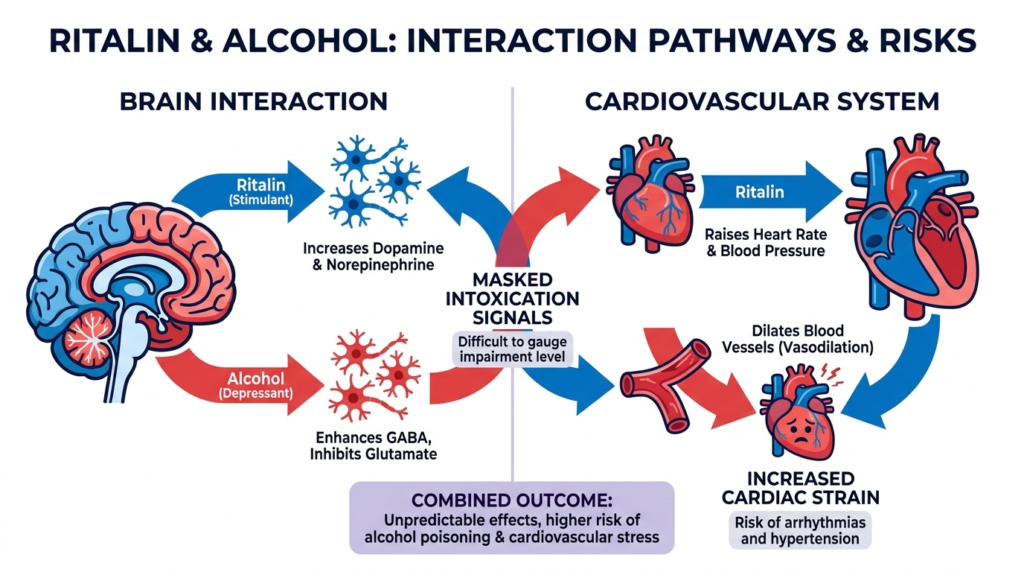
Ritalin is a brand name for methylphenidate, a Schedule II central nervous system stimulant prescribed primarily for attention-deficit/hyperactivity disorder and narcolepsy. It works by increasing dopamine and norepinephrine activity in the brain, improving focus, impulse control, and wakefulness.
The medication comes in multiple forms, including immediate-release tablets, sustained-release tablets, and various extended-release capsules and suspensions. MedlinePlus notes that some methylphenidate products are not interchangeable, which matters when considering alcohol interactions.
Because methylphenidate is a controlled substance with high abuse potential, prescribers must assess substance use history before starting treatment. The drug carries important warnings about cardiovascular risk, psychiatric adverse effects, and dependence potential.
Why People Ask About Mixing Ritalin and Alcohol?
Many adults prescribed Ritalin are of legal drinking age and may wonder whether they can safely have a drink while taking their medication. College students and young professionals, in particular, often encounter social drinking situations.
The question also arises in misuse contexts, where people combine stimulants with alcohol intentionally to stay alert while drinking or to intensify euphoric effects.
The belief that a stimulant will simply “cancel out” alcohol is dangerously misleading. The two drugs act through different mechanisms and produce a complex interaction rather than a straightforward neutralization.
What Happens When You Mix Ritalin and Alcohol?
Masked Intoxication and False Sobriety
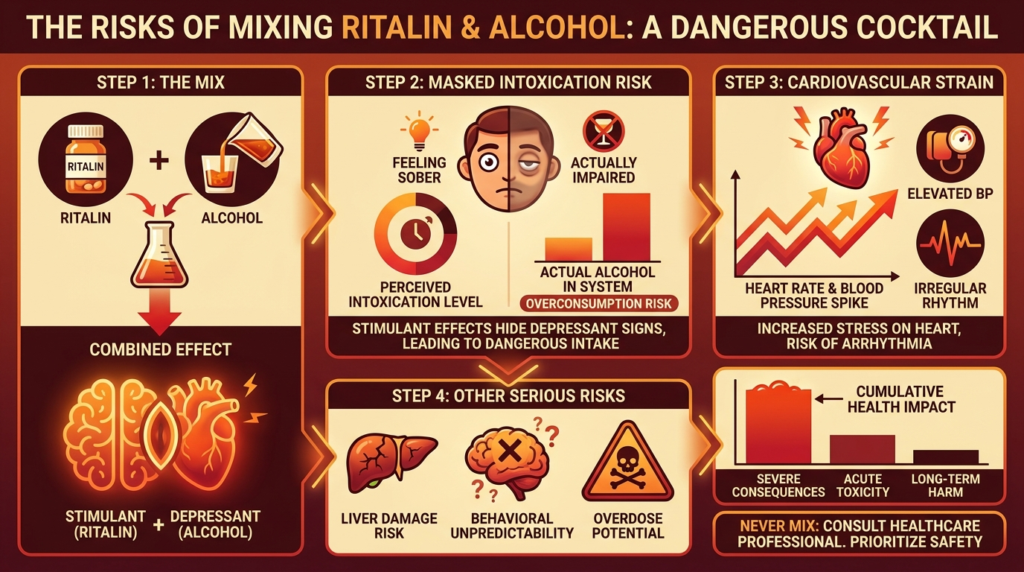
One of the most dangerous effects of combining Ritalin and alcohol is that the stimulant can mask how drunk you actually are.
A systematic review of ADHD medications with alcohol found that users reported diminished sense of drunkenness, increased energy, and euphoria when combining methylphenidate with alcohol. This false sobriety can lead to:
- Drinking more alcohol than intended
- Delayed recognition of alcohol poisoning
- Risky behaviors like driving while impaired
- Poor judgment about safety and consent
- Continued redosing of stimulant medication
StatPearls warns that the stimulant effect can mask alcohol intoxication and potentially increase risk, even contributing to severe respiratory depression in some cases.
Increased Alcohol Consumption
Human studies found that people consumed significantly more alcohol when using methylphenidate than when drinking alcohol alone.
The combination may enable “late night partying” and prolonged drinking sessions, increasing the risk of both acute alcohol poisoning and chronic alcohol-related harm.
This pattern is especially concerning among college students and young adults in social drinking environments.
Altered Drug Release in Extended-Release Products
Some extended-release methylphenidate formulations may release the drug more rapidly when alcohol is present.
Prescribing information for certain methylphenidate extended-release capsules shows that at 40% alcohol concentration, 84% of methylphenidate was released in the first hour, suggesting dose dumping. This accelerated release can cause:
- Higher peak drug exposure than intended
- More intense side effects early on
- Unpredictable symptom control later
- Increased overdose risk in misuse settings
Not all methylphenidate products show identical alcohol warnings, meaning the risk is formulation-specific. Patients taking extended-release capsules face particularly high concern.
Cardiovascular Risks of Mixing Ritalin and Alcohol
Methylphenidate already carries serious cardiovascular warnings, including sudden death in patients with heart problems, stroke and heart attack in adults, and increased blood pressure and heart rate.
FDA labeling instructs patients to tell their clinician about heart problems, heart defects, hypertension, or family history of cardiac conditions.
Alcohol can compound these risks by contributing to dehydration, arrhythmia susceptibility, and hemodynamic instability.
Even if alcohol does not directly cause severe cardiac events in every case, it amplifies the context in which stimulant cardiac risks become more dangerous. The combination is especially concerning for people with:
- Structural heart disease
- Prior arrhythmia
- Hypertension
- Family history of sudden cardiac death
- High stimulant doses
Patients should seek urgent medical help for chest pain, shortness of breath, fainting, or irregular heartbeat after mixing Ritalin and alcohol.
Psychiatric and Behavioral Dangers
Worsening Psychiatric Symptoms
FDA warnings state that Ritalin can worsen or trigger new behavior and thought problems, aggression, hostility, psychotic symptoms, and manic symptoms.
Alcohol can disinhibit behavior, worsen mood lability, increase impulsivity, and impair judgment. When combined with a stimulant, the result may be increased risk of:
- Severe agitation
- Panic-like states
- Aggressive or violent behavior
- Impulsive and dangerous decisions
- Psychotic or manic decompensation in vulnerable individuals
This is particularly concerning for patients with bipolar disorder, prior psychosis, severe anxiety, or significant emotional dysregulation.
Impaired Self-Monitoring as a Risk Multiplier
The diminished sense of drunkenness is not just a sensory oddity. It weakens self-correction and can act as a behavioral amplifier.
A person who feels unusually alert despite accumulating alcohol intoxication may keep drinking, underestimate impairment, become more argumentative, engage in driving or dangerous activity, and misjudge consent or safety.
This is why the combination can be behaviorally dangerous even when vital signs are not immediately alarming.
Misuse, Dependence, and Substance Use Disorder Concerns
MedlinePlus states that methylphenidate can be habit-forming and specifically instructs patients to tell their doctor if they drink or have ever drunk large amounts of alcohol, used street drugs, or overused prescription medications.
FDA safety labeling emphasizes that misuse and abuse of CNS stimulants, including Ritalin, can result in overdose and death, with greater risk at higher doses or non-approved routes such as snorting or injection.
The requirement to ask about heavy alcohol use reflects several clinical realities:
- Alcohol use disorder and ADHD frequently overlap
- People with active alcohol misuse may be more vulnerable to stimulant misuse
- Combined use may worsen self-control around both substances
- Ongoing alcohol misuse complicates interpretation of psychiatric and cardiovascular adverse effects
- Stimulant prescribing in substance-using patients requires closer monitoring
The human evidence showing greater alcohol consumption during methylphenidate co-use suggests the combination itself may encourage escalation, creating concern for binge drinking patterns, recurring combined use in party settings, self-medication cycles, and dependence on one or both substances.
Who is at Highest Risk?
Not all patients face the same level of danger from combining alcohol and Ritalin. The following groups are at particularly high risk:
Patients on Extended-Release Methylphenidate
Possible alcohol-related accelerated release in some formulations makes dosing unpredictable and increases the chance of higher peak exposure and intensified side effects.
People with Heavy Alcohol Use or Alcohol Use Disorder
Specifically flagged by official drug information, these patients face higher risk of binge drinking, dependence, and recurrent co-use patterns.
Individuals with Substance Use Disorder History
Methylphenidate misuse and dependence risk is elevated, along with higher chance of nonmedical use, dose escalation, or diversion.
Patients with Cardiac Disease or Cardiovascular Risk
Methylphenidate already carries serious cardiovascular warnings. Co-use may increase physiologic stress and delay recognition of trouble.
People with Bipolar Disorder, Psychosis History, or Severe Anxiety
Stimulant psychiatric warnings combined with alcohol-related disinhibition and rebound dysphoria can worsen instability.
Adolescents and College-Age Young Adults
Real-world user-report evidence is especially relevant here, with heightened risk-taking, peer influence, and simultaneous polysubstance use.
People Using Methylphenidate Nonmedically
Often involving higher doses or unsafe routes, risk is magnified by alcohol, poor monitoring, and multiple coingestants.
Warning Signs and When to Seek Medical Help?
Immediate Red Flags
A person who has taken Ritalin and alcohol should seek urgent medical assessment if they develop:
- Chest pain
- Shortness of breath
- Fainting
- Severe agitation
- Hallucinations or psychotic symptoms
- Seizures
- Severe confusion
- Irregular heartbeat or palpitations
- Loss of consciousness
- Suspected overdose
These red flags align with FDA cardiovascular and psychiatric warnings for methylphenidate and with general overdose concerns from stimulant use.
Lower-Threshold Concerns
Even absent an emergency, patients should contact their clinician if they notice repeated drinking while on methylphenidate, feeling less drunk than expected, drinking more than intended, new anxiety or mood swings, worsening insomnia, recurrent tachycardia, or medication seeming to hit harder or less predictably when alcohol is involved.
The Role of Screening and Brief Intervention
If a patient taking Ritalin repeatedly drinks alcohol, especially heavily, the clinically appropriate response is not just to repeat “don’t do that.” It is to assess the severity and pattern of use and intervene proportionally. SAMHSA defines SBIRT as a comprehensive, integrated public health approach that combines screening, brief intervention, and referral to treatment.
Brief intervention aims to increase insight and awareness regarding substance use and motivate behavioral change, while referral to treatment connects patients needing more intensive care to specialty services. SBIRT can be used in primary care clinics, emergency rooms, trauma centers, schools, and community settings, making it highly applicable to methylphenidate-alcohol risk.
A brief intervention for a patient drinking on Ritalin should minimally include a concern statement, feedback linking alcohol to health, and clear advice to abstain from alcohol while taking the medication or at least to stop co-use until prescriber review.
Referral to specialty treatment is appropriate when screening or clinical history suggests recurrent binge drinking, alcohol use disorder symptoms, stimulant misuse or diversion, repeated unsafe co-use, co-occurring psychiatric instability, or inability to control intake despite harm.
Long-Term Risks of Repeated Co-Use
The methylphenidate-alcohol problem is not only about a single night out. If co-use repeatedly promotes heavier alcohol consumption, then even without dramatic acute toxicity it could contribute to worsening alcohol use disorder, chronic cardiovascular strain, deterioration in mood or anxiety control, medication nonadherence, treatment failure in ADHD, and higher misuse or diversion risk.
A 2025 narrative review concludes that methylphenidate remains effective for ADHD, but its use requires comprehensive assessment and ongoing monitoring, with the main safety concerns being cardiovascular adverse effects, psychiatric adverse effects, and misuse or dependence potential.
The same review emphasizes that chronic methylphenidate exposure may have cumulative adverse effects not fully visible in short-term trials, particularly regarding cardiovascular function, neurodevelopment, and psychiatric comorbidities.
What Official Sources Say About Drinking on Ritalin?
MedlinePlus offers clear patient counseling: ask your doctor about the safe use of alcoholic beverages while taking methylphenidate, alcohol can make methylphenidate side effects worse, and tell your doctor if you drink or have ever drunk large amounts of alcohol. This is one of the clearest government-backed patient-facing statements available.
While some FDA label excerpts do not explicitly show alcohol interaction statements, broader Ritalin labeling and medication guides strongly warn about cardiovascular risks, psychiatric adverse effects, abuse and dependence, and the importance of substance use history.
The absence of an explicit alcohol sentence in one label excerpt should not be misread as evidence of safety.
Practical Recommendations
For Patients
- Do not assume alcohol is safe because you feel more alert
- Do not use your subjective sense of drunkenness to judge safety
- If you are taking an extended-release methylphenidate product, be especially cautious
- Tell your prescriber if you drink heavily, binge drink, or have past alcohol or drug misuse
- Seek urgent help for chest pain, shortness of breath, fainting, severe agitation, hallucinations, seizures, or irregular heartbeat
- If you repeatedly drink while on methylphenidate, ask for a medication and alcohol-use review rather than self-experimenting
For Clinicians
- Ask specifically about alcohol use before and during methylphenidate treatment
- Counsel on false sobriety, increased drinking risk, and product-specific formulation issues
- Do not assume absence of explicit alcohol language in one label excerpt equals absence of risk
- Distinguish immediate-release from extended-release products in counseling
- Use SBIRT for patients with risky alcohol use
- Monitor more closely when there is cardiac disease, psychiatric comorbidity, or substance use history
The Bottom Line: Should You Mix Ritalin and Alcohol?
The evidence does not support a simplistic answer, but it does support a clear clinical judgment. Oral therapeutic methylphenidate taken with alcohol does not appear to produce severe acute toxicity in every case, and limited human research does not justify sensational claims that any amount of co-use is uniformly catastrophic. However, that narrow reassurance is outweighed by a more important and better-integrated risk picture.
The combination can reduce the perceived sensation of drunkenness, increase alcohol consumption, produce euphoria and stimulation that reinforce repeated co-use, and potentially disrupt extended-release drug delivery in some formulations. Because methylphenidate already carries established cardiovascular, psychiatric, and misuse-related warnings, alcohol is entering an already risk-sensitive treatment context.
For that reason, the most defensible evidence-based advice is that patients taking Ritalin or other methylphenidate products should avoid alcohol unless their clinician has reviewed the specific product, dose, timing, and individual risk profile.
In practical terms, the greatest dangers are likely to occur not in carefully controlled laboratory conditions, but in real-world contexts: college parties, binge drinking, repeated redosing, nonmedical stimulant use, preexisting heart disease, bipolar-spectrum vulnerability, and histories of heavy alcohol or other substance misuse.
If you or someone you know is struggling with alcohol use while taking Ritalin, or if you are concerned about patterns of co-use, reach out for our professional support. Thoroughbred Wellness & Recovery offers dual diagnosis treatment that addresses both substance use and mental health concerns in a compassionate, evidence-based environment.


 Give Us A Call


