
 info@thoroughbredbhc.com
Struggling with anxiety or depression can make everyday life feel unbearable, and many people want treatment that goes beyond talk therapy alone. Equine therapy for anxiety and depression pairs guided horse activities with licensed counseling, and one cohort study found young adults in a similar program were nearly four times more likely to stay in treatment for 90 days. This guide explains how horse therapy for anxiety and depression works and what the research really shows.
How Equine Therapy for Anxiety and Depression Works
Equine therapy for anxiety and depression is not about a horse magically curing a mood disorder. It is an umbrella term for services that use structured, supervised time with horses to help people practice skills they already need in treatment. The Professional Association that sets standards for this field describes equine assisted services broadly as professional services that bring horses into a person’s care, covering everything from psychotherapy to adaptive horsemanship.
The value shows up in a few concrete ways. A horse reacts in real time to a person’s pace, posture, and tension, which gives a therapist something specific to talk about right away. Simple tasks like grooming or walking beside a horse can slow breathing and quiet racing thoughts. For someone who freezes up in a normal office visit, standing near a large animal can open a door that words alone could not reach. And for someone whose depression has stripped away routine, showing up to feed or brush a horse is a small, doable win that builds on itself.
A well run program pairs a licensed clinician with a trained equine handler from the first meeting. The clinician sets the treatment goals and processes what comes up emotionally. The handler manages the horse’s comfort and safety. Neither role replaces the other, and neither role replaces medication, cognitive behavioral therapy, or trauma focused care when those are needed. Equine work functions best as one part of a larger anxiety and depression treatment plan, not the whole plan.
What Happens During a Horse Therapy Session
People new to this often picture riding lessons, but most clinically guided programs stay on the ground. Riding adds real physical risk and medical requirements, so many sessions focus on tasks a person can do while standing next to the horse.
A typical session may include:
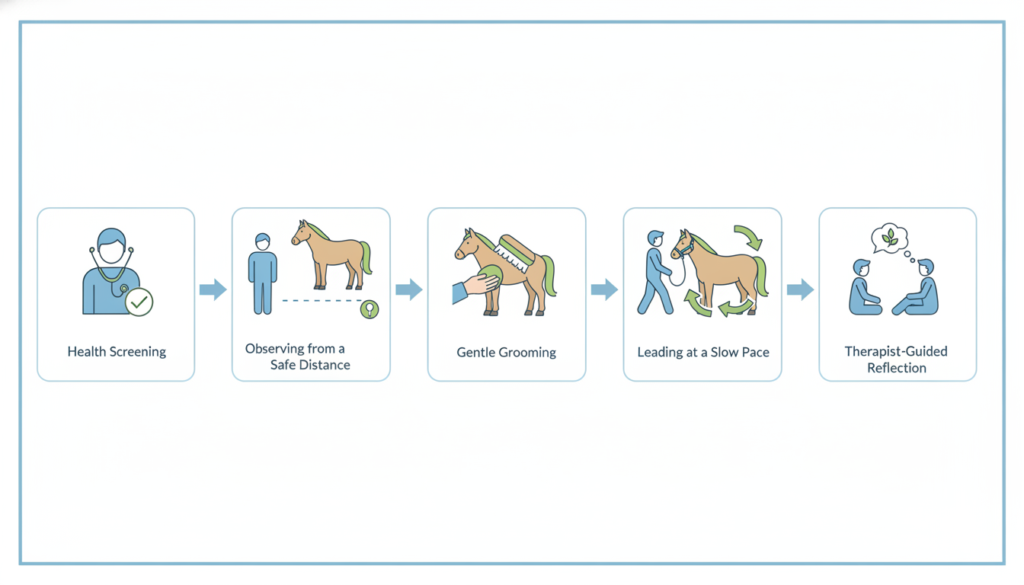
- Observing a calm horse from a safe distance before any contact
- Grooming, leading, or walking beside the horse at a comfortable pace
- Simple obstacle or teamwork tasks done together with the horse
- Guided reflection with a therapist connecting what happened to real life patterns
- Mounted work only when it fits the person’s goals and medical clearance
A systematic review of equine-assisted interventions found groundwork in every program it examined, while riding appeared in fewer than half. Ground-based work avoids the medical clearance and fall risk that come with mounted sessions, which makes early sessions accessible even for someone who has never been near a horse and feels anxious about the idea.
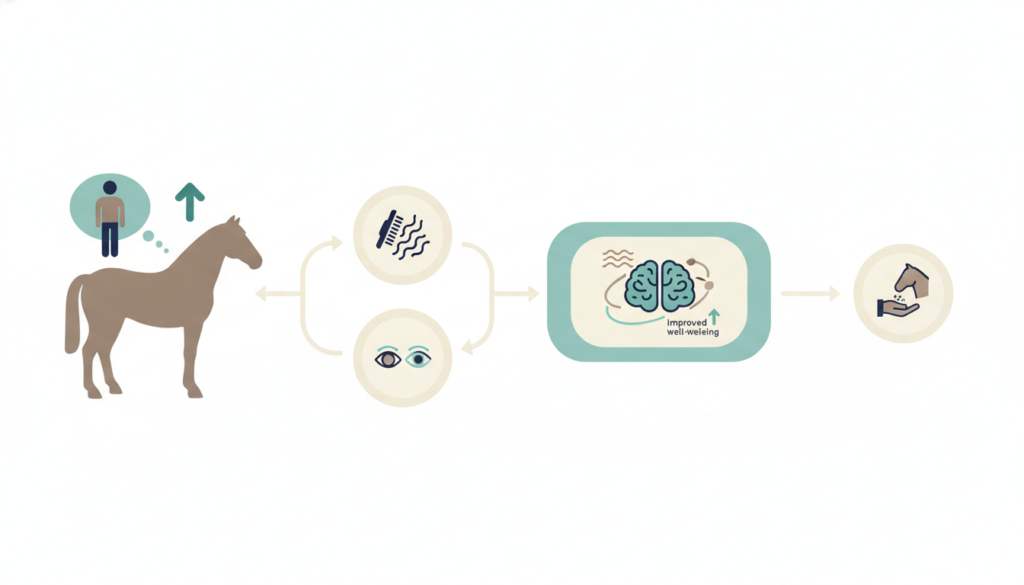
The Science Connecting Horses and Mental Health
Horses and mental health research overlaps most clearly at the point of emotion regulation, which is the ability to notice a feeling, tolerate it, and choose a response instead of reacting on autopilot. People who struggle with heavy emotions, including many with anxiety, depression, or a history of substance use, tend to score much worse on standard emotion regulation measures than people without those struggles. A large research review found a large gap between these groups, meaning emotion regulation is a fair and well supported target for any adjunct treatment, equine work included.
Separately, a broad meta analysis of behavioral treatments found a small but real improvement in emotional outcomes overall, and that programs teaching mindfulness or emotion focused skills directly produced bigger drops in negative emotion than programs that did not. That detail matters for equine work. A horse session that offers only a pleasant afternoon outdoors is unlikely to move the needle much. A session built around noticing bodily tension, naming feelings, and practicing a slower response has a much clearer path to the outcomes people actually want from treatment.
Does Equine Therapy Actually Help Depression
So does equine therapy help depression and anxiety in a way research can confirm. The honest answer is mixed, and anyone weighing whether horse therapy for depression is worth trying deserves that honesty up front. A 2022 scoping review of equine assisted services for substance use disorders found only nine usable studies worldwide, with wildly different formats, session lengths, and outcome measures, which makes broad claims about effectiveness hard to support.
The strongest controlled test to date, a randomized trial comparing horse assisted therapy plus usual care against usual care alone, did not find a statistically meaningful difference in treatment completion, dropout, or time in treatment. Attendance at the horse sessions was also low, which complicates the picture further. Earlier observational research had looked more promising, but without random assignment it cannot rule out the chance that more motivated or more stable participants simply chose the horse program in the first place.
There is more encouraging news on specific symptoms. An open label controlled study of hospitalized adults with substance use disorder found meaningful gains in emotion regulation, confidence in one’s own ability to cope, and self esteem when equine assisted therapy for anxiety was added to standard care. That study was not randomized either, so it should be read as a promising signal rather than final proof. Put plainly, equine assisted therapy for anxiety and depression can be a reasonable add on for the right person, but no study has shown it outperforms established anxiety and depression treatment on its own.
Grooming, Movement, and Emotional Regulation
A lot of the equine therapy mental health benefits people describe come from simple, repetitive activity rather than anything mystical. Grooming a horse involves steady, matched arm movement and close attention to texture and rhythm, which can work like a grounding exercise. Walking at a slow, matched pace beside a horse gives an anxious mind something concrete to focus on besides racing thoughts.
This kind of bottom up regulation starts with the body instead of starting with analysis or conversation. Anxiety is not only a thought pattern. It shows up as tight shoulders, shallow breathing, and a restless need to move. Depression often shows up as heaviness and low motivation to do much of anything. A grooming task or a short walk with a horse gives a person something achievable to do with their hands and feet while a therapist helps them notice what is happening inside.
Over several sessions, that noticing can become a portable skill. A person might carry it into an argument, a craving, or a hard morning outside the barn, using the same slow breath and paced movement they first practiced next to a calm, patient animal.
Safety, Screening, and Realistic Expectations
Horses are large animals, and any responsible program screens people carefully before contact begins. Staff typically ask about balance problems, seizure history, pregnancy, current intoxication, withdrawal symptoms, and any medication that affects coordination or judgment. Medical clearance matters even more when riding is part of the plan.
Official program standards call for staff to understand precautions and contraindications for each participant, and to explore ground based alternatives whenever mounted work is not appropriate for someone’s health or history. A session should never pressure someone to touch or approach a horse before they feel ready, and a person should always be able to step back without being treated as though they failed the exercise.
It is also worth setting expectations honestly from the start. Equine therapy for depression or anxiety is not a quick fix, a substitute for medication when medication is needed, or proof that someone is broken if a horse reacts a certain way during a session. The horse is a partner in the exercise, not a diagnostic tool, and a good therapist will say so plainly.
Is Horse Therapy Right for You
Horse therapy for anxiety tends to fit best for people who shut down in a typical office visit, who describe their feelings in words but cannot seem to locate them in the body, or whose depression has made ordinary routines feel impossible to restart. It can also help people who simply respond better to a hands on, outdoor activity than to sitting and talking through a session.
It is a poor fit as a stand-alone treatment for severe depression, active suicidal thinking, unmanaged psychosis, or acute withdrawal, all of which need direct medical and psychiatric care first. Used well, alongside proper diagnosis, medication when needed, and ongoing therapy, equine work can give someone a concrete, memorable way to practice regulation, connection, and small daily wins. That combination, more than the horse itself, is usually what moves people forward over time.
If anxiety, depression, or a substance use struggle has made it hard to know where to start, talking with a team that treats the whole picture at Thoroughbred Wellness and Recovery can help you find the right mix of care, including options like equine assisted therapy alongside proven mental health treatment.


 Give Us A Call


