
 info@thoroughbredbhc.com
Attorneys facing substance misuse often hide their struggles behind professional competence until crisis forces disclosure.
Georgia’s Lawyer Assistance Program offers confidential support through a 24/7 hotline, six prepaid clinical sessions, and digital tools, yet no public data show how many lawyers with severe alcohol or opioid problems actually use it.
This article examines whether Georgia’s LAP design and national success metrics suggest the state is reaching its highest‑risk attorneys or leaving them behind.
What National Research Shows About Lawyer Substance Use?
The legal profession has a documented substance misuse problem. A landmark 2016 study involving 19 states, including Georgia, found that 21% of licensed attorneys qualified as problem drinkers, 28% struggled with depression, and 19% showed anxiety symptoms. Younger lawyers in their first decade of practice had the highest rates, with 28% demonstrating problematic drinking.
The same research identified the biggest barrier to seeking help: fear of others finding out and confidentiality concerns. That fear matters because it determines whether lawyers will use assistance programs at all.
Opioid misuse receives less attention in lawyer‑specific studies, but adjacent research on health care professionals suggests 10 to 15% will misuse substances during their careers. For both populations, untreated substance use threatens not only the professional but also clients and public safety.
How Georgia’s Lawyer Assistance Program Works?
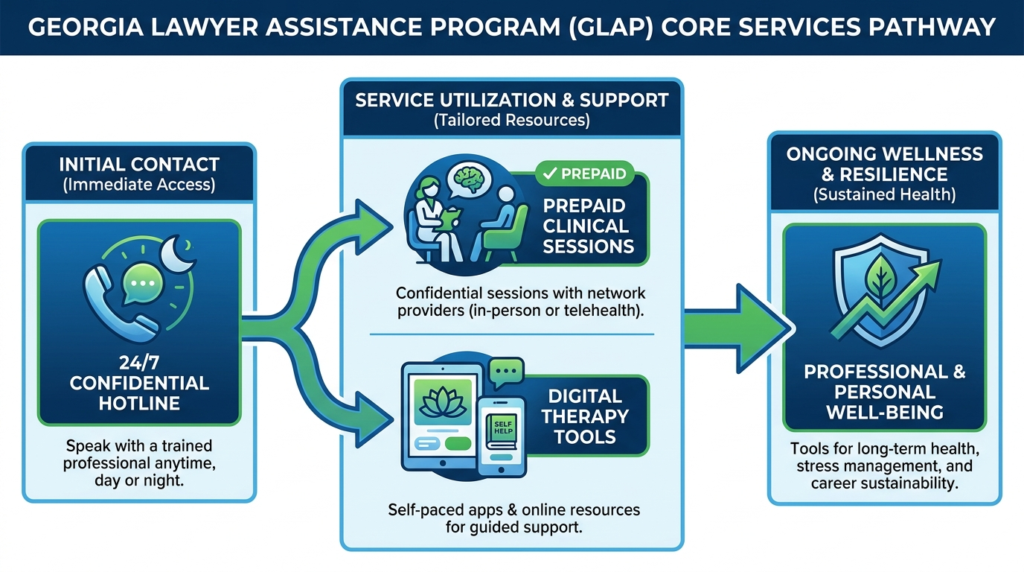
Georgia’s LAP is a confidential member service administered through SupportLinc and CuraLinc Healthcare. The program provides State Bar members with six prepaid clinical sessions per calendar year, accessible via a 24/7 hotline at 800‑327‑9631, email, or web portal.
Core Services Available
The program addresses stress, anxiety, depression, substance abuse, family problems, and workplace conflicts. Members can access:
- 24/7 confidential hotline staffed by trained counselors
- Real‑time scheduling with licensed counselors
- Text therapy and digital cognitive behavioral therapy
- Virtual group support and mental health navigation tools
- Peer support through Georgia Lawyers Helping Lawyers
The digital platform includes tools specifically designed for substance use, sleep fitness, and stress management. Members can also contact the program by email at gabar@curalinc.com for lower‑barrier initial outreach.
Who Can Use the Program?
The service is offered exclusively to State Bar members and is not available to the general public. It is not a lawyer referral service. This restriction ensures confidentiality but also limits reach to attorneys who maintain active bar membership.
Georgia’s Strengths in Program Design
Georgia’s LAP has several features that likely improve early engagement:
Low Financial Barrier
Six prepaid sessions eliminate cost as an obstacle to first contact. Members do not need insurance approval or upfront payment to begin counseling.
Multiple Access Points
The 24/7 hotline, web portal, email, text therapy, and peer support create multiple pathways for lawyers who may be reluctant to make a visible treatment contact. Digital tools allow discreet access without calling from an office line.
Confidentiality Emphasis
The program is outsourced to an independent vendor partly to ensure confidentiality. This structural separation from bar disciplinary functions addresses one of the profession’s biggest help‑seeking barriers.
Peer Support Component
Georgia Lawyers Helping Lawyers provides profession‑specific empathy and credibility. For some attorneys, peer conversation may be the decisive factor in entering or staying in recovery‑oriented care.
Where Georgia’s Public Evidence Falls Short?
Despite strong access features, Georgia’s LAP has a critical transparency gap. The state publishes no data on:
- Annual intakes or unique users
- Percentage of participants presenting with substance use disorders
- Counseling uptake or session completion rates
- Referrals to specialized addiction treatment
- Abstinence, relapse, or return‑to‑practice outcomes
- Trends over time
Without these metrics, it is impossible to determine whether the program is reaching a meaningful share of distressed lawyers, serving mostly low‑acuity wellness users, or capturing only a small self‑selected subset.
Why This Matters for High‑Risk Attorneys?
If roughly one in five lawyers nationally qualifies as a problem drinker, Georgia’s bar membership likely includes thousands of attorneys at risk.
The absence of utilization data means the state cannot show whether its highest‑risk members are being reached at adequate scale.
Six prepaid sessions and digital tools are well suited to early‑stage distress and moderate substance‑related problems.
They are less likely to be sufficient for severe alcohol dependence or opioid misuse without strong referral pathways to specialized treatment. Georgia’s public materials do not demonstrate that such escalation is happening successfully.
Are the Highest‑Risk Attorneys Being Reached?
Based on the available evidence, the answer is probably not at adequate scale. That conclusion rests on five specific grounds.
The Prevalence Problem is Too Large
If national attorney problem drinking is around 21%, and younger lawyers are particularly vulnerable, then the at‑risk population is substantial. In the absence of Georgia utilization data, the default inference should not be that reach is adequate. It should be that adequacy is unproven.
Confidentiality Fear Suppresses Help‑Seeking
The 2016 study identified fear of disclosure and confidentiality concerns as major barriers. Georgia’s confidential design helps, but there is no evidence the state has measured whether those barriers are actually being overcome.
Severe Substance Use Requires More Than Low‑Intensity Support
Evidence from health care professionals strongly suggests that specialized treatment and monitoring improve outcomes for professional populations. Georgia’s public‑facing model is excellent for entry‑level support but may not, by itself, indicate robust capture of the most severe cases.
States That Measure Outcomes Look More Credible
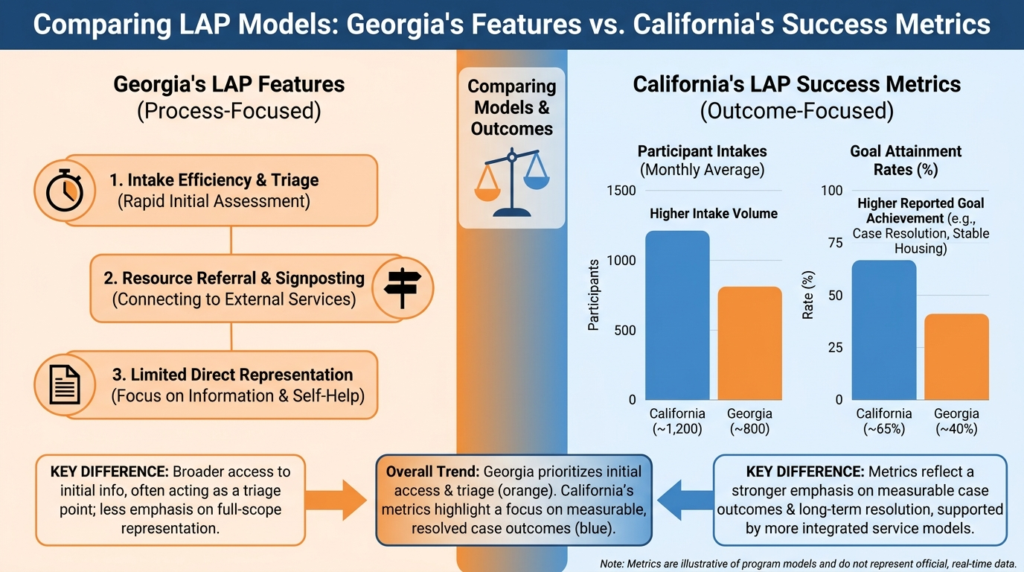
California reports intakes, closed cases, goal attainment, and redesign efforts tied to recidivism. Georgia publishes no comparable evidence. That lack of transparency is not neutral; it materially weakens any claim that high‑risk lawyers are being reached.
General Wellness Framing Can Miss Concealed Addiction
A program that invites members to seek help for stress, family issues, and workplace conflict may lower stigma and is therefore valuable. But it may also function primarily as a general support program unless accompanied by strong screening and referral metrics.
What Success Rates Actually Show?
Direct outcome data for lawyer assistance programs are rare. Among the sources reviewed, California provides the clearest picture.
According to California’s 2019 annual report, the state LAP served 164 new participants and 296 total participants that year. Among 172 closed cases, 31% ended with participants meeting their stated program goals, while 17% were not admitted and two were terminated for noncompliance.
Participant reasons for entering the California program were revealing:
- 40% substance use disorder
- 29% mental health issue
- 30% both substance use and mental health
California also reported participation in a redesign project aimed at reducing recidivism and better protecting the public, suggesting the state recognized that traditional service models needed stronger performance measurement.
By 2022, California logged 172 new intakes, showing continued demand and utilization tracking over time.
What Adjacent Evidence Reveals?
Because lawyer‑specific outcome data are limited, research on health care professionals offers useful comparison.
Hazelden Betty Ford Foundation studies found that 96% of health care professionals subject to random drug testing remained drug free, compared with 64% not subject to mandatory testing. Among those who completed treatment requirements, 95% were licensed and actively working at five‑year follow‑up.
These figures suggest that specialized treatment combined with structured monitoring can produce high abstinence and return‑to‑practice outcomes in licensed professional populations.
The research also found no significant difference in outcomes between self‑referred and board‑coerced participants, indicating that the threat of losing licensure can motivate treatment adherence.
What Georgia Should Do Next?
The evidence supports several practical steps for Georgia and similarly situated jurisdictions.
Publish Annual Utilization and Outcome Reports
Georgia should publish, at minimum, annual intakes, unique users, presenting problem categories, number referred to external treatment, percentage engaging beyond first contact, closed cases, and goal attainment. California’s reporting model is imperfect but materially superior to no outcome reporting.
Separate Wellness Use From Substance‑Use Intervention Metrics
Georgia’s broad well‑being framing is useful, but it obscures whether the highest‑risk subgroup is being reached. Reporting should distinguish stress and wellness users from alcohol and substance users and co‑occurring cases.
Publicly Document Referral Pathways for Severe Addiction
The Georgia LAP page should clearly explain what happens after the six prepaid sessions when a lawyer presents with probable alcohol dependence, opioid misuse, relapse risk, or functional impairment.
Add Public Evidence of Specialized Attorney Addiction Partnerships
Research indicates that professional populations benefit from specialized treatment structures that address licensure and reputation concerns. Georgia should show whether such pathways exist.
Why This Matters?
Lawyer assistance programs are not cosmetic wellness perks. They exist because untreated impairment can injure both lawyers and the public.
The American Bar Association’s Commission on Lawyer Assistance Programs frames its mission as ensuring that judges, lawyers, and law students can access support when confronting alcoholism, substance use disorders, or mental health issues, with the dual aim of supporting recovery and protecting the public.
Georgia has built a strong access platform. Confidentiality, six prepaid sessions, digital access, and peer support are all smart design choices. But design quality is not the same as demonstrated reach or success.
The most likely reality is partial reach: a competent front door without sufficient public proof of deep penetration into severe alcohol or opioid misuse cases. That matters because in this field, lack of evidence is not a minor administrative gap. It is a strategic blind spot.
When one of the profession’s best‑established risks is hidden drinking and concealed distress, a state bar cannot responsibly assume its highest‑risk members are being reached simply because a hotline exists. It must show the numbers.
Moving Forward
Georgia’s Lawyer Assistance Program is probably reaching some attorneys who are distressed, some who are willing to seek confidential help early, and probably some with substance‑related problems. But there is no public evidence that it reaches the highest‑risk group at adequate scale or with demonstrably effective intensity.
The strongest direct LAP outcome evidence comes from California, where annual reports show real utilization, measurable closures, and a nontrivial share of closed cases ending with participants meeting stated goals. California’s reports also show a mature understanding that LAP effectiveness should be evaluated with performance metrics and recidivism reduction goals, not just counseling counts.
For Georgia attorneys facing severe alcohol or opioid misuse, the current program offers a valuable first step. But without transparent reporting, stronger referral pathways, and evidence of specialized treatment partnerships, the state cannot credibly claim it is adequately serving the lawyers most at risk.
If you or someone you know is struggling with substance use and needs specialized, confidential support beyond what a general assistance program can provide, consider reaching out to Thoroughbred Wellness and Recovery’s addiction counseling designed for working professionals who need both clinical expertise and discretion.


 Give Us A Call


