
 info@thoroughbredbhc.com
Families searching for equine therapy often face a frustrating gap between clinical promise and insurance reality. Most major health plans classify hippotherapy and equine-assisted services as investigational or complementary medicine, triggering automatic denials when billed under equine-specific codes.
However, when licensed therapists integrate equine movement into medically necessary occupational, physical, or speech therapy, and code those sessions using standard therapy CPT codes, many insurers will cover the service, provided documentation and medical necessity requirements are met.
This article explains how equine therapy coverage actually works, what sessions typically cost, which coding strategies succeed, and how to navigate denials and out-of-network penalties to access care.
What Determines Whether Equine Therapy is Covered by Insurance?
Insurance coverage for equine-assisted interventions hinges on how the service is defined, delivered, and coded, not simply on the presence of a horse. Hippotherapy is a treatment tool used within occupational therapy, physical therapy, or speech-language pathology by licensed clinicians to address functional motor, sensory, balance, and communication goals.
It is not a standalone service. When therapists manipulate equine movement to elicit therapeutic responses aligned to measurable outcomes, the session is billed using standard therapy CPT codes that reflect the skilled intervention, such as therapeutic exercises or neuromuscular reeducation, rather than an equine-specific code.
In contrast, equine-assisted psychotherapy may qualify under psychotherapy CPT codes when delivered by licensed mental health professionals and when session content and time meet psychotherapy criteria.
Equine-assisted learning and therapeutic riding are typically educational or recreational programs led by instructors or coaches, and they fall outside covered healthcare benefits.
The critical distinction is professional licensure, clinical goals, documentation, and correct coding. Payers reimburse covered professional services, not tools or settings.
Major Payer Positions on Hippotherapy and Equine-Specific Codes
Aetna’s Clinical Policy Bulletin 0151 explicitly classifies hippotherapy as experimental, investigational, or unproven for all listed indications and all other indications, citing insufficient evidence of effectiveness.
This blanket investigational label drives denials across Aetna’s lines of business unless a contractual exception applies.
Multiple Blue Cross Blue Shield plans adopt similar stances. Blue Cross Blue Shield of Mississippi deems hippotherapy investigational and explicitly lists HCPCS S8940, the code for equestrian or hippotherapy per session, as investigational.
Blue Cross Blue Shield of Texas policy THE803.022 also classified hippotherapy as experimental, investigational, or unproven before the policy became inactive in June 2025, indicating the service remains noncovered under other frameworks.
Medicare does not have a National Coverage Determination for hippotherapy, and S-codes like S8940 are generally unrecognized by Medicare.
Medicare Advantage plans frequently mirror Original Medicare’s coverage scope and exclude complementary and integrative services, making S8940 claims nonpayable in those plans as well.
The operational effect is clear: billing hippotherapy using equine-specific codes results in automatic denials based on code categorization, regardless of clinical documentation or medical necessity arguments.
How Much Does Equine Therapy Cost Per Session?
Equine-assisted services carry higher overhead than traditional clinic-based therapy due to horse care, facility costs, specialized staffing, liability insurance, and continuing education.
These structural costs drive market prices above typical talk-therapy benchmarks.
Typical U.S. cash price ranges by service type are:
- Hippotherapy: $120 to $250 per session
- Equine-assisted psychotherapy: $90 to $200 per session
- Therapeutic or adaptive riding: $40 to $90 per lesson
- Equine-assisted learning: $50 to $100 per individual session
These ranges vary by staffing model, facility type, session format, and regional cost of living.
Industry education platforms and advocacy organizations report that families frequently rely on Medicaid waivers, VA programs, grants, or school partnerships as alternative funding when insurance denies coverage.
Hidden Clinical Fees and Structural Overhead
Horse welfare is an embedded, ongoing cost that does not map to CPT codes and remains unreimbursed. Feed, veterinary care, farrier services, tack, conditioning, and rest are substantial and continuous expenses.
Equine facility access, arena maintenance, and specialized liability coverage for animal-assisted environments add further fixed costs.
Many sessions require a licensed clinician plus an equine specialist and sometimes side-walkers for safety, increasing personnel cost per hour compared with a single-clinician office visit.
Professional development and certification, such as PATH International’s Equine Specialist in Mental Health and Learning workshop at $650 plus related travel and food, adds to fixed overhead spread across sessions.
These structural realities explain why cash rates for equine-assisted therapy sit at the upper end of therapy pricing and why diversified funding streams are essential for program viability.
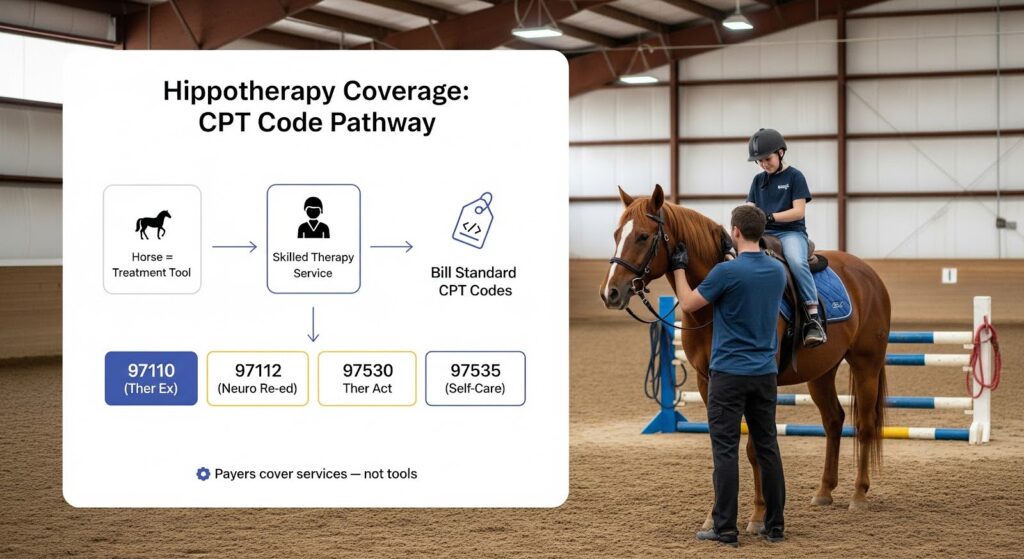
The CPT Code Pathway: How Hippotherapy Can Be Covered as Standard Therapy?
The American Hippotherapy Association clarifies that hippotherapy is not a distinct service line but a treatment tool within covered therapy services.
When medically necessary occupational, physical, or speech therapy is delivered by licensed therapists, documented under a plan of care with measurable goals, it should be coded using standard therapy CPT codes, because the clinical service is therapy, regardless of the tool used.
In this framework, the horse is analogous to other therapy tools such as therapy balls or swings, albeit with unique biomechanical properties.
This is not a semantic dodge. It is a coding alignment: payers do not pay for tools; they pay for covered professional services. When a licensed therapist furnishes medically necessary therapy services, the appropriate CPT code describes the clinical work, not the device or setting.
Common CPT code families relevant to therapy using equine movement include therapeutic exercises, neuromuscular reeducation, therapeutic activities, and self-care or home management training.
These are time-based codes billed in 15-minute units and subject to Medicare’s National Correct Coding Initiative edits. Therapy claims to Medicare and aligned commercial payers require discipline-specific therapy modifiers: GP for physical therapy, GO for occupational therapy, and GN for speech-language pathology.
Documentation Essentials to Sustain Payment
To sustain payments under therapy benefit rules, documentation should include a clear diagnosis with functional impairments amenable to therapy, a plan of care with measurable and time-bound functional goals, objective baseline and progress measures, rationale for using equine movement relative to the goals, description of skilled therapist interventions, assessment of response, and plan for the next session. Safety screening and risk mitigation given the nontraditional venue should also be documented.
The presence of a horse or barn is not the service; the skilled therapeutic process is. Documentation must foreground clinical reasoning, not recreational participation.
Equine-Assisted Psychotherapy and Psychotherapy Code Requirements
Equine-assisted psychotherapy may qualify under psychotherapy CPT codes when delivered by licensed mental health professionals and when session content and time meet psychotherapy criteria.
Federal Medicare billing guidance defines time-based psychotherapy without evaluation and management services as 16 to 37 minutes for CPT 90832, 38 to 52 minutes for CPT 90834, and 53 or more minutes for CPT 90837. Documentation must include start and stop times or total time, and psychotherapy of less than 16 minutes cannot be reported.
Psychotherapy codes are payable in all settings, so a barn or arena is permissible if clinical content and documentation requirements are met. However, non-psychotherapy activities, such as teaching grooming, recreational or experiential content without therapeutic processing, or safety tasks, cannot be counted toward psychotherapy time.
This is vital in equine-assisted sessions where horsemanship and safety tasks consume substantial minutes, potentially reducing billable psychotherapy time bands. For example, a 60-minute session with 20 minutes of grooming and setup may yield only 40 minutes of psychotherapy content, qualifying as CPT 90834 instead of 90837.
Billing resources aligned with payer expectations stress that 90834 typically pays 70 to 80 percent of a 90837 session, incentivizing accurate time documentation and session design that maximizes psychotherapy content.
Add-on psychotherapy codes paired with evaluation and management services are restricted to physicians, physician assistants, nurse practitioners, and clinical nurse specialists.
Psychotherapy time must be documented separately from evaluation and management time, and most behavioral health professionals cannot use these add-on codes.
Why Therapy Visit Caps and Out-of-Network Penalties Compress Revenue?
Even when clinical coding is appropriate, administrative constraints and network status can limit reimbursement. Cigna’s Occupational Therapy policy limits outpatient occupational therapy to a maximum of four timed codes, about one hour, per date of service, capping revenue per encounter regardless of equine overhead.
Reimbursement occurs only when claims include covered diagnosis and procedure codes under the plan; services billed without covered codes are denied.
Programs that are out of network may face reduced allowed amounts, balance billing complexities, and lower collection rates. Equine-specific codes like S8940 are commonly denied outright, shifting the entire cost to families.
Denials are more likely when documentation fails to segregate psychotherapy time from equine activities or when therapy plans of care do not clearly tie interventions to functional goals.
The mismatch between equine overhead and therapy code ceilings implies that sustainable programs will price cash services at the high end of national ranges and build diversified funding pipelines.
Attempting to rely solely on insurance reimbursement, especially under out-of-network penalties and unit caps, is, in most local markets, not viable.
Equine Therapy Insurance: Practical Billing and Appeals Strategies
Correct coding posture is essential. Bill standard therapy CPT codes aligned to the skilled intervention and documented functional goals; do not code hippotherapy as a distinct service.
Equine-specific labels and codes trigger investigational denials across major payers.
For psychotherapy, design sessions to maximize psychotherapy content time, ideally 53 or more minutes for CPT 90837 when clinically appropriate, and clearly exclude non-psychotherapy activities from timed documentation.
Document start and stop times or total time, and ensure session notes reflect psychotherapy content, not horsemanship education.
For occupational, physical, or speech therapy, engineer care plans to ensure each 15-minute unit reflects distinct skilled interventions tied to goals, improving defensibility and unit capture within plan caps.
Always append discipline-specific therapy modifiers and apply distinct service modifiers only when documentation supports separate, non-overlapping services in the same session.
Appealing Denials and Verifying Coverage
If claims are denied for missing modifiers, correct with the appropriate therapy modifier and resubmit. If denied for bundling, provide annotated time logs and distinct goals to justify separate codes.
When appealing investigational denials, argue that the clinical service is standard therapy or psychotherapy, not equine therapy, and provide plan-of-care evidence. Cite the American Hippotherapy Association’s position that hippotherapy is a therapy tool within scope, not a separate service.
Before beginning treatment, verify coverage by contacting the payer to confirm whether the specific therapy CPT codes and diagnosis combinations are covered under the member’s plan.
Ask whether there are visit limits, prior authorization requirements, or site-of-service restrictions. Do not assume equine-specific codes will pay; if the payer mentions S8940 or hippotherapy by name, clarify that the service will be billed as standard therapy using therapy CPT codes.
Equine Therapy CPT Code: Selecting the Right Codes for Reimbursement
The viable billing path for hippotherapy is to integrate equine movement into medically necessary therapy plans and code standard occupational, physical, or speech therapy procedures that match documented goals and skilled interventions. Common CPT codes include:
- 97110 – Therapeutic exercises to develop strength, endurance, range of motion, and flexibility
- 97112 – Neuromuscular reeducation of movement, balance, coordination, kinesthetic sense, posture, and proprioception
- 97530 – Therapeutic activities, direct one-on-one patient contact to improve functional performance
- 97535 – Self-care or home management training
These codes are billed in 15-minute units and require discipline-specific modifiers. Documentation must support the time billed and the skilled nature of the intervention.
The horse’s movement is manipulated by the therapist to elicit specific therapeutic responses aligned to measurable functional goals; this clinical rationale must be clear in the plan of care and session notes.
For psychotherapy, the primary codes are CPT 90832, 90834, and 90837, based on time bands. Family psychotherapy codes 90846 and 90847 require at least 26 minutes and do not include consultation with paid staff. Group therapy is coded as 90853, with interactive complexity add-on 90785 if medically necessary.
Do not use HCPCS S8940 unless a plan explicitly covers it, which is rare. S8940 functions as a denial trigger under investigational and complementary medicine policies across major payers.
Cost of Equine Therapy: Balancing Cash Pricing and Insurance Reimbursement
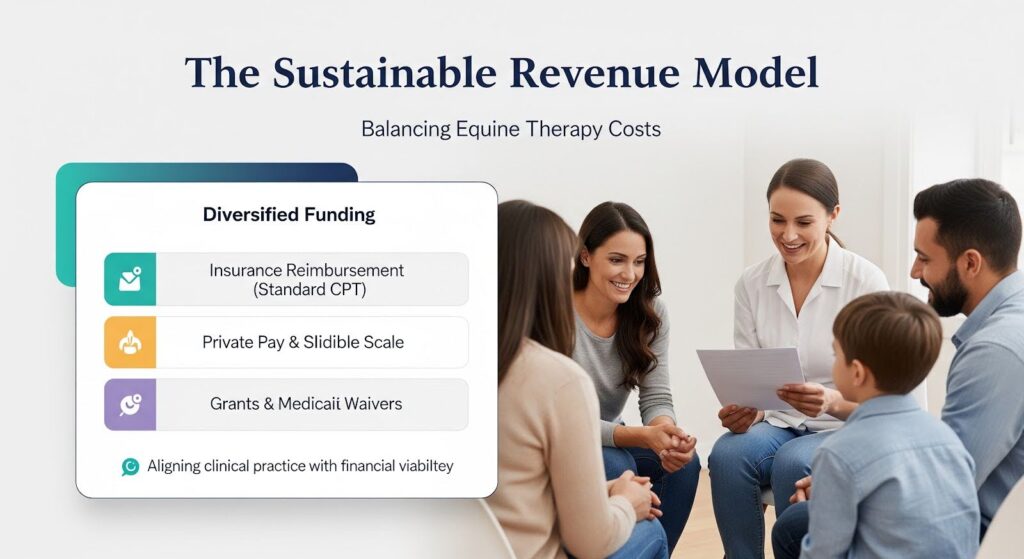
Given current payer positions and coding constraints, sustainable reimbursement for equine-assisted therapy hinges on coding strictly within covered benefit frameworks, setting cash prices at the upper end of published ranges to reflect true overhead, and diversifying funding through Medicaid waivers, VA programs, grants, and school partnerships.
Programs that rely on hippotherapy-specific codes or attempt to count horsemanship as psychotherapy time face chronic underpayment or denials.
Transparent communication with families about pricing, value, and funding options is essential. Offering sliding scale or scholarship slots supported by grants and external funding protects access while maintaining financial viability.
Equine-assisted therapy delivers unique clinical benefits, but the economics require careful alignment of clinical practice, coding discipline, and diversified revenue streams.
The structural mismatch between equine overhead and therapy code ceilings means that cash rates for equine-assisted psychotherapy and hippotherapy sit above typical talk-therapy rates, and programs must plan accordingly.
Finding Equine-Assisted Therapy That Accepts Insurance
When searching for equine-assisted therapy, ask providers whether they are in network with your insurance plan and whether they bill therapy or psychotherapy CPT codes rather than equine-specific codes.
Verify that the clinician is a licensed occupational therapist, physical therapist, speech-language pathologist, or mental health professional, as licensure is essential for insurance coverage.
Request a superbill or detailed invoice that includes CPT codes, diagnosis codes, dates of service, and provider credentials.
This documentation is necessary for submitting claims to insurance or appealing denials. Confirm whether the program requires prior authorization or a physician referral, as some plans mandate these steps for therapy services.
If you are seeking equine-assisted therapy as part of a comprehensive treatment plan for substance use or co-occurring mental health disorders, look for programs that integrate holistic modalities within evidence-based care.
Thoroughbred Wellness & Recovery in Marietta, Georgia, offers equine-assisted therapy alongside dual diagnosis treatment, individual and group counseling, and trauma-focused therapies, all delivered by licensed professionals within a continuum of care that includes detox, inpatient, partial hospitalization, intensive outpatient, and standard outpatient programs.
If you or a loved one is navigating the intersection of addiction, mental health, and innovative therapies like equine-assisted work, reach out to explore Thoroughbred’s treatment options that honor both clinical rigor and compassionate, personalized support.


 Give Us A Call


