
 info@thoroughbredbhc.com
Gabapentin can reach your bloodstream within hours, but that is not the same as pain relief. For most people with neuropathic pain, meaningful improvement usually takes days to weeks because the dose must be gradually increased to a level that actually works. This article walks you through the real timeline, explains how gabapentin works in the body, and helps you understand why the answer differs depending on your condition, kidney function, and dose.
How Long Does Gabapentin Take to Work?
For immediate-release gabapentin in adults with normal kidney function, side effects like dizziness or drowsiness can appear on the first day, some sensory symptoms may shift within several days, but a fair assessment of neuropathic pain relief generally requires a 4 to 6 week trial that includes at least one to two weeks at the highest tolerated dose.
That gap between “drug in the body” and “pain actually better” confuses a lot of people. You feel the medication quickly, but you may not feel it helping quickly. Understanding why that happens starts with how gabapentin works.
How Does Gabapentin Work in the Body?
Gabapentin binds to the alpha-2-delta subunit of voltage-gated calcium channels in the central nervous system. This reduces the release of excitatory neurotransmitters involved in neuropathic pain signaling. It is a neuromodulatory effect, not a direct painkiller effect like an opioid or anti-inflammatory drug.
That distinction matters. Because gabapentin works by gradually calming overactive pain signals rather than blocking them outright, it needs consistent, scheduled dosing to build up its effect. Taking it occasionally or at low doses often produces little to no pain benefit.
Immediate-release gabapentin is absorbed through a saturable transporter system in the upper gut. As the dose rises, the body absorbs a smaller proportion of each dose. This is why gabapentin is typically split into multiple daily doses rather than taken as one large amount, and why simply doubling the dose does not double the effect. Pharmacokinetic research confirms that immediate-release, gastric-retentive, and extended-release formulations produce meaningfully different exposure patterns and are not interchangeable milligram for milligram.
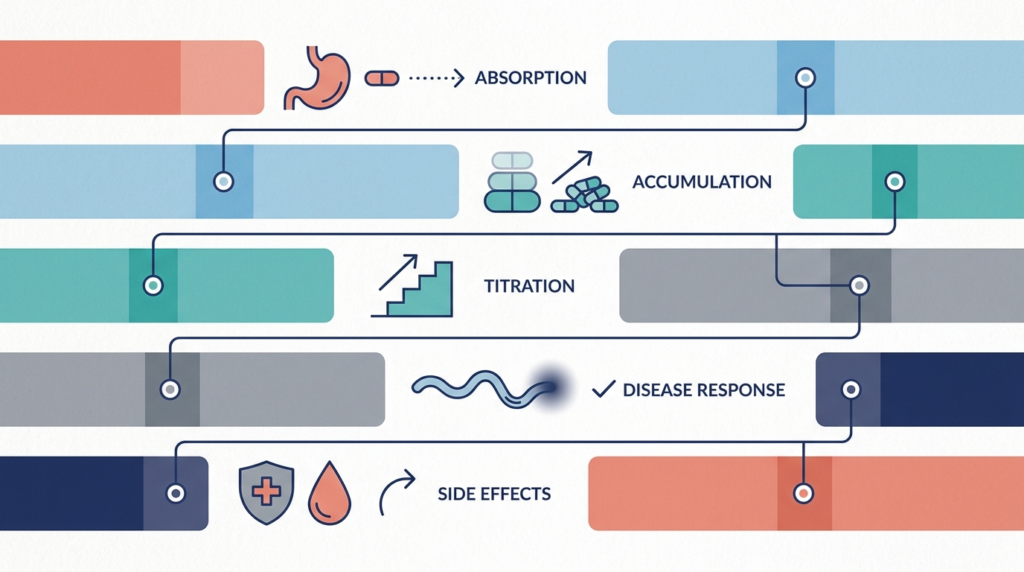
How Fast Does Gabapentin Work: The Five Timelines
There is no single answer to how quickly gabapentin works because five overlapping processes govern the experience.
Absorption: Peak blood levels arrive in about 2 to 3 hours after an immediate-release dose. This is when early side effects like drowsiness, dizziness, or unsteadiness tend to appear.
Accumulation: With a half-life of roughly 5 to 7 hours in adults with normal kidney function, repeated doses build up over the first few days. In people with reduced kidney function, this clock stretches dramatically, up to about 52 hours when creatinine clearance falls below 30 mL/min, according to FDA prescribing information.
Titration: Most people start at a low dose and increase gradually. The analgesic dose is often far higher than the starting dose, so pain relief may not appear until the dose reaches a therapeutic range, which can take days to weeks.
Disease response: Neuropathic pain outcomes need time to observe. Sleep quality, burning sensations, and functional ability should be tracked over weeks, not after a single dose.
Safety: Sedation can appear immediately. Falls, cognitive changes, edema, and respiratory risks may emerge during titration or with long-term use, especially in older adults or people taking opioids.
These five timelines explain why patients, pharmacists, and clinicians often talk past each other. Each person may be describing a different clock.
How Long Does Gabapentin Work by Condition?
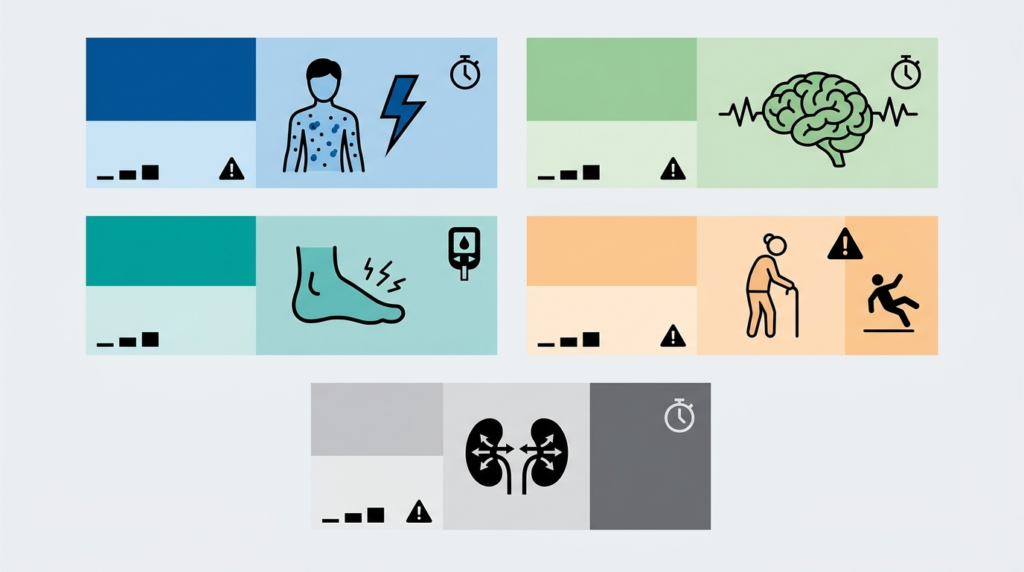
The timeline differs by condition because each one has a different target dose, different evidence strength, and a different acceptable speed of titration.
| Clinical context | When early effects may appear | When to judge meaningful benefit |
| Postherpetic neuralgia | Same day for side effects; pain may shift within days once scheduled dosing starts | After titrating toward 1,800 mg/day; usually within the first few weeks |
| Diabetic peripheral neuropathy | Sedation or dizziness same day; sensory changes within days | 4 to 6 weeks, including about 2 weeks at the maximum tolerated dose |
| Partial-onset seizures | Drug exposure within hours; steady levels within days | Seizure frequency assessed over weeks to months |
| Older adult or frail patient | Side effects may appear quickly and be more dangerous | Longer trial needed because dose increases must be slower |
| Reduced kidney function | Effects may last much longer due to accumulation | Slower, lower dosing; judge only after renal-adjusted steady exposure |
Postherpetic Neuralgia: The Clearest Timeline
Gabapentin has FDA approval for postherpetic neuralgia in adults, and the labeled titration schedule is relatively fast. The FDA-approved schedule starts at 300 mg on day one, 300 mg twice daily on day two, and 300 mg three times daily on day three, then titrates as needed up to 1,800 mg per day.
This means some people with postherpetic neuralgia may begin noticing improvement within the first week, once they reach 900 mg per day and continue toward 1,800 mg per day. Clinical studies showed efficacy across 1,800 to 3,600 mg per day, but additional benefit above 1,800 mg per day was not clearly demonstrated for postherpetic neuralgia in those trials.
Broader Neuropathic Pain: Usually Longer
For neuropathic pain outside the postherpetic neuralgia schedule, many clinicians start lower, often 100 to 300 mg per day, and increase by 100 to 300 mg every one to three days. Palliative care guidance describes usual effective total daily dosing as 1,200 to 3,600 mg per day in three divided doses.
A common clinical mistake is judging gabapentin ineffective before the patient reaches a therapeutic dose. A patient taking 100 mg nightly has not had a valid failure trial. Many reports that “gabapentin did not work” are actually dose-titration failures, not true pharmacologic failures.
A neuropathic pain algorithm recommends trialing gabapentinoids for 4 to 6 weeks, with two weeks at the maximum tolerated dose, before declaring failure. If there is no meaningful relief or intolerable side effects, the guidance supports adjusting the dose, stopping, switching to another first-line agent, or considering combination therapy.
Epilepsy: Drug Exposure Is Fast, Outcome Assessment Is Slow
For adjunctive treatment of partial-onset seizures in patients aged 12 and older, the FDA recommends starting at 300 mg three times daily, with titration up to 600 mg three times daily. The maximum gap between doses should not exceed 12 hours, reflecting the need for consistent antiepileptic coverage.
Drug exposure begins within hours. But seizure control is measured statistically over time. A fair assessment of seizure frequency requires weeks to months of observation, not a single dose.
How Soon Does Gabapentin Work: What Patients May Notice
Most people experience gabapentin before they benefit from it. Drowsiness, dizziness, and unsteadiness often appear on the first day, before any pain relief is obvious. This is one reason people stop early: they feel side effects within hours but do not yet feel better.
Here is a rough guide to what may happen and when:
- First dose to first day: Sleepiness, dizziness, or lightheadedness. This is pharmacologic activity, not proof of pain benefit.
- Days 2 to 7: Some people notice better sleep or less burning and shooting pain, especially if the dose has reached 900 mg per day. Others only notice side effects.
- Weeks 1 to 2: More meaningful neuropathic symptom changes may emerge if the dose has reached a therapeutic range.
- Weeks 4 to 6: A reasonable point to judge most neuropathic pain trials if the maximum tolerated dose has been tested.
- Beyond 6 to 8 weeks: Continued titration may be justified only if there is partial benefit and good tolerability.
If gabapentin is stopped, it should be tapered gradually. The FDA recommends reducing over at least one week, and some guidance suggests slower individualized tapering, such as 5 to 10 percent of the current dose every two to six weeks, with reductions generally not exceeding 300 mg in one week.
Why Kidney Function Changes Everything
Gabapentin is eliminated almost entirely unchanged by the kidneys. This makes kidney function the single most important biological factor in how long gabapentin works, how it accumulates, and how safe it is to use.
In adults with normal kidney function, the half-life is about 6.5 hours. In people with creatinine clearance below 30 mL/min, that half-life can stretch to about 52 hours. The drug does not necessarily take longer to start working, but it accumulates more slowly and lasts far longer, which means side effects can build up over days and persist long after a dose.
A simulation study in adults aged 65 and older found that using MDRD-based eGFR rather than Cockcroft-Gault creatinine clearance produced 37 percent higher gabapentin dose recommendations in older patients. This matters because many older adults have reduced kidney function even when their lab values look near normal. Using the wrong equation can lead to excessive dosing, which then causes confusion, dizziness, or falls that get mistaken for the disease rather than the drug.
Older adults also face higher risks from gabapentin because the central nervous system becomes more sensitive to sedating medications with age. A 2022 longitudinal study found that gabapentin initiation was significantly associated with clinically meaningful decline in cognitive and functional status and increased falls in cognitively normal older adults.
Safety Effects Often Appear Before Benefit
The most common early adverse effects include somnolence, fatigue, dizziness, ataxia, peripheral edema, and cognitive slowing. These may appear before any analgesic benefit is obvious, which creates a clinical paradox: the patient experiences gabapentin immediately but does not experience it as helpful immediately.
There is also a serious respiratory risk. The FDA warns that breathing difficulties may occur in patients using gabapentin who have respiratory risk factors, including opioid use, other CNS depressants, COPD, and older age. The MHRA similarly warns that gabapentin has been associated with severe respiratory depression even without opioids, with higher-risk groups including people with respiratory disease, neurological disease, renal impairment, or CNS depressant use.
This means that in high-risk patients, the answer to “how quickly can we titrate?” should often be: more slowly than the pain alone would suggest.
Gabapentin Is Not a PRN Painkiller
One of the most important practical points from pharmacy guidance is that gabapentin should be taken around the clock rather than as needed. Appropriate dosing guidance emphasizes that intermittent dosing commonly leads to treatment failure because the neuromodulatory mechanism requires sustained exposure to work.
This also means that if a patient misses midday doses consistently, they may experience end-of-dose failure that feels like the medication wearing off or stopping work. Before concluding that gabapentin has failed, it is worth checking whether the dosing schedule has been followed as prescribed.
When Gabapentin May Not Be the Right Choice
Evidence for gabapentin is strongest for postherpetic neuralgia and diabetic peripheral neuropathy. For other pain conditions, the picture is less clear. Australian Prescriber notes that gabapentinoids are commonly used outside approved indications despite limited support, especially for chronic nonspecific back pain and nonradicular leg pain.
NICE found insufficient evidence for gabapentin in sciatica and noted expert concern about its use in that condition. If gabapentin was started for a condition with weak evidence, waiting longer may not improve the outcome. A 6 to 8 week trial for nonspecific low back pain is not equivalent to a 6 to 8 week trial for postherpetic neuralgia, because the expected probability of benefit differs.
If gabapentin is not working after a fair trial at an adequate dose, the most evidence-aligned next steps are switching to another first-line agent such as duloxetine or a tricyclic antidepressant, adding a medication from a different class at a lower dose, using topical options for localized pain, or deprescribing if the risks outweigh the benefits.
A Practical Summary
Gabapentin works by calming overactive pain signals in the nervous system, not by blocking pain directly. It reaches the body within hours, but meaningful neuropathic pain relief usually requires days to weeks of scheduled, titrated dosing. For postherpetic neuralgia, the FDA titration can reach a potentially therapeutic dose within the first week. For broader neuropathic pain, a fair trial generally takes 4 to 6 weeks. Kidney function, age, dose, and the specific pain condition all shape how quickly and how well it works.
The most common mistake is judging gabapentin ineffective too early, at a dose that was never high enough to work. The second most common mistake is continuing it too long without measurable benefit. A structured approach, with a clear diagnosis, a renal-appropriate dose, gradual titration, and a predetermined reassessment point, gives gabapentin the best chance of helping while keeping the risks manageable.
If you or someone you care about is navigating prescription medication concerns alongside substance use or mental health challenges, the team at Thoroughbred Wellness and Recovery can help. Reach out today to learn about dual diagnosis treatment and find a path forward.


 Give Us A Call


