
 info@thoroughbredbhc.com
Choosing inpatient rehab for drug or alcohol addiction is a major decision, and one of the first questions people ask is how long does inpatient rehab last.
Most U.S. inpatient and residential addiction programs are structured around 30, 60, or 90 days, with the typical stay lasting 30 to 90 days depending on individual needs.
This article explains what determines your length of stay, what happens during each phase, and how to know when you’re ready to step down to outpatient care.
What Inpatient Rehab Actually Means?
Before we talk about duration, it helps to clarify what inpatient rehab includes. In everyday language, people use “inpatient rehab” to describe any live-in addiction treatment.
Clinically, the U.S. system distinguishes between hospital-based inpatient care for acute medical needs and residential treatment, which provides 24-hour structured support in a non-hospital setting.
Most people asking about inpatient rehab are actually asking about residential treatment, which typically lasts 30 to 90 days.
Residential treatment includes withdrawal management if needed, individual and group therapy, psychiatric care for co-occurring conditions, medication management, psychoeducation, relapse prevention planning, and discharge coordination.
The goal is not just to stop using substances but to address the underlying drivers of addiction and build a foundation for long-term recovery.
The 30/60/90-Day Framework
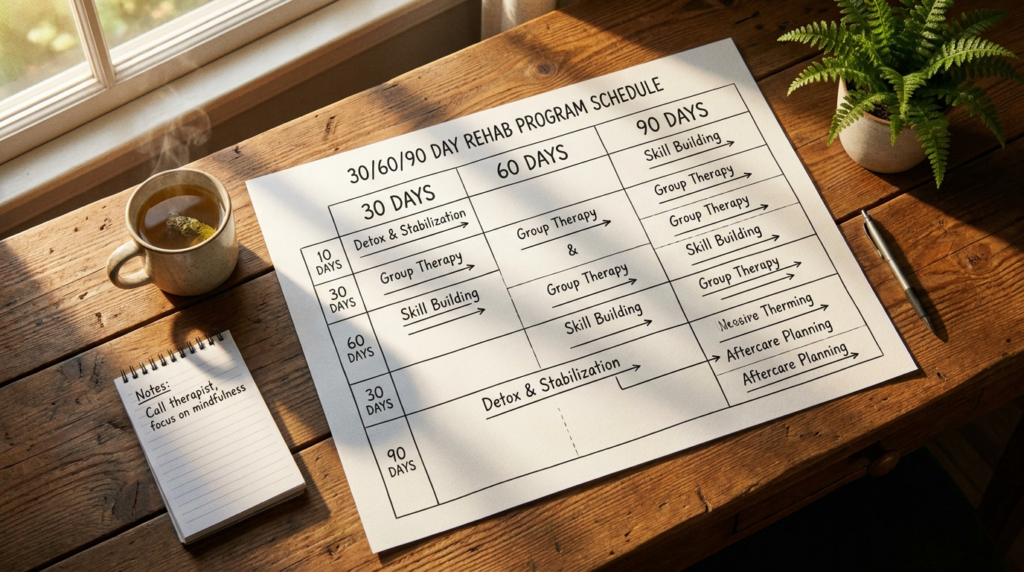
U.S. addiction treatment programs are commonly organized into 30-, 60-, and 90-day tracks. These durations are not arbitrary.
They reflect common insurance authorization cycles, treatment planning milestones, and the time needed for different levels of clinical complexity.
30-Day Programs
A 30-day program is often the baseline. It typically includes detox if needed, stabilization, therapy initiation, and discharge planning.
This duration works well for people with mild to moderate substance use disorder, strong family support, stable housing, and no major psychiatric complications.
The main limitation is that 30 days may not be enough time to address deeper trauma, chronic relapse patterns, or co-occurring mental health conditions.
60-Day Programs
Sixty days allows more time to consolidate recovery after the initial stabilization phase. This middle option is often appropriate for people with prior relapse, unresolved trauma, co-occurring anxiety or depression, or weaker recovery supports at home.
The extra month creates space for deeper therapeutic work, family engagement, and more realistic discharge planning.
90-Day Programs
Ninety-day programs are typically reserved for severe or complex cases. Research on justice-involved pregnant women found that staying 91 days or longer was associated with much higher odds of treatment completion compared with stays under 30 days.
This suggests that crossing the 90-day threshold may be clinically meaningful for retention and completion, especially in high-risk groups.
A 90-day stay allows time for comprehensive psychiatric treatment, repeated relapse prevention rehearsal, family reintegration, and gradual step-down transitions.
What Determines How Long You Stay?
While 30/60/90-day structures are common, the clinically appropriate duration depends on individual factors.
The American Society of Addiction Medicine framework, which is the dominant U.S. standard for placement and continued-stay decisions, uses six dimensions to assess need: withdrawal risk, biomedical conditions, psychiatric conditions, readiness to change, relapse potential, and recovery environment.
Detox Time
Detox is the first phase, not the whole treatment episode. Medically supervised withdrawal typically lasts 3 to 7 days, depending on the substance, withdrawal severity, and medical complications. Completing detox does not mean you’re ready to leave.
Withdrawal management addresses acute physiological instability, but residential rehab addresses broader relapse risk, behavioral patterns, psychiatric symptoms, and environmental safety.
Addiction Severity
Severity is one of the strongest predictors of how long inpatient rehab lasts. Higher severity generally means greater craving, more entrenched use patterns, greater functional impairment, and slower stabilization.
People with chronic relapse, overdose history, or inability to abstain outside controlled settings often need 60 to 90 days or longer.
Co-Occurring Mental Health Conditions
Co-occurring psychiatric disorders are among the clearest reasons inpatient rehab may last longer. Research shows that co-occurring mental illness is associated with substantially lower odds of treatment completion.
Dual-diagnosis patients often need more integrated, sustained care because psychiatric instability can increase suicide risk, impulsivity, and relapse risk. Medication adjustments may require close monitoring, and unresolved anxiety, depression, trauma symptoms, or psychosis can undermine readiness for outpatient care.
Recovery Environment
Your living situation matters. If you’re returning to a home with active substance use, unsafe relationships, or no social support, you may need a longer residential stay or a step-down arrangement involving sober housing.
The ASAM framework explicitly includes recovery environment in its placement model because even strong clinical progress can unravel quickly in an unsafe environment.
Treatment Progress
The most clinically legitimate determinant is how you respond to treatment. You should remain in inpatient care while you continue to meet criteria for that level and step down when acute instability has improved, participation is established, relapse prevention planning is workable, psychiatric and medical needs are sufficiently controlled, and a lower level can safely sustain gains.
Alcohol Rehab vs Drug Rehab Duration
People often ask whether alcohol rehab lasts longer than drug rehab or vice versa. The answer is that both use the same 30/60/90-day structures, but the clinically appropriate duration can differ by substance due to withdrawal risk, medication options, and relapse patterns.
Alcohol withdrawal can be medically dangerous, so detoxification may require close monitoring. Once stabilized, many people with mild to moderate alcohol use disorder may move through standard residential timelines, especially if they have supportive post-discharge conditions.
Drug rehab covers a wide range: opioids, benzodiazepines, stimulants, cannabis, and polysubstance use. High-dose benzodiazepine use, polysubstance use, or prior withdrawal seizures may require inpatient or medically managed residential initiation due to 24-hour nursing and medical care. For opioid use disorder, residential duration may be only one part of care, since medication treatment often continues far beyond the residential stay.
Polysubstance use is especially important because it tends to increase withdrawal complexity, medication interactions, psychiatric burden, and relapse risk. The evidence does not support a simple rule like “alcohol rehab is 30 days” or “drug rehab is 90 days.”
Both commonly use 30/60/90-day structures, but drug-related cases, particularly opioid, benzodiazepine, or polysubstance cases, more often raise issues that favor higher-acuity placement or longer total treatment engagement.
Does Longer Treatment Work Better?
The evidence on outcomes is nuanced. Research suggests that longer treatment often performs better, particularly for retention, completion, and high-complexity cases. But the strongest support is for longer treatment engagement overall, not always longer residential stay alone.
A study of justice-involved pregnant women found that staying 91 days or longer was associated with much higher odds of treatment completion versus stays under 30 days.
Participation in self-help groups was also associated with higher odds of completion, while co-occurring mental illness reduced completion odds. This combination of findings links duration, peer support, and dual diagnosis within one outcome framework.
Other research suggests that staying through the first 30 to 60 days, and especially at least 45 days, is associated with better outcomes, while some analyses found no further significant improvement beyond 90 days in certain populations.
The strongest clinically defensible target is not “as long as possible,” but “long enough to achieve meaningful stabilization and engagement, typically at least several weeks, often 30 to 60 days for appropriate residential patients, with extension beyond that when ongoing clinical indicators justify it.”
Why 30 Days is Common Even When It May Not Be Optimal?
Thirty-day treatment has deep operational and historical roots. It is easy to package and market, easier to staff and cycle beds around, and often aligns better with insurance authorization patterns than open-ended care.
Multiple sources state explicitly that the prevalence of 28- to 30-day treatment is often driven by insurance coverage rather than individualized clinical optimality.
By the time you detox, complete intake, begin group and individual therapy, start medications if needed, and reach discharge planning, a 30-day episode may leave limited time for deeper work, especially if you have trauma, psychiatric disorders, chronic relapse, social instability, or significant skill deficits. This is not an argument against 30-day rehab. It is an argument against treating it as universally sufficient.
Thirty days should be understood as a common initial treatment episode, sometimes sufficient for lower-complexity cases, often insufficient as a standalone treatment for severe or chronic cases, and best viewed as one part of a broader continuum.
How Insurance Shapes Inpatient Rehab Duration?
Clinical need does not operate in a vacuum. In the United States, actual inpatient rehab length is often shaped by prior authorization, concurrent review, medical-necessity criteria, continued-stay documentation, network status, facility-type limitations, and benefit design.
The Mental Health Parity and Addiction Equity Act generally bars plans offering mental health and substance use disorder benefits from imposing more restrictive financial requirements or treatment limitations on those benefits than on comparable medical and surgical benefits.
The law also applies to nonquantitative treatment limitations such as prior authorization, medical management, and standards that limit the scope or duration of services, including facility-type limits and network adequacy.
Many disputes over residential substance use disorder treatment concern whether detox is approved but residential days are denied, whether continued-stay reviews are more frequent or stricter than for medical and surgical admissions, whether “fail first” or “least restrictive” logic is applied more harshly to behavioral health, or whether residential facilities are limited by network design or facility-type exclusions.
Insurance is not just a payment issue; it is a determinant of length of stay because it can shorten care through utilization management even when your clinical trajectory suggests ongoing need.
The Treatment Continuum: Why Inpatient Stay Cannot Be Evaluated in Isolation?
For serious substance use disorder, people are generally recommended to remain engaged in treatment for at least one year across multiple levels of care rather than treating detox or inpatient rehab as a standalone episode.
This is one of the most important facts in the evidence base. The implication is profound: even if inpatient rehab lasts only weeks, the total effective treatment duration should often be much longer.
Research on intensive outpatient programs explicitly concludes that engagement in longer, less-intensive services may have greater benefit than brief, intensive interventions without ongoing support, and that the important feature appears to be continuity of care over a long duration.

Recent research on community re-entry after residential treatment reinforces this. The transition back into the community is described as a vulnerable period, and continuity of care is identified as central to post-discharge recovery success.
A common pathway described in federal clinical guidance is 3 to 7 days of withdrawal management, 1 to 3 months of residential rehab, then intensive outpatient, then standard outpatient care.
This continuum approach reconciles two apparently conflicting findings: residential care may be necessary for safety and stabilization in severe cases, yet long-term outcomes often depend on what happens after discharge.
Step-Down Care After Residential Treatment
The evidence does not say inpatient duration is unimportant. It says inpatient duration should be evaluated as one segment of a broader care trajectory.
The wrong question is “How many days should rehab last?” The better question is “How many days of 24-hour care are needed before I can successfully continue at the next level?”
Outpatient systems commonly include partial hospitalization programs, intensive outpatient programs, extended outpatient care, aftercare, peer support, and ongoing counseling.
Research on recovery housing linked to outpatient treatment found that structured sober living was associated with longer overall lengths of stay in outpatient services, greater likelihood of satisfactory discharge, and support, structure, accountability, and recovery-skill practice.
Recovery housing paired with intensive outpatient may function as a clinically appropriate bridge, potentially preventing unnecessarily prolonged inpatient stays while still preserving structure.
When is Step-Down Appropriate?
Step-down is appropriate when acute withdrawal and medical instability are resolved, participation is consistent, you can use coping and relapse-prevention skills with support, co-occurring symptoms are sufficiently managed, partial hospitalization or intensive outpatient follow-up is active, and safe housing exists or recovery housing is arranged.
Extension of inpatient or residential care is strongest when lower levels remain unsafe or previously unsuccessful, psychiatric or medical instability persists, you still require 24-hour containment, housing is unsafe and no recovery housing is available, or discharge planning is not yet clinically feasible.
A Concrete Answer
Based on the strongest sources, the most evidence-supported approach is individualized care that secures at least adequate early retention, often around 30 to 60 days for those requiring residential treatment, while extending beyond that only when persistent withdrawal risk, psychiatric instability, failed lower levels of care, or an unsafe living environment continue to justify 24-hour structure.
The better long-term predictor of recovery is not maximizing inpatient days in isolation, but ensuring an unbroken step-down into partial hospitalization, intensive outpatient, outpatient care, medication treatment when indicated, and supportive housing or recovery monitoring.
This opinion is more justified than the two common but flawed alternatives. “Detox then discharge” is too short because detox addresses acute withdrawal, not the broader relapse, psychiatric, and environmental risks that drive early return to use.
“Ninety days for everyone” is too rigid because peer-reviewed evidence suggests early retention matters greatly, but benefits beyond 90 days may plateau for some populations, and many individuals can do well with lower levels of care if continuity and housing supports are in place.
Summary Table: Common Durations and Their Clinical Role
| Duration | Typical use | Typical patient profile | Key limitations |
|---|---|---|---|
| 30 days | Stabilization and foundation-building | Mild to moderate substance use disorder, stronger supports, first treatment episode | Often too short for severe substance use disorder or dual diagnosis |
| 60 days | Consolidation and deeper therapeutic work | Relapse history, unresolved trauma, co-occurring conditions | Still may be insufficient for severe chronic cases |
| 90 days | Higher-intensity extended treatment, stronger completion benchmark | Severe substance use disorder, chronic relapse, unstable environment, psychiatric comorbidity | Access and coverage barriers; not always necessary for all patients |
Final Thoughts
Inpatient rehab lasts until you no longer need 24-hour structured care and can safely continue recovery in a lower level of care with adequate supports. Detox time, addiction severity, mental health complexity, insurance rules, and treatment progress all matter, but continuity of care is the factor that best explains whether the chosen length will actually lead to durable recovery.
The U.S. addiction treatment industry still organizes inpatient and residential rehab around 30-, 60-, and 90-day packages, but this packaging is clinically secondary.
The most valid modern answer is that 30 days is the common operational baseline, 60 days is often more appropriate for people with unresolved psychiatric or relapse risks, and 90 days is a meaningful benchmark for high-severity cases, but the real standard is not fixed duration. It is assessment-based, continuously reassessed treatment across a continuum of care.
If you or someone you care about is considering inpatient rehab in Atlanta, the most important step is to seek a comprehensive assessment that evaluates all six dimensions of need: withdrawal risk, medical conditions, psychiatric conditions, readiness to change, relapse potential, and recovery environment.
That assessment will guide not only whether inpatient care is needed, but how long you should stay and what comes next. Recovery is not a calendar event. It is a process that unfolds over time, and the right length of stay is the one that gives you the best chance to build a foundation for lasting freedom.
If you’re ready to explore your options, reach out today to speak with Thoroughbred’s compassionate team that can help you find the right path forward.


 Give Us A Call


