
 info@thoroughbredbhc.com
Isotonitazene is a synthetic opioid that emerged in the illicit drug supply by 2019 and has since become one of the most dangerous substances in the ongoing overdose crisis.
This drug is often hidden in heroin, fentanyl, or counterfeit pills, meaning many people are exposed without knowing it. The evidence shows that isotonitazene can cause severe respiratory depression at very small doses, and standard drug tests frequently miss it.
This article explains what isotonitazene is, how it affects the body, why it is so dangerous, and what you need to know about overdose response and treatment.
What is Isotonitazene?
Isotonitazene belongs to a class of drugs called nitazenes, which are synthetic opioids derived from 2-benzylbenzimidazole.
The CDC describes nitazenes as novel synthetic opioids originally developed decades ago as possible pain medications but never approved for medical use in the United States.
These compounds were abandoned because early research showed extremely high potency, severe respiratory depression, and a very narrow margin between a psychoactive dose and a fatal dose.
Isotonitazene has no approved medical use and no recognized industrial purpose. It is structurally distinct from both morphine and fentanyl, which matters because this chemical novelty affects how the drug is detected by toxicology tests, how quickly it can be scheduled under drug laws, and potentially how it behaves in the body.
The drug first appeared in modern illicit markets in 2019. The European Monitoring Centre was first notified about isotonitazene in a biological sample in July 2019, and it has since been implicated in over 200 overdose deaths across Europe and North America. That number is likely an undercount because many laboratories do not routinely test for nitazenes.
By February 2026, the United Nations Office on Drugs and Crime reported that 34 nitazene analogues had been detected in at least 37 countries, underscoring the rapid global spread of this drug class.
How Isotonitazene Works in the Body?
Isotonitazene is a full opioid agonist, meaning it strongly activates mu-opioid receptors in the brain and body. These are the same receptors responsible for the effects of morphine, heroin, fentanyl, and prescription opioids. When isotonitazene binds to these receptors, it produces euphoria, pain relief, sedation, and respiratory depression.
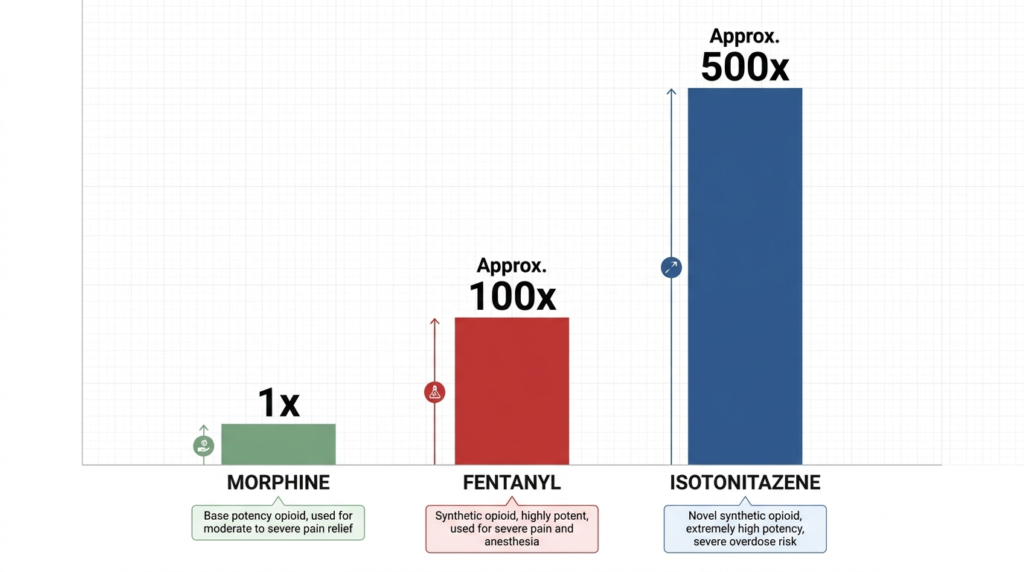
What makes isotonitazene especially dangerous is how efficiently it activates these receptors. Peer-reviewed signaling studies report that isotonitazene was about 500 times more potent than morphine and emphasized its dangerous high efficacy at the mu-opioid receptor. Another study found that isotonitazene had very high receptor affinity and in some assays was more than 100 times more potent than fentanyl in activating opioid pathways.
This extreme receptor-level potency means that very small amounts of isotonitazene can produce intense opioid effects. It also means the margin between a dose that produces euphoria and a dose that stops breathing is extremely narrow. That makes dosing precision in illicit manufacture extraordinarily difficult and increases lethality when the drug is substituted into counterfeit products.
One of the most concerning findings from recent research is that isotonitazene metabolites may also be pharmacologically active. Animal data cited in clinical reviews suggest that an isotonitazene metabolite caused greater respiratory depression and a longer return to baseline breathing than an equivalent amount of fentanyl.
This raises the possibility that some overdoses may be more prolonged or severe than fentanyl intoxication, and that the effects may not wear off as quickly as expected.
Isotonitazene Potency Compared to Fentanyl and Morphine
Understanding how potent isotonitazene is requires looking at different types of evidence. Potency claims vary across sources because they measure different things: receptor binding, animal studies, or clinical observations.
The most reliable summaries come from government and peer-reviewed sources. The CDC reports that some nitazene analogs, including isotonitazene, protonitazene, and etonitazene, have potency that greatly exceeds fentanyl.
A 2025 review presented a comparative table in which fentanyl was listed at about 50 times heroin potency, while isotonitazene was listed at about 250 times heroin potency, suggesting that isotonitazene may be approximately five times more potent than fentanyl in that framework.
Some commercial sources claim isotonitazene may be up to 20 times more potent than fentanyl or 500 times stronger than morphine, but these figures should be treated as secondary estimates rather than settled fact because they are not always transparently linked to primary data.
The exact numeric potency ratio matters less than the convergent conclusion from the stronger sources: isotonitazene is clearly a high-potency opioid that can exceed fentanyl in effect at low doses. The evidence is strong enough to reject any minimization of its lethality, even if precise potency multiples remain unsettled.
What makes this potency especially dangerous is that isotonitazene has a very narrow safe dose consumption range. A 2025 review states that the distance between an intended psychoactive dose and a dangerous respiratory-depressant dose may be extremely small. Combined with illicit production, where manufacturing precision is poor, this produces a structurally unstable overdose environment.
How Isotonitazene Enters the Drug Supply?
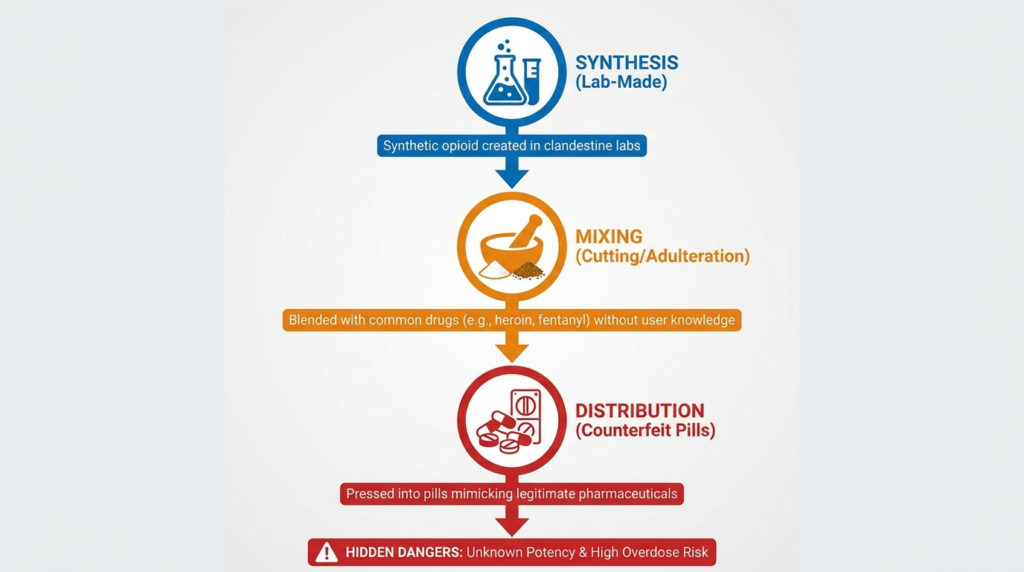
One of the most dangerous features of isotonitazene is that people are frequently exposed without knowing it. A peer-reviewed review reports that much of the isotonitazene sold on the street is not marketed as isotonitazene. The DEA found it was commonly used as a filler in heroin or sold in counterfeit opioid tablets such as fake hydromorphone, increasing the risk of unintentional exposure.
This theme appears repeatedly across the literature. Isotonitazene has been found:
- Mixed into heroin
- Pressed into counterfeit pills
- Sold as other opioids
- Present in products that users believe are something else
Counterfeit tablet contamination is especially concerning because it reaches people who may not identify as heroin users and may have lower opioid tolerance. DEA-related material notes isotonitazene encountered in counterfeit tablets marked “M30” or “M-8.”
Field and laboratory reports continue to show nitazenes in falsified pharmaceutical products. For example, Southern California drug checking identified nitazenes in counterfeit M30 pills in late 2025, indicating nitazenes in counterfeit oxycodone-style tablets in at least some U.S. markets.
The World Health Organization also reported that N-desethyl isotonitazene had been identified in falsified pharmaceuticals and linked to multiple deaths and hospital admissions.
Nitazenes may also appear in non-opioid mixtures. Reviews describe nitazenes as frequently mixed with fentanyl, heroin, methamphetamine, benzodiazepines, cocaine, and xylazine or misrepresented as prescription medications. This creates additional risk of unwilling ingestion by opioid-naïve people.
Hidden contamination is not merely a detection problem. It changes risk profiles in multiple ways. Opioid-naïve users may be exposed unexpectedly, tolerant users may misjudge potency, test methods may miss the analogue, and bystanders may delay recognition because they think the person took a non-opioid or a known pill.
This is why isotonitazene should be viewed as a market-structure hazard, not only a pharmacology hazard.
Isotonitazene Effects and Side Effects
Because isotonitazene is an opioid agonist, its acute effects largely resemble those of other opioids. The Alcohol and Drug Foundation lists the short-term effects of nitazenes as:
- Euphoria
- Relaxation
- Drowsiness and clumsiness
- Pain relief
- Reduced stress
- Itchiness
- Nausea and vomiting
- Fever and sweating
- Slow breathing
- Slow heart rate
The classic opioid toxidrome remains the most clinically useful framework for suspected isotonitazene intoxication: reduced consciousness or stupor, respiratory slowing or arrest, pinpoint pupils, blue or gray lips or skin, and non-responsiveness.
Colorado public-health educational summaries note that nitazene overdoses look like other opioid overdoses, including slowed or stopped breathing, loss of consciousness, pinpoint pupils, and blue or gray lips or fingernails.
Nitazenes can be injected, inhaled, swallowed, and in some reports vaped. The route matters because onset, peak effect, and overdose recognition may differ.
Injection may produce rapid onset and abrupt overdose, smoking or vaping may lead users to underestimate opioid exposure, and counterfeit tablets may delay recognition because ingestion may be assumed to involve prescription-strength dosing.
Nitazene cases often involve multiple substances, which can obscure symptom patterns. A 2025 review notes nitazenes are rarely encountered in isolation and are frequently mixed with fentanyl, heroin, methamphetamine, benzodiazepines, and xylazine.
This complicates clinical interpretation because stimulant co-use may temporarily mask sedation, while sedatives such as benzodiazepines or alcohol may amplify respiratory depression.
Isotonitazene Addiction and Dependence
The dependence risk of isotonitazene is best understood through standard opioid biology rather than through a separate unique addiction mechanism. Like other full mu-opioid agonists, isotonitazene strongly engages reward, analgesia, sedation, and withdrawal pathways.
The DEA states that because isotonitazene has an opioid pharmacological profile, frequent use may be associated with dependence, and substances acting as mu-opioid receptor agonists are well established to have high abuse potential.
A 2025 review similarly states that nitazenes, like other opioids, have a high potential for abuse and dependence through stimulation of the brain’s dopaminergic reward system.
Long-term nitazene effects are not well studied but are thought to be similar to other opioids, including increased tolerance and dependence.
This is clinically important because the same process that drives tolerance may also increase frequency of use and withdrawal avoidance, while tolerance to euphoric effects may not fully protect against respiratory depression, particularly when potency and batch variability are extreme.
Withdrawal symptoms after isotonitazene use have been documented in clinical settings. A 2025 clinical cohort from New South Wales identified seven acute withdrawals among 27 laboratory-confirmed nitazene exposures, demonstrating that withdrawal from regular nitazene opioid use is not merely theoretical but clinically observed.
Reported withdrawal symptoms include:
- Sweats
- Tremor
- Anxiety
- Nausea and vomiting
- Cravings
- Restlessness
- Runny nose
- Flu-like symptoms
These are broadly consistent with opioid withdrawal syndromes. Three features may make nitazene withdrawal especially difficult.
First, high potency means very small quantities can sustain physical dependence. Second, unknown analogue mixtures mean users may be dependent on more than one nitazene or additional opioids. Third, active metabolites or longer toxicity windows mean withdrawal onset and symptom pattern may be less predictable in some cases.
Isotonitazene’s addiction risk is probably at least as serious as its overdose risk in long-term public-health terms, because a drug that is highly potent, short on reliable self-dosing cues, and commonly hidden in adulterated supplies creates a powerful cycle of tolerance, withdrawal, redosing, and accidental poisoning.
Isotonitazene Overdose Risks
The overdose mechanism is fundamentally opioid-induced respiratory depression. A clinical review explains that nitazenes produce effects similar to any other opioid, including sedation and respiratory depression, and that morbidity and mortality are therefore due to hypoxia following hypoventilation and apnea.
Even experienced opioid users may misjudge isotonitazene risk because the substance may be hidden, the product may be counterfeit, the analogue may be stronger than expected, concentration within a batch may be uneven, and co-exposures may intensify sedation.
Evidence indicates a rapidly increasing fatal burden. A review reported that one surveillance interval identified 52 nitazene-involved fatal overdoses, with four times as many in 2021 as in 2020.
More broadly, the NFLIS database reportedly identified more than 4,300 reports of nitazenes since 2019 as of January 2024. Internationally, nitazenes have been implicated in a rising share of opioid-related deaths in several countries, and a 2026 Scientific Reports article describes them as a globally spreading threat with deaths in Europe, North America, and Australia.
The broader opioid market is becoming more chemically heterogeneous. CDC documentation on para-fluorofentanyl noted that it reemerged in heroin packets, counterfeit pills, and autopsy toxicology findings, demonstrating a more diverse and unpredictable illicit market.
Nitazenes are entering this already unstable environment rather than replacing fentanyl cleanly. That means users may face stacked opioid risks, not simply a switch from one substance to another.
Those at greatest risk likely include people using heroin or illicit opioids, users of counterfeit opioid tablets, opioid-naïve individuals exposed unintentionally, people combining opioids with alcohol, benzodiazepines, or other sedatives, and people using alone without naloxone access.
Signs and Symptoms of Isotonitazene Overdose
Overdose signs are those of severe opioid poisoning:
- Slow or shallow breathing
- Halting or stopped breathing
- Extreme drowsiness
- Non-responsiveness
- Pinpoint pupils
- Blue or gray lips or skin
- Passing out
- Coma
The Alcohol and Drug Foundation advises calling emergency services immediately if symptoms include slow or shallow breathing, bluish or greyish lips, passing out, coma, or death risk.
A 2025 cohort of laboratory-confirmed nitazene exposures found acute poisoning typically presented with sedation and hypoventilation, with severe cases requiring endotracheal intubation due to cardiac arrest and hypoxemia.
Because some nitazenes or metabolites may have prolonged effects, initial reversal does not eliminate danger. The same cohort concluded that ongoing monitoring is necessary to detect renarcotization after naloxone response. This aligns with broader review literature noting prolonged effects, repeated naloxone need, and occasional naloxone infusions.
Naloxone and Emergency Response
This is one of the most important high-confidence findings: naloxone works. The CDC states that naloxone can reverse nitazene-involved overdoses, though multiple doses may be required because of high potency. Reviews similarly state that nitazenes should respond to naloxone and that there is not an opioid naloxone has failed to reverse as of current review writing.
The reasons repeated naloxone may be necessary include high agonist potency, active metabolites, prolonged duration, co-ingestion of other depressants, delayed absorption in some formulations, and recurrent respiratory depression after initial improvement.
A 2025 review notes that because of high potency, slow dissociation from the mu-opioid receptor, and prolonged effects of active metabolites, higher or repeated doses of naloxone and sometimes continuous infusions may be required.
A 2025 scoping review of nitazene overdoses found limited data but concluded that most reviewed nitazene cases involved hospitalization, high naloxone dosing, and relatively long lengths of stay. Among the included cases, median total naloxone dose was 3.00 mg for isotonitazene, though sample size was small.
At the same time, a 2025 Australian cohort found that standard parenteral naloxone doses were typically effective, with a median reversal dose of 400 micrograms, though repeat dosing occurred in 45% of naloxone-treated cases.
These findings are not contradictory. They suggest that many cases respond to conventional naloxone, but recurrent or severe poisoning may require repeated doses or escalation.
The evidence supports the following objective conclusions:
- Use naloxone for any suspected opioid overdose involving nitazenes
- Do not assume one dose is enough
- Call emergency services immediately
- Provide rescue breathing or oxygenation support where possible
- Monitor for recurrent sedation or respiratory slowing after apparent reversal
Detection Challenges: Why Isotonitazene is Often Missed?
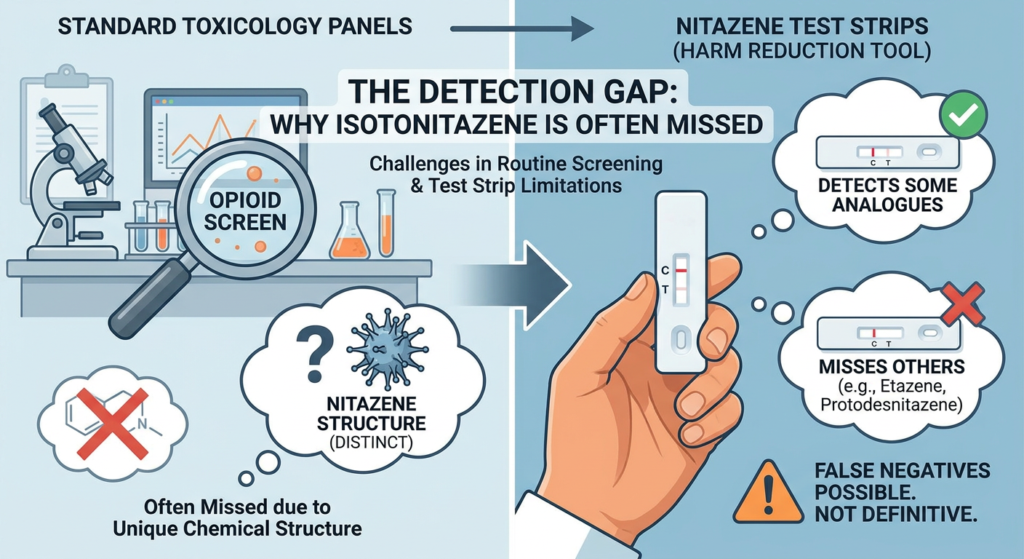
Nitazenes may evade routine toxicology panels. A clinical review notes their structures are distinct from morphine and therefore may not be identified by standard drug screens.
A broader review of drug testing in the era of new psychoactive substances explains that traditional immunoassays and even many targeted confirmatory mass spectrometry panels only detect substances they were specifically designed to detect.
Nitazene immunoassay strips are a major harm-reduction development, but the deeper evidence makes clear they are not definitive. A 2025 peer-reviewed evaluation found that commercial nitazene strips detected 28 of 36 nitazene analogs tested, meaning a substantial minority were missed. The reported limit of detection varied widely, from 250 ng/mL to 100,000 ng/mL, indicating uneven sensitivity depending on the analogue.
Isotonitazene itself was detectable by one strip at a reported limit of detection of 1,500 ng/mL, but several analogues were not detected at all, including metodesnitazene, etazene, protodesnitazene, and 5-aminoisotonitazene.
A 2025 systematic review reported that isotonitazene limit of detection was around 2,000 to 3,000 ng/mL, with lot-to-lot variation, and that 24 of 33 tested analogues cross-reacted at concentrations below or equal to 9,000 ng/mL, while some desnitazene derivatives had poor or no response even at high concentrations.
Two risks matter: false negatives and false positives. A negative strip does not rule out nitazene presence. This is one of the most important practical findings in the entire literature. False positives can occur as well.
The 2025 strip evaluation found caffeine-related false positives in seized heroin samples at high concentrations. NDEWS also reported that some Southern California field strip positives were not confirmed by lab testing and may have been associated with metamizole.
The systematic review found that in reviewed authentic drug-sample studies, all six tested real-world samples were positive with no false negatives reported, suggesting strips may be useful as a rapid field screen when followed by confirmatory mass spectrometry.
My concrete view is that nitazene test strips are worth using but dangerous to overtrust. A positive result is actionable; a negative result is not reassuring enough to support assumptions of safety. This is the most defensible interpretation of the higher-quality evidence.
Isotonitazene in the Context of the Broader Opioid Crisis
A common mistake is to think of fentanyl as the terminal stage of illicit opioid danger. The data do not support that view. CDC material has already shown that para-fluorofentanyl reemerged in heroin packets and counterfeit pills, indicating ongoing supply diversification. Nitazenes represent a further phase of diversification rather than an isolated anomaly.
Nitazenes emerged into a market already destabilized by illicitly manufactured fentanyl supplanting heroin and counterfeit pills becoming more common. Their entry intensifies three ongoing trends: more potent drugs, more counterfeit presentation, and more analytical uncertainty.
Nitazenes are not just stronger fentanyl-like drugs. They are structurally distinct, variably detectable, and rapidly proliferating as analogues. This matters clinically and operationally.
Routine screens miss them, some test strips miss entire subgroups, scheduling one analogue does not stop emergence of the next, and clinical familiarity lags behind market evolution. That is why several recent reviews describe nitazenes as a distinct and rapidly escalating public-health threat.
Treatment of Isotonitazene Addiction and Opioid Use Disorder
There is currently no large nitazene-specific body of long-term addiction treatment trials. However, current public-health guidance still supports the use of evidence-based opioid use disorder treatment principles.
The CDC’s 2024 OUD guidance emphasizes that opioid use disorder is a medical condition and that treatment is important to prevent overdose and death; treatment can help, and recovery is possible. CDC references continue to support buprenorphine and methadone as core evidence-based treatments for opioid dependence.
This is a key synthesis point: federal guidance is not nitazene-specific, but that should not be interpreted as a gap so large that treatment principles are unusable. Since isotonitazene is an opioid agonist causing opioid dependence, the best-supported inference is that standard opioid use disorder medications remain the most evidence-based available response, even if formal nitazene-specific trials are lacking.
SAMHSA’s rules and guidance have continued expanding flexibility for treatment access, including telehealth screening for buprenorphine and, under certain conditions, methadone initiation, reflecting efforts to improve access in an era of ongoing synthetic-opioid mortality.
Although medications remain foundational, nitazene dependence may complicate clinical management because of uncertain opioid exposure histories, polysubstance co-use, variable potency, potential prolonged withdrawal or toxicity, and incomplete toxicology detection. This argues for more individualized induction and monitoring, not abandonment of medication treatment.
My concrete conclusion is that buprenorphine and methadone should be offered aggressively, not cautiously, to people exposed to isotonitazene or other nitazenes, because the risk of untreated opioid use disorder in this drug environment is likely greater than the risk of withholding treatment due to uncertainty. The evidence may be indirect, but it is still stronger than any alternative strategy based on abstinence-only delay or purely symptomatic detox.
What You Need to Know: Key Takeaways
Based on the full evidence hierarchy, my valid and concrete conclusion is this: isotonitazene is one of the clearest examples of a next-stage opioid threat, not simply because it is potent, but because it combines extreme potency with concealment, analytical invisibility, and rapid analogue turnover. That makes it, in practical public-health terms, more destabilizing than many better-known opioids.
I do not think the evidence supports sensational claims that every isotonitazene exposure is categorically worse than fentanyl in every dimension. That would overstate the data. However, I do think the evidence strongly supports the judgment that isotonitazene is disproportionately dangerous because users frequently do not know they are taking it, emergency and laboratory systems may not immediately recognize it, and standard single-dose overdose expectations may underestimate recurrence or severity. That combination makes it a high-priority target for public-health action.
If reduced to the most important evidence-based takeaways:
- Isotonitazene is a very potent illicit opioid
- It often appears hidden in heroin, fentanyl products, or counterfeit pills
- It can cause severe respiratory depression and death
- Naloxone works, but more than one dose may be needed
- A negative test strip does not rule out nitazenes
- Addiction treatment works; buprenorphine and methadone remain central
- The best response is rapid overdose recognition, naloxone access, honest drug-checking communication, and expanded treatment access
If you or someone you know is struggling with opioid use or has been exposed to isotonitazene, remember we’re here to help. So, reach out to Thoroughbred Wellness and Recovery’s addiction treatment today to explore evidence-based care options that can support your lasting recovery.


 Give Us A Call


