
 info@thoroughbredbhc.com
Nitazenes are a rapidly expanding class of synthetic opioids now detected across at least 37 countries, often hidden in heroin, counterfeit pills, and even benzodiazepines.
Some analogues exceed fentanyl in laboratory potency by wide margins, yet the greatest danger lies not in molecular strength alone but in their stealth contamination of drug supplies where users may not expect opioids at all.
This article explains what nitazenes are, how they compare to fentanyl and morphine, what overdose symptoms look like, and why naloxone still works but may require repeated doses and longer observation.
What Are Nitazenes?
Nitazenes belong to the benzimidazole opioid family, a group of synthetic compounds first developed in the 1950s as potential analgesics.
Researchers at CIBA AG synthesized several nitazene compounds, including etonitazene and clonitazene, but abandoned them before clinical use because of extreme potency, severe respiratory depression, and an unacceptably narrow margin between therapeutic and toxic doses. For decades, nitazenes remained pharmacological curiosities with only isolated illicit appearances.
That changed in 2019 when isotonitazene was first reported to the United Nations Office on Drugs and Crime Early Warning Advisory. By early 2024, 13 nitazene analogues had been identified across six global regions.
By February 2025, that number rose to 26 substances in 30 countries. By February 2026, the UNODC documented 34 nitazene analogues across at least 37 countries, marking one of the fastest expansions of any synthetic opioid class in modern surveillance history.
Nitazenes are structurally distinct from both morphine-derived opioids and fentanyl analogues, which matters for two reasons. First, standard opioid immunoassays may fail to detect them.
Second, their chemical diversity allows clandestine producers to generate new analogues faster than regulatory systems can schedule them. This structural novelty creates detection gaps, legal lag, and incomplete cross-reactivity with field tests.
How Nitazenes Work: Mechanism and Pharmacology?
Nitazenes act primarily as strong agonists at the mu-opioid receptor, the same target responsible for the effects of morphine, heroin, and fentanyl.
Receptor profiling studies show that nitazenes are far more selective for mu-opioid receptors than for kappa- or delta-opioid receptors, with kappa potencies 7 to 7,920 times lower and delta potencies 24 to 9,400 times lower than mu potencies.
This intense mu-opioid receptor activation drives the core toxicology: analgesia, euphoria, sedation, respiratory depression, and overdose death through hypoventilation and apnea.
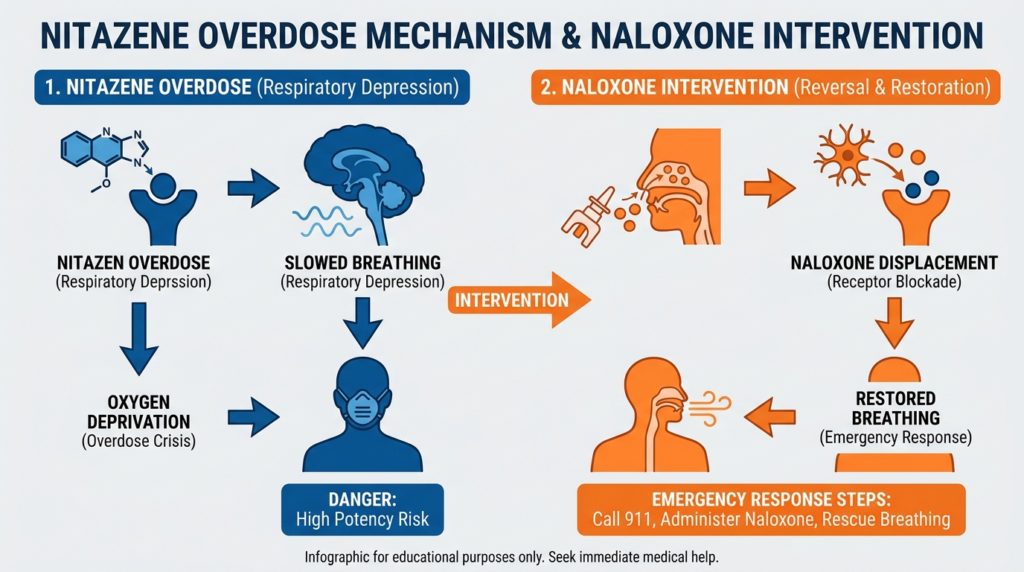
Because nitazenes produce opioid effects via the same receptor system as other opioids, their overdose mechanism is fundamentally familiar. The central danger is depression of respiratory drive leading to hypoxia, cardiac arrest, and death if untreated.
This is not a novel toxidrome requiring an entirely new clinical framework. The main emergency remains respiratory failure, and the main intervention remains restoring oxygenation and administering naloxone.
What distinguishes nitazenes clinically is not an exotic mechanism but rather duration and recurrence. Some nitazenes may have active metabolites that contribute to respiratory depression lasting longer than fentanyl at equivalent exposure.
This helps explain why some patients experience recurrent respiratory depression after initial reversal and why repeated naloxone doses or infusions are sometimes necessary.
Nitazenes Effects and Side Effects
As opioid agonists, nitazenes produce expected opioid effects including analgesia, euphoria, sedation, miosis, reduced respiratory drive, and decreased level of consciousness. These effects overlap heavily with fentanyl, heroin, and morphine, and there is no special nitazene toxidrome that bystanders can reliably distinguish in the field.
Non-overdose effects outside acute toxicity can include euphoria, relaxation, sedation or “the nod,” itching, nausea and vomiting, sweating or fever, slowed breathing and heart rate, constipation with repeated use, and tolerance and dependence over time.
However, the evidence base for long-term nitazene-specific side effects remains limited because these substances are not well studied in controlled human contexts. Most knowledge is extrapolated from opioid pharmacology and case reports rather than long-term cohort research.
What may distinguish some nitazene cases from routine heroin overdose is not unique symptoms but duration and recurrence. Reviews and advisories repeatedly note prolonged toxicity, repeat naloxone dosing, and the need for extended observation because respiratory depression may recur after initial reversal.
Nitazenes Potency Compared to Morphine and Fentanyl
Potency comparisons are the most requested and most misused part of the nitazene discussion. Potency can refer to receptor affinity, in vitro signaling, antinociceptive potency in animals, human clinical dose-response, or real-world lethality.
These are related but not interchangeable. The strongest evidence base currently consists of receptor studies and animal behavioral assays, while human data remain limited.
Potency Relative to Heroin and Morphine
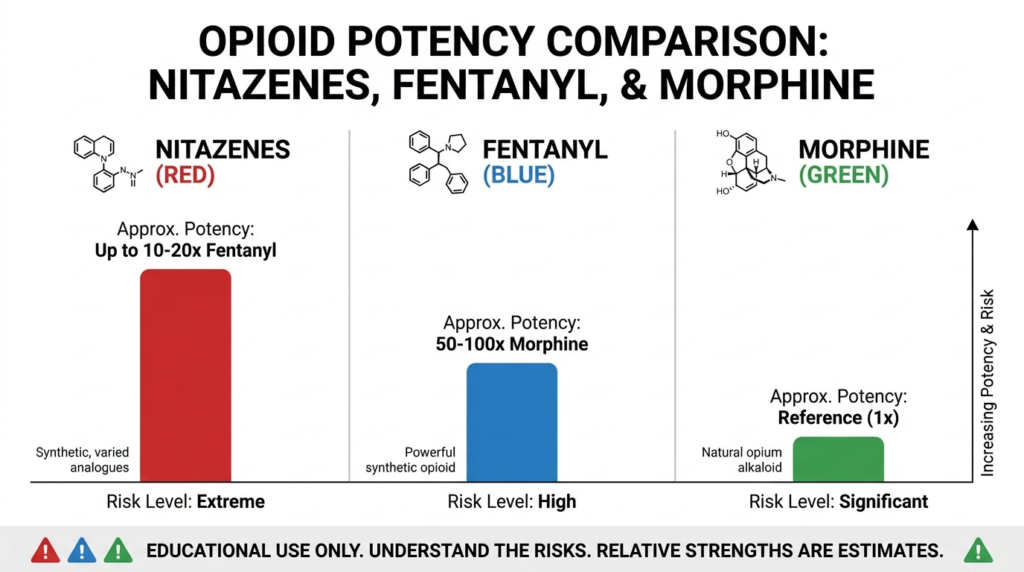
A 2025 review in *Substance Abuse Treatment, Prevention, and Policy* provides comparative values showing that fentanyl is about 50 times heroin potency, metonitazene about 100 times, protonitazene about 100 to 200 times, isotonitazene about 250 to 1,000 times, and etonitazene about 500 to 1,000 times heroin or morphine potency. Behavioral studies place isotonitazene around 3 times fentanyl and etonitazene around 10 to 12 times fentanyl in antinociceptive assays.
Four nitazenes with subnanomolar mu-opioid receptor potency have been identified: N-pyrrolidino etonitazene, N-pyrrolidino isonitazene, N-pyrrolidino protonitazene, and N-desethyl isotonitazene.
These compounds ranked among the most potent in receptor studies, indicating that newer analogues and metabolites may rival or exceed the already alarming potencies of earlier nitazenes.
Why Laboratory Potency May Overstate Human Risk?
The 2025 comparative pharmacology review cautions that human potency data are scarce and that in vitro potency can be much higher than apparent human in vivo potency.
Post-mortem concentrations for many nitazenes are similar to fentanyl, suggesting that in some real-world contexts their lethality may be comparable to fentanyl despite dramatic laboratory potency estimates. This is a crucial corrective to simplistic ranking claims.
The most accurate summary is that some nitazenes are markedly more potent than morphine and can exceed fentanyl, but nitazenes as a class should not be treated as having one fixed relationship to either drug.
The public health problem is not merely that some nitazenes exceed fentanyl; it is that the unregulated supply can contain compounds ranging from approximately fentanyl-like to far more potent, often without the user’s knowledge.
Are Nitazenes Stronger Than Fentanyl?
The question of whether nitazenes are stronger than fentanyl cannot be answered with a simple yes or no because nitazenes are a heterogeneous class spanning compounds below, around, and above fentanyl in potency. Some are less potent, some roughly similar, and some stronger.
Isotonitazene has been described around 3 times fentanyl in behavioral studies. Etonitazene is around 10 to 12 times fentanyl. Some newer analogues exceed fentanyl in vitro. However, the human review literature warns against assuming these ratios translate directly to overdose severity or naloxone resistance in clinical settings.
For scientific precision, nitazenes are best compared to fentanyl rather than morphine, because fentanyl is the current real-world synthetic opioid benchmark in illicit markets. But for communicating scale to non-specialists, morphine remains helpful.
The most concrete conclusion supported by the evidence is that the most concerning nitazenes and some metabolites clearly exceed fentanyl in preclinical potency, yet in actual overdose management, many nitazenes may behave as fentanyl-like or somewhat worse rather than as uniformly incomparable outliers.
Saying nitazenes are “more potent than fentanyl” is partly accurate but analytically incomplete. It obscures three realities: not all nitazenes exceed fentanyl, laboratory potency may overstate human clinical potency, and market danger depends on concealment, formulation, route, and co-use, not potency alone.
Nitazenes Overdose Symptoms
Nitazene overdose resembles other opioid overdoses. The hallmark signs are sedation or unresponsiveness, slow, shallow, irregular, or absent breathing, hypoxia, pinpoint pupils, cyanosis or bluish or greyish lips and skin, loss of consciousness, coma, and death if untreated.
The review literature is explicit that morbidity and mortality primarily result from hypoxia after hypoventilation or apnea, not from some unusual toxic mechanism unique to nitazenes.
Detailed possible signs include inability to wake the person, slow, shallow, or irregular breathing, snoring, choking, or gurgling sounds, blue, pale, grey, or ashen lips or fingertips, limp body, cold or clammy skin, pinpoint pupils, vomiting, reduced heart rate, seizures in some mixed-drug scenarios, and coma.
Public health guidance therefore emphasizes treating suspected nitazene overdose exactly like suspected opioid overdose: call emergency services, support breathing, position a vomiting person on their side, and administer naloxone.
A key misconception is that nitazenes require an entirely novel clinical framework. The deeper review evidence does not support that. The main danger remains opioid-induced respiratory depression causing hypoxia and death, not a distinct syndrome beyond opioid toxicity. Co-exposures can create added features, but the central emergency remains respiratory failure.
Why Nitazene Overdoses Are Especially Dangerous?
One of the strongest recurring findings across evidence branches is that nitazenes are often consumed unintentionally.
They appear in products expected to contain other opioids or entirely different drugs, including benzodiazepines and counterfeit pills. WEDINOS data cited in clinical review showed that from April 2022 to March 2023, 36 samples containing nitazenes were detected and none were originally thought to contain nitazenes; 22% were thought to contain only benzodiazepines such as alprazolam or diazepam.
Nitazenes have also been identified in counterfeit hydromorphone and in counterfeit oxycodone tablets reported to European systems. UNODC’s 2026 report on synthetic opioids appearing in new forms adds another layer: between 2024 and 2026, among synthetic opioid samples with product-form information, nitazenes were most frequently detected in tablets (60%) and then powders (33%).
UNODC explicitly warns that synthetic opioids in products not typically associated with opioid use increase overdose risk because opioid toxicity may go unrecognized.
This hidden exposure substantially raises risk for opioid-naïve individuals, people taking what they think is a benzodiazepine or oxycodone, people who use stimulants or club drugs not expecting opioid contamination, and people using counterfeit medications.
Because nitazenes can be sold as counterfeit sedatives, pain pills, or nontraditional products, overdose risk extends to people intentionally using opioids, people using counterfeit benzodiazepines, people buying counterfeit prescription pain medication, people using vaping products, and bystanders or first responders less likely to suspect opioids.
Nitazenes are frequently found with other depressants, especially heroin or other opioids, benzodiazepines, alcohol, and GHB. Combining respiratory depressants increases overdose risk through additive or synergistic effects on breathing and consciousness.
The New Zealand High Alert example is particularly instructive: a fake oxycodone tablet containing both bromazolam and a nitazene created a dual-depressant risk in which naloxone could address the opioid component but not the benzodiazepine sedation.
Nitazenes Outbreaks and Severe Overdoses
Nitazene outbreaks are often not single neatly bounded events, but clusters of severe overdoses, hospitalizations, detections in drug checking, and post-mortem signals that trigger alerts. The research shows a pattern of repeated alerts across multiple regions.
Australia
Nitazenes are now described as an established feature of the Australian illicit drug market, with first confirmed detections in 2021.
Analytically confirmed emergency department cases involving protonitazene, metonitazene, isotonitazene, butonitazene, etodesnitazene, and etonitazepyne were documented across 32 cases from July 2020 to February 2024. Australian coronial data identified 17 deaths due to nitazene toxicity, involving etodesnitazene, metonitazene, and protonitazene, with the first death recorded in 2021.
Australian public drug alerts show nitazenes sold as or found in heroin, oxycodone, alprazolam, ketamine, cocaine, MDMA, GHB, methamphetamine, and other substances, with harms including multiple hospitalizations, ICU admissions, overdoses, and suspected deaths. Notable alerts include NSW alerts regarding heroin-associated overdoses and severe opioid overdoses in 2024.
Scotland and the Wider UK
Scotland’s RADAR alert shows a clear public health escalation: first published January 2023, post-mortem toxicology added November 2023, increasing detections in heroin and benzodiazepines added July 2024, legal status updated January 2025, and comprehensive intelligence update August 2025.
This is one of the strongest examples of an official public health system documenting a progressively worsening threat over time.
Public Health Scotland reported that nitazene-type drugs are now widely detected across Scotland and pose substantial risk of overdose, hospitalization, and death. Between January and March 2025, nitazenes were detected in 38 deaths in Scotland.
A BBC summary of Scottish data reported that nitazenes were present in 6% of all deaths, probably an underestimate because of testing limitations.
United States
According to the NDEWS summary of CDC SUDORS data, 320 overdose deaths across 38 jurisdictions in 2023 involved nitazene analogs, with the most concentration in Ohio, Pennsylvania, and Illinois. Metonitazene and isotonitazene were the most frequently implicated compounds.
The same NDEWS issue characterized the United States as having the highest documented burden of nitazene-related mortality at present.
Canada
Canada identified nitazenes in the unregulated drug supply in 2019, and the CCSA warning in 2022 emphasized rising presence, analog diversification, accidental use, and limitations in post-mortem and urine testing.
These early Canadian observations were important because they anticipated the now widely recognized pattern: hidden exposure in opioid products and counterfeit tablets, often alongside non-medical benzodiazepines.
New Zealand
The Wellington-region alert updated January 31, 2026 documented fake oxycodone tablets containing bromazolam and a nitazene later identified as N-desethyl protonitazene or one of its isomers. The tablets were pink, circular, and misrepresented as oxycodone; no oxycodone was detected.
This alert captures several major themes in one event: counterfeit medication, unexpected nitazene exposure, benzodiazepine-opioid combination, need for nitazene-specific test strips, and explicit warning that fentanyl strips do not detect nitazenes.
Overdose Response: Does Naloxone Work on Nitazenes?
A central question is whether naloxone reverses nitazene overdose. The best available review evidence states clearly that nitazene overdoses should still be reversible with naloxone, and as of publication there was not an opioid that naloxone had failed to reverse, including nitazenes.
This is one of the most important facts to communicate because misinformation claiming naloxone “doesn’t work” against ultra-potent opioids can delay lifesaving action.
Although naloxone works, high potency and prolonged effects may require repeated administration, larger total doses, and longer observation because overdose can recur after naloxone wears off. The scoping review summarized by NDEWS examined 19 overdose cases involving metonitazene, isotonitazene, protonitazene, and etonitazene.
Median naloxone doses ranged from 1 mg for protonitazene to 6 mg for metonitazene, and 59% of cases required multiple doses.
The 2025 review found a median parenteral dose of 1.20 mg for successful reversal in reviewed cases. The Australian cohort found a median parenteral reversal dose of 400 micrograms, with repeat dosing in 45% of naloxone-treated cases.
A bestBETs review concluded that most suspected or confirmed nitazene overdoses responded to standard naloxone dosing rather than dramatically higher-than-usual doses.
Why Multiple Doses May Be Required?
There are real reasons the literature seems inconsistent. Case mixes are tiny and heterogeneous. Many exposures involve other opioids and sedatives. Some patients receive prehospital naloxone before ED dosing is counted. Different analogues may behave differently. The total dose is not the same as the minimum effective dose.
The 2025 scoping review found median total naloxone doses of 6.00 mg for Metonitazene, 3.06 mg for etonitazene, 3.00 mg for Isotonitazene, and 1 mg for Protonitazene, but only 19 patients across 6 articles were included.
Where the evidence is strongest is not on “mega-dose naloxone,” but on the need for repeat dosing and longer observation. Missouri DHSS advises repeating naloxone after 2 to 3 minutes if breathing does not improve or if the person becomes unresponsive again, and emphasizes staying with the individual until EMS arrives.
JournalFeed recommends considering about 6 hours of observation after reversal when synthetic opioids are suspected, especially if multiple doses were required.
Rescue Breathing and Oxygenation Are Not Optional
The review literature strongly emphasizes that immediate response should focus on restoring breathing and oxygenation, including rescue breathing and naloxone. This is a vital nuance. Public messaging sometimes overfocuses on antidote administration, but in opioid overdose the proximate threat is lack of oxygen.
Based on the strongest sources, the practical sequence is: recognize opioid overdose signs such as slowed breathing, unresponsiveness, and blue lips; call emergency services immediately; administer naloxone if available; provide rescue breathing and airway support; repeat naloxone if needed after appropriate intervals; monitor for recurrence because symptoms may return; and do not leave the person alone.
Detection Challenges: Why Nitazenes Are Often Missed?
Nitazenes are structurally distinct from morphine and fentanyl and may not be identified by standard drug screens. This contributes to both clinical under-recognition and undercounting in surveillance. Specialized confirmatory testing such as LC-MS/MS or other advanced toxicology methods may be required.
UNODC’s 2026 advisory on test strips emphasizes that nitazene immunoassay strips often detect only a limited subset of analogues, commonly isotonitazene and protonitazene. Due to structural diversity, a negative test strip result does not reliably exclude all nitazene-type opioids.
This limitation becomes even more important as analogues diversify and as orphine analogues, a distinct emerging opioid class, are not detected by nitazene or fentanyl strips.
Ontario’s Drug Checking Community found that two commercially available nitazene test strips performed imperfectly, with correct results in 72% and 33% of assessed cases respectively, and limited effectiveness at detecting trace amounts in the street supply.
This creates a major operational problem: fentanyl test strips do not detect nitazenes, and nitazene test strips may not detect all analogues.
Harm Reduction and Practical Safety Advice
Across the strongest public health and service sources, the most consistent advice is: do not use alone, carry naloxone, expect more than one naloxone dose may be needed, start with a very small amount if using unregulated drugs, avoid mixing with opioids, benzodiazepines, alcohol, GHB, or other depressants, use drug checking where available, understand that fentanyl strips do not detect nitazenes, and seek opioid agonist treatment such as methadone or buprenorphine when appropriate.
The 2025 review emphasized expanding naloxone distribution and addiction care as key harm-reduction responses. This is fully consistent with CDC prevention strategies emphasizing harm reduction, partnerships, linkage to care, and overdose response capacity.
Drug checking can identify misrepresentation and contamination, but the evidence shows important limitations: nitazene strip sensitivity is imperfect, analogue coverage is incomplete, and access remains uneven. So drug checking should be treated as risk reduction, not risk elimination.
Why Does This Matter?
Nitazenes have transitioned from an emerging toxicological curiosity into a substantial and globally distributed overdose threat. Their danger lies in a convergence of extreme potency, analogue diversity, stealth contamination of multiple drug types, incomplete toxicology detection, and recurrent severe respiratory depression.
The clinical picture remains fundamentally opioid in nature: sedation, respiratory depression, hypoxia, coma, and death. The correct response remains equally fundamental: recognize overdose quickly, call emergency services, give naloxone, support breathing, and be prepared to repeat naloxone dosing.
Recent evidence from 2024 to 2026 shows that nitazene-related harms are escalating across regions rather than receding.
Australia’s confirmed deaths and emergency cases, Scotland’s repeated RADAR updates and mortality detections, the United States’ 320 documented deaths in 2023, UNODC’s tally of 34 analogues in 37 countries by 2026, and counterfeit-pill incidents in New Zealand all indicate that nitazenes are now embedded in the international unregulated drug supply.
Because they are often taken unknowingly, the population at risk is broader than people intentionally seeking strong opioids.
The most defensible public health conclusion is therefore not simply that nitazenes are “very dangerous,” but that they are dangerous in a way current systems still underestimate: they exploit the blind spots of toxicology, supply surveillance, and risk perception.
If you or someone you care about is struggling with opioid use or has been affected by contaminated drugs, remember we’re right here for your help. Thoroughbred Wellness & Recovery offers comprehensive dual diagnosis treatment that addresses both substance use and co-occurring mental health conditions with compassion, evidence-based care, and 24/7 support. Reach out today at 678-498-6853.


 Give Us A Call


