
 info@thoroughbredbhc.com
Cychlorphine is an emerging synthetic opioid that has been linked to fatal overdoses across multiple states since mid‑2025.
Early laboratory data suggest it may be approximately 10 times more potent than fentanyl, making even tiny exposures potentially lethal.
This article explains what cychlorphine is, how it affects the body, its side effects, and what you need to know to stay safe.
What is Cychlorphine?
Cychlorphine, also known as N‑propionitrile chlorphine, is a novel synthetic opioid that belongs to a class of compounds called orphine analogues.
The Center for Forensic Science Research and Education first detected cychlorphine in mid‑2024, and fatal overdose cases involving the drug have risen sharply since mid‑2025.
Unlike fentanyl, cychlorphine is not a fentanyl analogue. It comes from a different chemical family related to benzimidazolone compounds such as brorphine and chlorphine.
This structural difference matters because it means cychlorphine often escapes detection by standard toxicology panels designed to catch fentanyl and its close relatives.
Cychlorphine has no approved medical use. It is not prescribed by doctors, not sold legally, and not repurposed from legitimate pharmaceutical channels.
Instead, it appears in the illicit drug supply, often mixed with fentanyl, methamphetamine, cocaine, or other substances without the user’s knowledge.
The Orphine Family
Cychlorphine is part of a broader and growing family of orphine analogues. These compounds trace their roots to pharmaceutical research from the 1960s and 1970s but only entered recreational drug markets around 2020 with the spread of brorphine. Since then, at least six orphine analogues have been confirmed in forensic casework.
This family context is important. Cychlorphine is not an isolated anomaly. It represents a new evolutionary branch in the synthetic opioid market, one that may continue to diversify as enforcement and scheduling decisions shift market incentives.
How Potent is Cychlorphine?
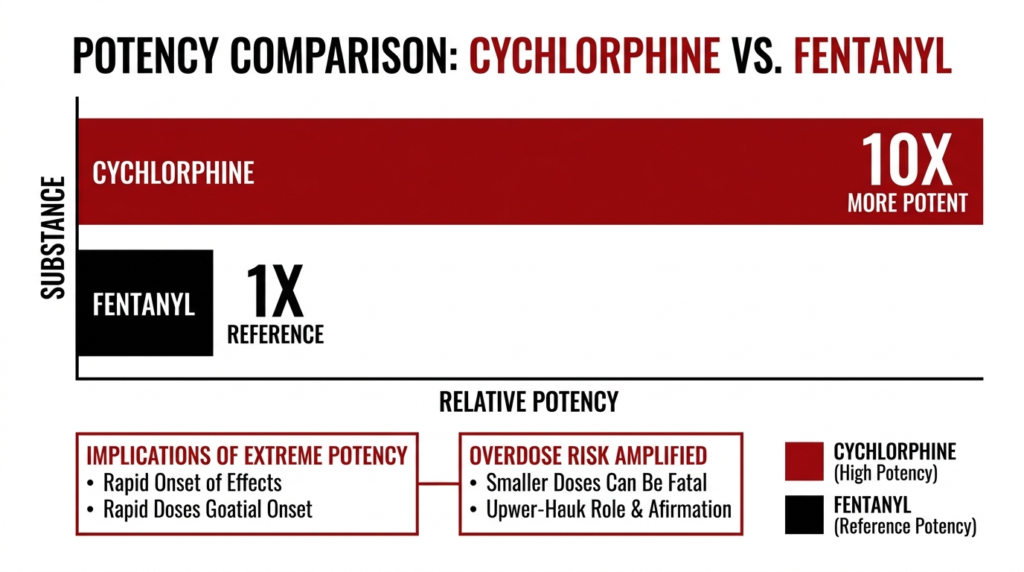
The most cited potency estimate comes from the Center for Forensic Science Research and Education, which reported that in vitro pharmacology data show cychlorphine to be approximately 10 times more potent than fentanyl. Tennessee officials and multiple public safety summaries have echoed this estimate.
To put that in perspective, fentanyl is already roughly 50 to 100 times more potent than morphine. If cychlorphine is truly 10 times stronger than fentanyl, it could be 500 to 1,000 times more potent than morphine. That means extremely small amounts can produce profound respiratory depression and death.
One Tennessee forensic case involved a fatal overdose where cychlorphine was the only drug identified, measured at approximately 0.5 nanograms in femoral blood.
A nanogram is one‑billionth of a gram. While a single concentration cannot define a population‑level lethal range, it supports the conclusion that extremely low measured levels can be associated with fatal outcomes.
Why Potency Estimates Matter
High potency means the margin between an effective dose and a lethal dose is exceptionally narrow. Even a tiny miscalculation, uneven mixing in a powder, or unknowing exposure can be fatal. This is especially dangerous when cychlorphine is mixed into other drugs without the user’s knowledge.
How Cychlorphine Works in the Body?
Cychlorphine is believed to act primarily as a mu‑opioid receptor agonist. This means it binds to the same receptors in the brain and body that other opioids target, producing effects similar to morphine, heroin, or fentanyl.
When cychlorphine activates these receptors, it can cause:
- Pain relief
- Euphoria
- Sedation
- Slowed breathing
- Reduced consciousness
- Constricted pupils
The most dangerous effect is respiratory depression. Opioids slow breathing by suppressing the brain’s respiratory centers. At high doses or in sensitive individuals, breathing can stop entirely, leading to death.
Because cychlorphine appears to be extremely potent, respiratory suppression may occur rapidly, at very small doses, and before bystanders recognize the severity of the situation.
Effects of Cychlorphine
The acute effects of cychlorphine are expected to resemble those of other strong opioids. Across public health and forensic sources, the reported or inferred effects include:
- Euphoria
- Analgesia or pain relief
- Sedation
- Drowsiness
- Slowed breathing
- Reduced consciousness
- Respiratory depression
These effects are not unique to cychlorphine. They are the classic physiological consequences of excessive opioid receptor stimulation. What makes cychlorphine especially concerning is that the dose margin between effect and lethality may be exceptionally small.
Speed and Unpredictability
Highly potent synthetic opioids can shorten the survival window between intoxication and fatal respiratory arrest. Although direct human onset data are limited for cychlorphine, the combination of extreme potency and clandestine admixture strongly suggests high unpredictability in onset and severity.
When cychlorphine is mixed into stimulants or counterfeit pills, a person’s risk is not only pharmacological but cognitive. They may fail to recognize an opioid overdose as it begins because they did not expect to consume an opioid at all.
Side Effects of Cychlorphine
Given its likely action at the mu‑opioid receptor, side effects and overdose manifestations are expected to overlap with other potent opioids. These include:
- Drowsiness
- Profound sedation
- Dizziness
- Nausea and vomiting
- Constricted pupils
- Slowed breathing
- Confusion
- Loss of consciousness
- Hypoxia
- Death in severe overdose
Direct systematic clinical case series for cychlorphine are still limited, so these side effects are inferred from opioid class effects and supported by toxicological descriptions of profound sedation and respiratory compromise in emerging reports.
Side Effects Versus Overdose Signs
For cychlorphine, the distinction between side effect and overdose symptom may collapse quickly because of extreme potency.
A dose that might cause sedation in one context could produce rapid respiratory arrest in another, particularly when the product is impure or unevenly mixed, the user has low opioid tolerance, the route produces fast absorption, or other substances are present.
Polysubstance‑Related Adverse Effects
An especially important cychlorphine‑specific issue is that it is often found with other substances. The Center for Forensic Science Research and Education reported detection alongside fentanyl, oxycodone, methamphetamine, cocaine, carfentanil, nitazene analogues, novel benzodiazepines, and other orphine analogues.
This has two implications. First, the side effect profile in real life may be mixed or masked. Second, risk is often greater than the sum of individual substances because overdose recognition becomes harder. A stimulant‑opioid combination, for example, may temporarily obscure sedation while still permitting fatal respiratory decline.
Cychlorphine Overdose Risk and Deaths
The strongest documented fatality evidence includes 25 blood specimens from fatal overdoses positive for cychlorphine at the Center for Forensic Science Research and Education, more than 100 toxicology cases tentatively identified at NMS Labs, and an East Tennessee cluster that grew from 16 to 41 deaths across 11 counties between July 2025 and February 2026.
Cychlorphine was the sole opioid in 11 of 25 fatal cases reported by CFSRE. In the remaining cases, it appeared alongside fentanyl, methamphetamine, cocaine, and other substances. This finding is crucial because it weakens any attempt to dismiss cychlorphine as merely a background contaminant or incidental co‑detection.
Why Overdose Risk is Unusually High
The overdose risk from cychlorphine is elevated by the convergence of four factors:
1. Extreme potency – Very small amounts may be lethal.
2. Frequent adulteration and mixing – Users often do not know cychlorphine is present.
3. Poor routine detectability – Standard toxicology panels may miss it.
4. Potential need for repeated naloxone dosing – One dose may not be enough.
In my judgment, this combination makes cychlorphine more operationally dangerous than fentanyl in the present surveillance environment, even if future data refine the exact potency ratio. The crucial difference is not just receptor strength; it is the combination of strength plus invisibility in current systems.
Signs of Cychlorphine Overdose
The most dangerous and actionable signs are standard opioid overdose signs, with particular urgency due to cychlorphine’s apparent potency:
- Severely slowed or stopped breathing
- Unresponsiveness or inability to wake
- Pinpoint pupils
- Blue or gray lips or nails
- Slow or irregular pulse
- Gurgling or choking sounds
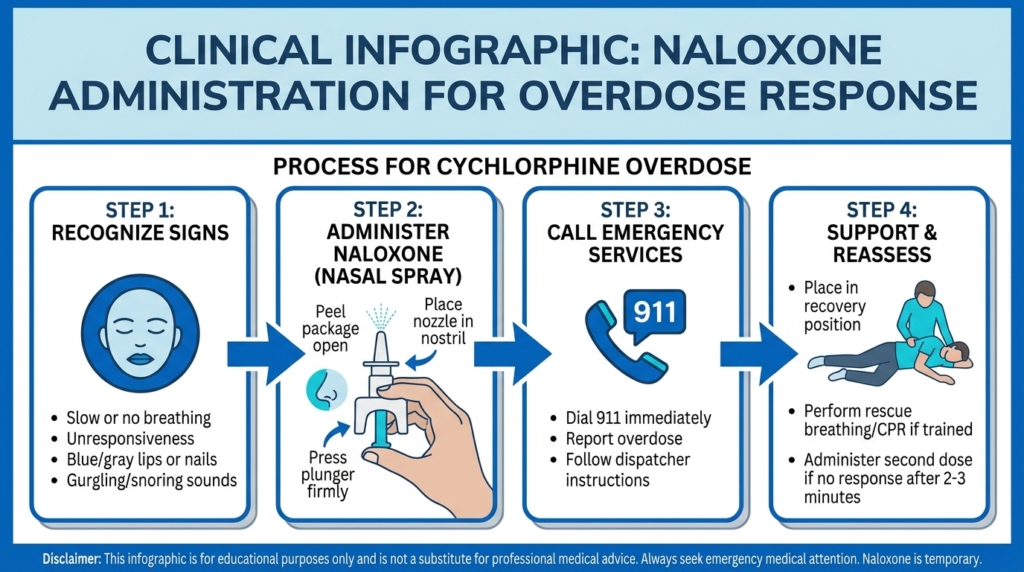
If you see these signs, call 911 immediately and administer naloxone if available.
Does Naloxone Work on Cychlorphine?
The strongest clinical principle in the evidence base is clear: naloxone remains the first‑line reversal agent for synthetic opioid overdose, including newly emerged potent synthetics.
Marion County Public Health Department states that naloxone is still believed to be effective in reversing cychlorphine‑related overdoses.
This should settle the key operational question: do not withhold naloxone because cychlorphine is suspected.
Why Multiple Doses May Be Needed
Peer‑reviewed reviews on synthetic opioids note that higher naloxone doses may be necessary due to the increased potency of newer synthetic opioids, and that extended bioavailability can produce re‑intoxication after initial response.
This broader evidence supports local warnings from Tennessee officials and laboratory sources that cychlorphine overdoses may require multiple doses of naloxone.
Some media headlines state or imply that cychlorphine may not fully respond to naloxone. That wording should be interpreted cautiously. The stronger evidence does not show that naloxone is ineffective.
Rather, it suggests reversal may be incomplete or slower in some cases, higher or repeated doses may be needed, airway support and emergency care remain essential, and non‑opioid co‑intoxicants may limit apparent improvement.
What to Do in an Overdose
After naloxone administration:
- Call emergency services immediately.
- Be prepared to give additional naloxone if breathing worsens again.
- Provide rescue breathing if trained.
- Monitor until professional care arrives.
- Do not assume waking up means the danger has passed.
Synthetic opioids may have longer duration or extended bioavailability relative to naloxone, creating a risk of rebound toxicity after apparent improvement. Therefore, observation after reversal is necessary.
Detection Challenges and Why They Matter?
A repeated finding across forensic and public health reporting is that standard toxicology panels may not detect cychlorphine because it is structurally distinct from commonly screened opioids and newly emerged in U.S. workflows.
This is not a failure of individual laboratories; it is a structural reality of analytical toxicology. Panels detect what they are built to detect.
Detection of cychlorphine may require expanded LC‑MS/MS or GC‑MS panels, high‑resolution mass spectrometry, updated spectral libraries, or referral to specialized or research laboratories for confirmation. This requirement means geographic detection may reflect lab capability as much as true prevalence.
Fentanyl Test Strips and Cychlorphine
The evidence strongly suggests fentanyl test strips should not be assumed to detect cychlorphine. Public health communication sources explicitly state that fentanyl test strips detect fentanyl, not cychlorphine, and several cychlorphine summaries note that current community test tools do not specifically detect it.
Fentanyl test strips are useful but limited and depend on analyte cross‑reactivity. They are not universal opioid detectors. They may still detect fentanyl in a mixed sample, which remains useful, but they do not offer validated cychlorphine‑specific reassurance.
Surveillance Consequence
The surveillance implication is severe: deaths can occur before routine mortality systems adequately register the compound. This lag was explicitly noted in Tennessee reporting and public health discussion of emerging‑drug detection workflows.
Detection limitations create several problems: delayed identification of local outbreaks, underestimation of mortality burden, misclassification of overdose causes, poorly targeted public health messaging, and difficulty evaluating whether interventions are working.
Cychlorphine Versus Fentanyl: How They Compare
| Dimension | Cychlorphine | Fentanyl |
|---|---|---|
| Drug class | Novel synthetic opioid; orphine analogue | Synthetic opioid; anilidopiperidine |
| Medical approval | No approved medical use | Approved medical analgesic and anesthetic |
| First major forensic awareness | Mid‑2024 detection; major alerts in 2026 | Clinical use since 1960s; illicit dominance over past decade |
| Main receptor action | Likely mu‑opioid receptor agonist | Mu‑opioid receptor agonist |
| Potency estimate | Approximately 10 times fentanyl in early in vitro data | Approximately 50 to 100 times morphine |
| Routine toxicology detection | Often missed without expanded panels | More established, though analogues still require tailored assays |
| Common street role | Emerging adulterant and mixture; sometimes sole opioid | Major primary illicit opioid and adulterant |
| Naloxone response | Naloxone advised; multiple doses may be required | Naloxone effective, but multiple doses may also be needed |
Fentanyl is already extraordinarily potent. The possibility that cychlorphine may be 10 times stronger means it could be dramatically more hazardous at tiny exposures. In practical terms, that means the margin for dosing error, contamination, or uneven distribution in powders or pills is even narrower than with fentanyl.
Fentanyl is dangerous, but clinicians at least have decades of experience with it in both legitimate and illicit contexts. Cychlorphine lacks that body of knowledge.
Therefore, even if two drugs had comparable potency, the one with less established detection, reversal expectations, and surveillance coverage would be more difficult to manage. That is currently cychlorphine.
My concrete conclusion is this: cychlorphine is not just like fentanyl but stronger. It is a more analytically elusive, less characterized, and potentially more lethal opioid threat than fentanyl in the current stage of surveillance and response.
Cychlorphine Withdrawal and Dependence
Direct cychlorphine‑specific withdrawal research is very limited. There are no large human studies defining onset, severity, or duration. Therefore, any statement must be inferential and clearly labeled as such.
However, because cychlorphine is a potent mu‑opioid receptor agonist and synthetic opioid, dependence and withdrawal are highly plausible with repeated use. Like other opioids, regular use may produce tolerance, dependence, and withdrawal when stopped.
Expected Withdrawal Symptoms
Reported symptoms of opioid withdrawal include:
- Anxiety and restlessness
- Insomnia
- Muscle aches and pain
- Abdominal cramps
- Nausea, vomiting, diarrhea
- Sweating
- Chills and hot flashes
- Runny nose and tearing
- Pupillary dilation
- Tremor
- Irritability
- Yawning
- Gooseflesh
For short‑acting opioids, withdrawal generally begins within 8 to 24 hours after last use, peaks at 36 to 72 hours, and tapers over 4 to 10 days. For longer‑acting opioids, onset may be delayed to 2 to 4 days, with symptoms lasting around 10 days or longer.
Because cychlorphine’s human half‑life is not well characterized, its exact withdrawal timetable is unknown.
Still, three conclusions are reasonable: repeated cychlorphine use likely produces opioid physical dependence, withdrawal would likely resemble other opioid withdrawal syndromes, and the exact onset and duration could differ depending on formulation, duration of action, and co‑use with other opioids.
Why Detox Alone is Not Enough
Opioid withdrawal is often described as less directly lethal than alcohol or benzodiazepine withdrawal, but that simplification is incomplete.
Severe vomiting, diarrhea, dehydration, electrolyte abnormalities, and coexisting health conditions can make poorly managed withdrawal dangerous, and relapse after detox sharply increases overdose risk due to reduced tolerance.
National guideline literature strongly recommends opioid agonist treatment, particularly buprenorphine‑naloxone when appropriate, rather than withdrawal management alone. Withdrawal management without prompt transition to evidence‑based ongoing treatment is associated with relapse and elevated overdose risk.
This point is especially important for cychlorphine. A novel opioid with apparent extreme potency could make post‑detox relapse particularly deadly.
Where Cychlorphine Has Been Detected?
By spring 2026, cychlorphine had been reported in multiple U.S. states, several Canadian provinces, and parts of Europe. The Center for Forensic Science Research and Education confirmed toxicology specimens from 8 U.S. states and 3 Canadian provinces.
Yet geographic spread is almost certainly underestimated because routine screens often miss it. States with stronger routine analytical screening may detect emerging compounds earlier than states relying on targeted testing.
East Tennessee Cluster
The Tennessee cluster is the best documented regional signal. Initial reports linked cychlorphine to 16 deaths in East Tennessee between late 2025 and mid‑January 2026.
Later reporting from the Knox County Regional Forensic Center stated the drug had appeared in 41 deaths across 11 counties between July 2025 and February 2026, with additional cases under review.
That revision upward is itself analytically important. It suggests retrospective case finding increased once awareness and testing improved. In other words, case counts rose not only because exposure rose, but because recognition improved.
Marion County, Indiana
Marion County detected cychlorphine in 10 paraphernalia items from January 2025 to January 2026. All 10 items also contained fentanyl and methamphetamine, and peak prevalence was 1.2 percent of tested items in September 2025. Officials noted that prevalence remained low in local paraphernalia surveillance.
This local signal supports two interconnected conclusions: cychlorphine may still be relatively low prevalence in some markets, and even low prevalence can be highly consequential when the substance is extremely potent and difficult to detect.
Harm Reduction and Staying Safe
If cychlorphine overdose is suspected, current evidence supports the following steps:
1. Call emergency services immediately.
2. Give naloxone right away.
3. Give additional naloxone if needed.
4. Provide rescue breathing or airway support if trained.
5. Place the person on their side if vomiting risk exists.
6. Do not leave the person alone.
7. Expect the possibility of re‑sedation or recurrent respiratory depression.
Community‑Level Harm Reduction
Useful measures now include:
- Carry naloxone
- Avoid using alone
- Use available drug‑checking services where possible
- Do not assume fentanyl‑negative means opioid‑safe
- Follow local health alerts
- Seek treatment early if use has become compulsive or withdrawal‑driven
Limits of Current Tools
Standard fentanyl strips may not rule out cychlorphine, visual inspection is useless, routine toxicology often misses it, and community awareness remains low.
Why Cychlorphine Matters for Public Health?
The most urgent policy issue is not merely scheduling. It is analytical readiness. A drug can be legally controlled and still produce a severe mortality wave if detection capacity lags. The cychlorphine case demonstrates that surveillance infrastructure is as important as legal status.
The most justified policy priorities include expanding laboratory capacity, increasing naloxone saturation and training, improving forensic‑public health communication, building compound‑family surveillance rather than single‑drug surveillance, and expanding access to medication treatment for opioid use disorder.
A narrow schedule it and move on response would be insufficient. The most important intervention is not punitive scheduling alone; it is analytic modernization plus overdose‑response readiness plus treatment access. Cychlorphine is dangerous precisely because it can outrun outdated detection systems.
Final Thoughts
Cychlorphine is an emerging synthetic opioid of unusually high concern. The most credible current evidence shows that it belongs to the growing orphine analogue family, was first identified by CFSRE in 2024, appears approximately 10 times more potent than fentanyl in vitro, has been increasingly detected in fatal overdoses since mid‑2025, and is often missed by routine testing workflows.
It has been found both as a sole opioid and in complex polysubstance mixtures, particularly with fentanyl and methamphetamine. The East Tennessee cluster and multistate forensic detections indicate that the threat is real, growing, and likely undercounted.
From a clinical and public health perspective, the practical message is straightforward: treat suspected cychlorphine overdose as a medical emergency, use naloxone immediately and expect that multiple doses may be needed, monitor for recurrence because potent synthetic opioids may outlast naloxone, assume standard toxicology and drug‑checking tools may miss cychlorphine, recognize that repeated use likely creates opioid dependence and withdrawal, and do not rely on detox alone.
My concrete judgment, based on the strongest available evidence, is that cychlorphine represents a high‑severity, under‑recognized opioid threat whose public health danger lies as much in incomplete detection as in its apparent potency. If current trends continue, the communities that appear least affected may simply be those that are least able to see it.
If you or someone you care about is struggling with opioid use or facing the risks of emerging synthetic opioids like cychlorphine, we’re here for you. Reach out to Thoroughbred Wellness and Recovery’s addiction counseling today to explore compassionate and evidence‑based treatment options that can guide you toward lasting recovery.


 Give Us A Call


