
 info@thoroughbredbhc.com
If you are worried about the signs of alcoholism, look for patterns, not stereotypes. Alcohol use disorder can be diagnosed when at least two symptoms happen within the same 12 month period, even if someone keeps their job, home, and relationships. This guide will help you understand what counts, what physical signs mean, and when alcohol withdrawal needs medical care.
Signs of Alcoholism Under DSM 5
The word “alcoholic” is still common, but it is not the current clinical diagnosis. The current term is alcohol use disorder, often shortened to AUD. If you are asking, “am i an alcoholic,” a better question is, “Does my drinking meet alcohol use disorder dsm 5 criteria?”
The DSM 5 alcohol use disorder framework does not require a person to be homeless, arrested, unemployed, divorced, or visibly intoxicated in public. It focuses on symptoms. Those symptoms can be private, hidden, or easy to excuse.
A direct answer is this: alcohol use disorder is a pattern of alcohol use that causes real distress or impairment, shown by at least two of 11 symptoms in the same 12 month period.
That means someone can seem outwardly fine and still have AUD. They may go to work, pay bills, parent their children, and show up at social events. But inside, they may be fighting cravings, breaking their own drinking limits, or using alcohol even when they know it is harming their health.
The 11 DSM 5 symptoms in plain language
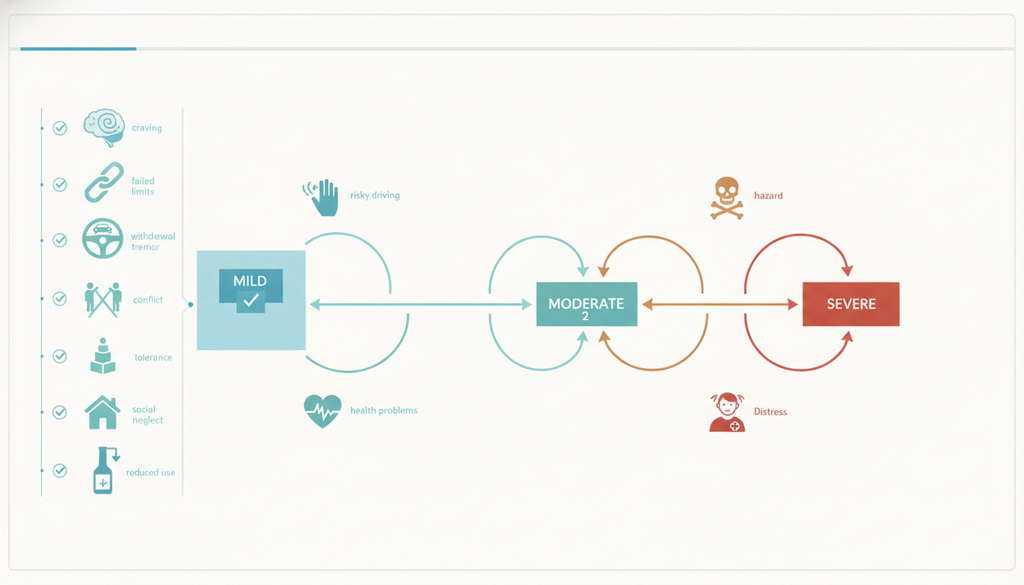
The DSM 5 TR criteria are often grouped into impaired control, social problems, risky use, tolerance, and withdrawal. In plain language, the signs include:
- Drinking more, or for longer, than you meant to
- Wanting to cut down or stop but not being able to do it
- Spending a lot of time drinking, getting alcohol, or recovering from drinking
- Craving alcohol or feeling a strong urge to drink
- Drinking causing missed work, school, parenting, or home duties
- Drinking continuing even though it causes conflict with other people
- Giving up or reducing important activities because of alcohol
- Drinking in risky situations, such as before driving or unsafe work
- Drinking even after knowing it worsens a physical or mental health problem
- Needing more alcohol than before to feel the same effect
- Having withdrawal symptoms, or drinking to avoid them
A person does not need all of these symptoms. Two or three symptoms are classified as mild AUD. Four or five are moderate AUD. Six or more are severe AUD.
That severity label matters, but it is not a moral score. It also does not decide treatment setting by itself.
Why stereotypes miss the problem
Many people delay getting help because they do not match the image they have in mind. They may think, “I do not drink in the morning,” or “I only drink wine,” or “My friends drink this much too.”
Those details can matter, but they do not rule out AUD. The key issue is what alcohol is doing in your life. Are you keeping promises to yourself? Are you able to stop once you start? Are you drinking despite anxiety, sleep problems, liver concerns, relationship strain, or risky behavior?
The DSM shift also matters because older labels separated alcohol abuse and dependence. The DSM 5 change moved alcohol problems into one spectrum and added craving while removing legal problems as a separate criterion. That helps explain why no arrest record does not mean no disorder.
What Is Alcohol Use Disorder?
What is alcohol use disorder? It is a clinical diagnosis based on specific symptoms, not a label for a certain “type” of person.
AUD can show up as a loss of control. You plan to have two drinks but keep having five. You decide not to drink during the week but return to nightly drinking. You try a sober month and stop after a few days, again and again.
It can show up as craving. You may think about alcohol during work, feel restless when plans change, or feel unable to relax unless drinking is available.
It can also show up as continued use despite harm. You may know alcohol worsens anxiety, depression, sleep, blood pressure, stomach symptoms, or relationship conflict, yet keep drinking anyway.
A person can drink heavily and not meet AUD criteria if those symptoms are not present. A person can also drink in a way others see as normal and still meet criteria. The diagnosis depends on the pattern, not only the number of drinks.
Mild does not mean harmless
Mild AUD means two or three symptoms. That may sound small, but two symptoms can be serious.
For example, repeated failed efforts to cut down plus drinking more than intended can show that alcohol is no longer fully under your control. That is worth taking seriously before bigger losses happen.
At the same time, mild AUD does not automatically mean someone needs inpatient care. It means they need honest assessment and a plan that fits their risk.
Moderate AUD often points to a wider pattern across several parts of life. Severe AUD means many symptoms are present, but even severe AUD does not always mean the same level of care for every person.
Physical Signs of Alcoholism
Physical signs of alcoholism are not always obvious. Some people look tired, flushed, shaky, or unwell. Others look healthy while alcohol is still causing harm.
The most useful physical clues are often tied to timing. Symptoms that appear after several hours without alcohol, especially in the morning, can be more concerning than symptoms that happen only during drinking.
Common early physical clues may include poor sleep, fatigue, stomach upset, appetite changes, weight changes, repeated injuries, or higher tolerance. These signs are not proof of AUD. They can come from many causes. But if they occur with loss of control, craving, or repeated failed efforts to cut down, they deserve attention.
Morning shaking can mean withdrawal
Morning tremor, sweating, nausea, anxiety, agitation, racing heart, and insomnia can be signs of alcohol withdrawal when they happen after heavy or regular drinking is stopped or reduced. Cleveland Clinic describes withdrawal symptoms as possible within hours after a person stops or sharply reduces alcohol.
This is one of the most important safety points in the whole article. If someone wakes up shaky, sweaty, nauseated, or panicky, then drinks to feel normal, that may not be “just a hangover.” It may mean the nervous system has adapted to alcohol.
Withdrawal can occur even if alcohol is still in the body. In people with dependence, a sharp drop from their usual alcohol level can trigger symptoms.
Hangover and withdrawal can overlap
A hangover can cause headache, nausea, fatigue, thirst, and anxiety after a heavy drinking episode. Withdrawal can cause nausea and anxiety too, but it often adds tremor, sweating, agitation, insomnia, fast heart rate, and rising blood pressure.
The pattern matters. A one time rough morning after unusual drinking is different from waking most days with shaking and needing alcohol to settle.
If symptoms worsen when alcohol is delayed, or improve after drinking, that is a warning sign. It is also a reason not to quit suddenly without medical advice if drinking has been heavy or daily.
Am I an Alcoholic?
If you are searching “am i an alcoholic,” you are probably not looking for a lecture. You may be scared, embarrassed, irritated, or quietly hoping someone says you are fine.
I think the most honest answer is this: you do not need to accept the label “alcoholic” to take alcohol use disorder seriously.
Try asking more specific questions. Do I drink more than I plan to? Have I tried to cut down and failed? Do I crave alcohol? Do I hide how much I drink? Do I keep drinking when it makes my sleep, mood, health, or relationships worse? Have I driven after drinking or taken other risks?
If the answer to two or more is yes, an evaluation is worth it.
When an am i an alcoholic quiz helps
An am i an alcoholic quiz can help you notice patterns. It can give language to things you have been minimizing. It can also push you to talk to a professional sooner.
But a quiz is not a diagnosis. It cannot fully judge withdrawal risk, mental health, medical problems, medications, family history, or whether detox should be supervised.
A good assessment looks at both AUD symptoms and safety. It asks how much you drink, how often, what happens when you stop, whether you have had seizures or hallucinations, and whether you have depression, trauma symptoms, anxiety, or suicidal thoughts.
Merck notes that diagnosis relies on a careful clinical history, because appearance and lab results alone cannot tell the whole story.
If you are asking for someone else
It is painful to watch someone drink in a way that scares you. It is also tempting to argue over labels. That usually does not help.
Instead, describe what you see. You might say, “I am worried because you planned not to drink this week and ended up drinking every night,” or “I noticed you were shaking this morning and felt better after drinking.”
Stick to facts. Avoid shame. If there are withdrawal symptoms, confusion, seizures, hallucinations, unsafe driving, or suicidal talk, treat it as a safety issue, not a debate.
When Stopping Drinking Can Be Unsafe
Not everyone who drinks needs detox. But some people should not stop abruptly on their own.
Alcohol withdrawal can become dangerous. The risk is higher if someone drinks heavily every day, has had withdrawal before, has had seizures or delirium, uses sedatives, has major medical illness, is older, or has severe anxiety, depression, or suicidal thoughts.
ASAM guidance on alcohol withdrawal warns that withdrawal risk must be assessed with more than a current symptom score. A person can seem only mildly uncomfortable early on and still get worse later.
Seizures often occur after alcohol is stopped or sharply reduced. Delirium tremens can occur later and may involve confusion, hallucinations, agitation, fever, tremor, and unstable heart rate or blood pressure. That is a medical emergency.
If there is a seizure, confusion, hallucinations, fainting, chest pain, persistent vomiting, severe shaking, unstable vital signs, or suicidal intent, emergency care is needed.
Why “just cut back” can be risky
People often try to manage withdrawal by drinking less each day. Sometimes they do this because they are afraid of detox, work responsibilities, cost, or stigma.
The problem is that withdrawal risk is not only about willpower. It is about brain and body adaptation. If the body has become dependent on alcohol, stopping or reducing too fast can trigger dangerous symptoms.
The World Health Organization states that benzodiazepines are the first line medication class for alcohol withdrawal because they reduce symptoms and help prevent seizures and delirium. These medicines need medical oversight, especially because mixing sedatives with alcohol can be dangerous.
Detox is not a punishment. It is medical support during a risky period.
Why Level of Care Is Not Just Severity
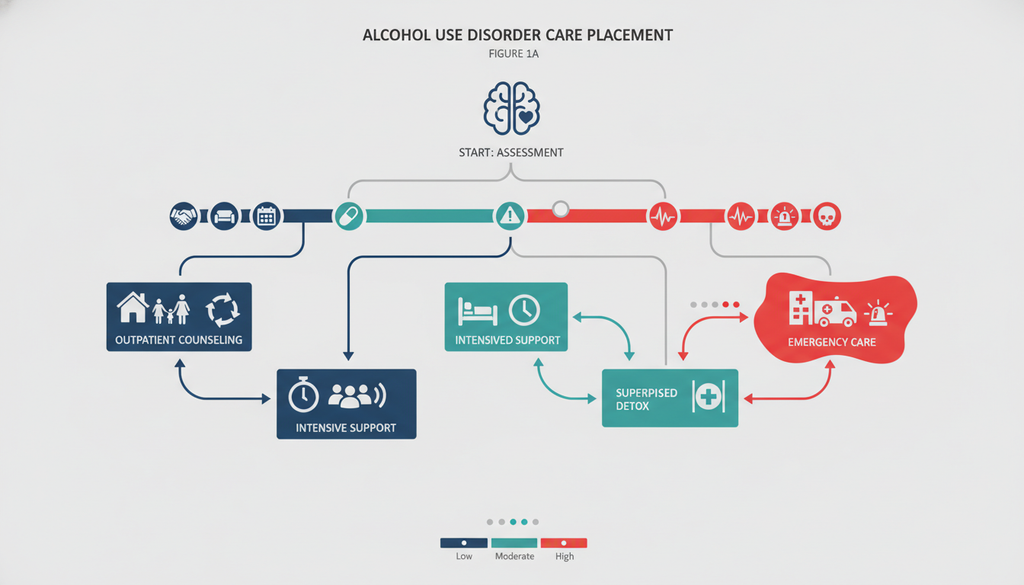
DSM 5 tells clinicians whether alcohol use disorder is present and how many symptoms are present. It does not, by itself, decide whether someone needs outpatient care, intensive outpatient care, residential treatment, or inpatient medical care.
That is where ASAM comes in. The ASAM Criteria use a broad assessment that looks at withdrawal risk, medical needs, mental health, substance use risks, recovery environment, and personal needs.
This matters because two people with the same AUD severity can need very different care.
One person with mild AUD may have no withdrawal risk, stable housing, and good support. Outpatient counseling, medication evaluation, and monitoring may fit.
Another person with mild AUD may have withdrawal symptoms, a prior seizure, and sedative use. That person may need supervised withdrawal care even though the DSM symptom count is low.
A person with severe AUD may need residential or inpatient care if withdrawal, medical issues, psychiatric symptoms, or safety risks are high. But another person with severe AUD may be stable enough for intensive outpatient treatment if they have safe housing, no acute withdrawal risk, strong support, and reliable care.
Treatment should match risk and goals
Good alcohol treatment is not one size fits all. It should match the person in front of you.
Some people need medical detox first. Some need outpatient therapy and medication. Some need dual diagnosis care for anxiety, depression, trauma, bipolar disorder, or other mental health concerns. Some need family support, peer support, or a safer living environment.
The best plan answers three separate questions. Does the person meet criteria for AUD? How severe is it by symptom count? What setting is safe and useful right now?
Keeping those questions separate prevents two common mistakes. The first is minimizing risk because someone looks successful. The second is forcing a higher level of care based only on a label.
What to Do Next
Alcohol use disorder is common enough that it can hide in plain sight. The signs are not always dramatic. They may look like broken promises to yourself, repeated “rules” that fail, morning shaking, sleep problems, anxiety after drinking, or a quiet fear that alcohol is starting to run the day.
If you recognize yourself in this article, try not to turn it into a character judgment. Treat it as information. AUD is a health condition with different levels of severity and many paths into care.
If you are worried about withdrawal, do not stop suddenly without medical advice. If you are having severe symptoms, get emergency help. If the concern is less urgent but still real, talk with a qualified addiction or mental health professional and be honest about your drinking pattern, morning symptoms, medications, and mental health.
You do not have to wait for a crisis to ask for help. If alcohol is causing harm or you feel unsure about stopping safely, consider reaching out to Thoroughbred Wellness and Recovery for detox support.


 Give Us A Call


