
 info@thoroughbredbhc.com
Choosing between inpatient and outpatient rehab can feel overwhelming when you or someone you care about needs help.
The right treatment is not “inpatient” or “outpatient” as fixed categories, but an ASAM-guided stepped continuum that begins at the least restrictive safe setting, escalates when medically or socially necessary, and transitions downward as stabilization improves.
This article explains the operational differences between inpatient and outpatient rehab, typical intensity patterns, costs, insurance rules, and decision factors so you can make an informed choice.
What is Inpatient vs Outpatient Rehab?
Inpatient rehab, also called residential treatment, means you live at the facility 24/7 while receiving care. You sleep there, eat there, and participate in structured programming throughout the day.
Inpatient settings provide round-the-clock supervision, medical monitoring, and a controlled environment away from triggers and daily stressors.
Outpatient rehab means you attend treatment sessions at a clinic or facility but return home each day. Outpatient care spans a wide spectrum, from standard weekly counseling to intensive outpatient programs that meet multiple times per week for several hours.
You maintain your daily responsibilities like work, school, or caregiving while receiving structured support.
The distinction matters because inpatient and residential treatment are often used for severe, complex, or unsafe presentations, while outpatient care can achieve outcomes comparable to inpatient care for many patients and may improve access, retention, and cost-efficiency when safety permits.
Understanding the Treatment Continuum
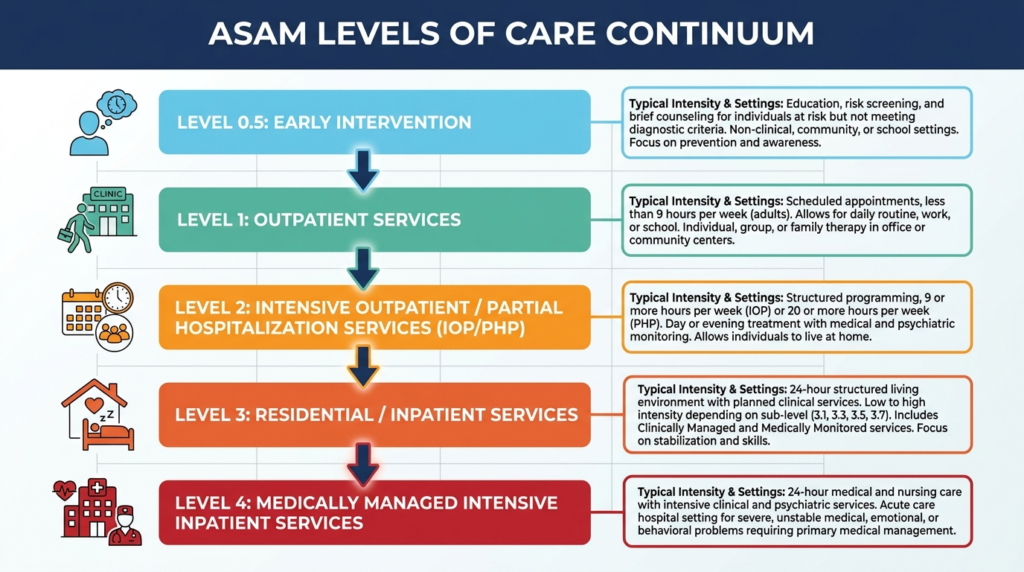
Modern addiction treatment is not a simple choice between two options. The American Society of Addiction Medicine (ASAM) Criteria describe a continuum of care ranging from early intervention to medically managed intensive inpatient services.
The ASAM framework is the most widely used system for placement, continued service, and transfer decisions for people with addiction and co-occurring conditions.
ASAM Levels of Care
| ASAM Level | Description | Setting | Typical Intensity |
|---|---|---|---|
| 0.5 | Early Intervention | Community/primary care | Varies |
| 1.0 | Outpatient Services | Office/clinic | Less than 9 hours/week |
| 2.1 | Intensive Outpatient Program (IOP) | Non-residential clinic | 9–19 hours/week |
| 2.5 | Partial Hospitalization Program (PHP) | Day treatment center | 20+ hours/week |
| 3.1 | Clinically Managed Low-Intensity Residential | Residential facility | 24-hour structure, lower clinical intensity |
| 3.3 | Population-Specific High-Intensity Residential | Residential facility | 24-hour specialized programming |
| 3.5 | High-Intensity Residential | Residential facility | 24-hour intensive clinical services |
| 3.7 | Medically Monitored Intensive Inpatient | Residential or inpatient | 24-hour medical monitoring |
| 4.0 | Medically Managed Intensive Inpatient | Hospital | Highest acuity, medically managed |
This continuum shows that “outpatient” itself is not one thing. Standard outpatient, IOP, and PHP are all outpatient levels, but they differ substantially in intensity and supervision.
Likewise, “inpatient” often conflates medically managed hospital care, medically monitored withdrawal management, and longer-term residential rehabilitation.
Core Features of Inpatient Rehab
Inpatient or residential treatment provides 24/7 onsite care and structure. You are removed from your home environment and participate in daily programming that typically includes coordinated individual therapy, group therapy, family therapy, recovery education, and relapse prevention.
Programs often include medically directed care coordination, holistic wellness activities, and supervised downtime.
Lengths of stay often run around 30 to 45 days or longer, depending on patient need and insurance authorization.
These programs are especially relevant when you have moderate-to-severe substance use disorder, recently relapsed, lack a safe or reliable home environment, have co-occurring psychiatric symptoms needing steady support, have not done well in outpatient treatment, or require detox and close monitoring.
Advantages of Inpatient Treatment
Safety during withdrawal and instability is one of the strongest reasons to choose inpatient or residential treatment. Patients with risk of severe withdrawal, especially from alcohol, benzodiazepines, or heavy opioid dependence with complications, may require 24-hour monitoring or hospital-level care.
Environmental protection removes you from daily triggers, unstable housing, substance-using peers, and interpersonal chaos. ASAM’s focus on recovery environment as a core dimension makes this more than a lifestyle preference; it is a formal placement factor.
Intensive containment for relapse and psychiatric risk helps patients with repeated outpatient failure, high relapse likelihood, or co-occurring psychiatric instability. This is reflected in both ASAM-oriented descriptions and CMS logic, which treats higher intensity as necessary when lower-intensity services have failed or are inadequate.
Limitations of Inpatient Treatment
Despite its importance, inpatient care has significant limitations. High cost is the most obvious. Residential and inpatient care are among the most expensive substance use disorder treatment modalities.
Industry sources suggest residential treatment usually costs several thousand to tens of thousands of dollars per month or per episode.
Disruption of work and caregiving affects treatment feasibility and continuity. Many patients cannot easily leave employment, childcare, or school obligations. Outpatient levels exist partly to address this reality.
Limited duration and transition risk mean residential stays are time-limited and usually require step-down planning. A patient who leaves residential care without a well-supported outpatient follow-up plan may face a sharp drop in support.
Core Features of Outpatient Rehab
Outpatient care includes several distinct levels. Standard outpatient treatment generally involves under 9 hours per week for adults. Intensive outpatient programs provide roughly 9 to 19 hours per week, often delivered 3 to 5 days per week for 2 to 4 hours per day.
Partial hospitalization programs offer 20 or more hours per week, often around 4 to 6 hours per day for 5 to 7 days per week.
Standard Outpatient Treatment
Standard outpatient treatment typically involves one or two therapy sessions per week and is most appropriate for patients with lower acuity, stronger support systems, stable housing, and ability to maintain sobriety outside a controlled environment. It may also be used as a lower-intensity step-down level after more intensive treatment.
Intensive Outpatient Programs
IOP commonly includes group therapy, individual therapy, relapse prevention, psychiatric check-ins, medication management or coordination, and family services in some programs.
IOP is well suited for patients who need more accountability and structure than weekly therapy but do not need 24-hour supervision, or for patients stepping down from inpatient or PHP care.
Partial Hospitalization Programs
PHP sits between IOP and residential care. CMS describes the level as appropriate when inpatient hospitalization is unnecessary but a less intensive outpatient program has failed or would not suffice, and when the patient has adequate support outside program hours.
This makes PHP a crucial bridge level. It can be a step-down from inpatient or residential care, or a step-up from standard outpatient or IOP when instability increases but 24-hour care is still not required.
Advantages of Outpatient Care
Lower cost is substantial. Outpatient care is usually much less expensive than inpatient care. Cost compilations indicate outpatient programs may cost a few thousand dollars per episode or around $5,000 for a three-month program at the lower end, versus much higher residential totals.
Flexibility and continuity with daily life allow you to maintain employment, school, parenting, and community ties. This can increase real-world treatment adherence for people who cannot leave home for weeks at a time.
Practice in the real environment lets you practice coping skills in real-world settings rather than only in a protected environment. That can be an advantage if the home and social context are reasonably stable.
Limitations of Outpatient Care
Greater exposure to triggers can be dangerous if you live with substance use, violence, unstable relationships, or easy access to drugs or alcohol. ASAM explicitly identifies recovery and living environment as a key placement factor.
Lower containment for severe withdrawal and instability means outpatient settings are often not sufficient for severe withdrawal risk, acute suicidality, psychosis, uncontrolled medical issues, or repeated inability to remain abstinent outside structure.
Dependence on support systems and patient functioning requires transportation, scheduling stability, family or peer support, housing safety, and reliable engagement. These social determinants are often underestimated but central to outcomes.
Inpatient vs Outpatient Care Difference: Direct Comparison
| Dimension | Inpatient/Residential Rehab | Outpatient Rehab |
|---|---|---|
| Living arrangement | Patient resides at facility or hospital | Patient lives at home, sober housing, or recovery residence |
| Supervision | 24/7 structure; may include continuous medical monitoring | Scheduled sessions; no overnight supervision |
| Best for | Severe SUD, unsafe home environment, significant withdrawal/medical/psychiatric risk | Mild-to-moderate SUD or step-down care when home environment is stable |
| Intensity | Residential 24-hour care; hospital-level options for highest acuity | OP less than 9 hours/week; IOP 9–19; PHP 20+ |
| Cost | Highest | Lower overall |
| Daily responsibilities | Usually requires time away from work/school/caregiving | Compatible with work, school, family roles |
| Exposure to triggers | Reduced during stay | Ongoing exposure outside sessions |
| Step-down role | Often starting point after detox or crisis stabilization | Often continuation/maintenance and reintegration |
| Insurance review | Usually stricter authorization due to higher cost | Still reviewed for medical necessity, but often easier to sustain |
The deepest connection across the research is that the real difference between inpatient and outpatient care is not merely intensity—it is where and how risk is managed.
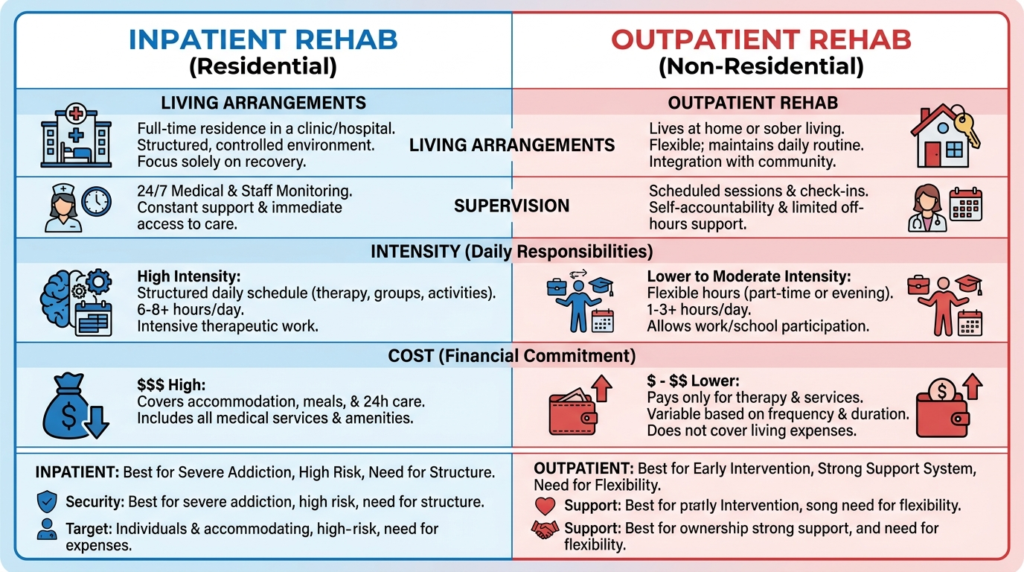
In inpatient or residential settings, the program manages much of your immediate risk through physical containment, staffing, medication supervision, and environmental control. In outpatient settings, you must manage much of that risk between sessions, often with support from family, peers, medications, or recovery housing.
Inpatient vs Outpatient Costs
Cost data vary widely, but the most reliable general conclusion is that inpatient or residential treatment costs more than outpatient treatment. Medical detox and hospital-level care can cost even more than standard residential care.
Actual patient out-of-pocket spending depends more on insurance design, network status, authorization, and state program rules than on headline facility pricing alone.
Example Cost Ranges
Affordable inpatient treatment often starts around $6,000 per month, while outpatient rehab may cost around $5,000 for a three-month program.
Inpatient treatment often costs $6,000 to $20,000 for a 30-day stay, with specialized or premium care costing more. These figures should be treated as illustrative rather than definitive national benchmarks, but they are directionally consistent.
Out-of-Pocket Costs
Common patient cost-sharing elements include deductibles, copayments, and coinsurance. Inpatient rehab out-of-pocket exposure often includes copayments, 10 to 30 percent coinsurance, and deductibles that can reach thousands of dollars, though the exact figures depend on the plan.
A neglected cost issue is that fragmented treatment can be more expensive in the long run than an appropriately stepped continuum.
A patient who cycles repeatedly through detox without follow-up, or who is discharged from residential care without outpatient continuation, may incur repeated acute-care costs and relapse risk.
Insurance Coverage for Inpatient and Outpatient Rehab
Two federal protections are central to understanding insurance coverage. The Mental Health Parity and Addiction Equity Act generally prevents group health plans and insurers that offer mental health or substance use disorder benefits from imposing less favorable financial requirements or treatment limitations on those benefits than on comparable medical or surgical benefits.
The Affordable Care Act requires mental health and substance use disorder services as one of the ten essential health benefit categories in non-grandfathered individual and small-group plans.
This distinction is crucial. Parity means if covered, it must be treated comparably. ACA essential health benefits mean certain plans must include mental health and substance use disorder benefits in the first place.
What Parity Does and Does Not Guarantee?
Parity does not mean every treatment center is covered, every requested level of care is automatically approved, or every denial is illegal. Parity generally means that limitations on mental health and substance use disorder benefits cannot be more restrictive than those applied to comparable medical or surgical benefits.
Therefore, insurers may still require medical necessity review, use provider networks, require prior authorization, deny non-covered facilities, and review continued stays. The key legal question is whether these controls are applied comparably and lawfully.
How Insurers Determine Coverage?
Most commercial payers and Medicaid programs use ASAM criteria to determine medical necessity for level-of-care placement. Payers assess whether documentation supports the assigned level across the six dimensions. This is one of the most important practical insights.
Insurance coverage is not primarily determined by marketing labels. It is determined by covered benefit category, network and contract status, authorization rules, documented medical necessity at the requested level, and continued review.
Private Insurance
Private insurance plans commonly cover detox, inpatient or residential treatment, outpatient therapy, and medication-assisted treatment to some degree, but coverage specifics vary widely by plan design, network rules, and cost-sharing obligations.
Patients with private insurance should expect potential variation in deductible exposure, coinsurance for residential stays, prior authorization requirements, out-of-network penalties, and duration review.
Medicaid
Medicaid is one of the most important payers for substance use disorder treatment, but it is also one of the most variable.
Medicaid beneficiaries continue to face substantial barriers to substance use disorder treatment access, including stigma, fragmented and underfunded delivery systems, limited service coverage, inadequate provider supply, and low provider participation.
In a June 2018 review, only 12 states paid for the full array of clinical substance use disorder services, including outpatient and residential treatment of varying intensity plus medication-assisted treatment.
That is one of the most policy-significant statistics because it shows that benefit variation remains profound even when parity and opioid-response initiatives are discussed nationally.
How to Choose Between Inpatient and Outpatient Treatment?
The most evidence-supported decision process is layered and multidimensional.
Step 1: Assess Acute Medical and Withdrawal Risk
If you have significant withdrawal risk, unstable medical conditions, or severe psychiatric symptoms, inpatient or medically monitored care may be necessary. Severe alcohol or sedative withdrawal is a key indicator for inpatient admission.
Step 2: Assess Recovery Environment
If home is unsafe, unstable, or saturated with triggers, outpatient care may be clinically unrealistic even if symptoms look moderate on paper. ASAM identifies recovery and living environment as a core dimension.
Step 3: Assess Current Functioning and Obligations
If you are medically stable, motivated, and supported but cannot leave work or caregiving, IOP or PHP may preserve treatment access better than insisting on residential admission.
Step 4: Assess Past Treatment Response
Repeated relapse or failure at outpatient levels may justify a step-up to residential care. Conversely, successful stabilization in residential care should trigger timely step-down rather than arbitrary extension.
Step 5: Verify Insurance and Benefit Fit
Check in-network status, prior authorization needs, covered ASAM levels, expected cost-sharing, medication coverage, and whether recovery residence or outpatient combinations might substitute for full residential treatment if clinically appropriate.
Patient Profiles and Likely Fit
- Severe alcohol withdrawal risk, unstable vitals, suicidality: Hospital or inpatient or medically monitored withdrawal management
- Repeated relapse, unsafe housing, co-occurring psychiatric symptoms: Residential treatment
- Stable medically, needs daily structure, lower level failed, good evening support: PHP
- Moderate symptoms, needs frequent therapy but can live safely at home: IOP
- Mild symptoms, strong supports, or stable step-down after higher care: Standard outpatient
Telehealth and Virtual Intensive Outpatient Programs
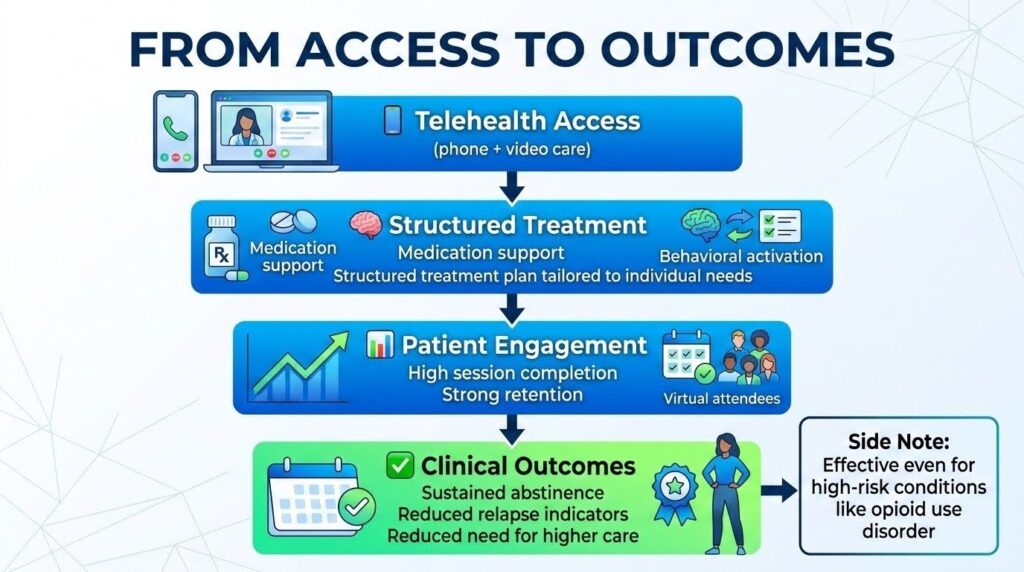
COVID-19 triggered rapid expansion of telephone and video-based telehealth across the substance use disorder care continuum. Although use declined after the pandemic peak, both phone and video continued to be viewed positively, suggesting persistence rather than complete reversion.
A large retrospective cohort of 4,724 participants in a telehealth substance use disorder intensive outpatient program from 2021 to 2023 found nearly 80 percent stayed engaged for at least 30 days, 91 percent achieved at least 30 consecutive days of abstinence during treatment, and nearly 45 percent had a successful response to care such that they no longer required IOP treatment.
A 2025 randomized trial found that a combined medication and behavioral activation intervention for people with opioid use disorder was feasible and acceptable, with 88 percent of intervention sessions completed and 100 percent retention at 6 months. Compared with controls, participants had fewer missed medication doses and visits and fewer opioid-positive toxicology screens.
These findings show that for a severe substance use condition with high mortality risk, outpatient medication treatment can work, structured behavioral augmentation can improve engagement, and virtual and hybrid delivery are feasible.
Questions to Ask Before Admission
1. What ASAM level of care is being recommended, and why?
2. What specific risks make outpatient unsafe or make residential unnecessary?
3. Is detox needed separately from rehabilitation?
4. What are the daily or weekly hours of programming?
5. Is the provider in network?
6. Does the plan require prior authorization?
7. What is the estimated out-of-pocket cost?
8. What medications for addiction treatment are available?
9. What is the step-down plan after discharge?
10. If home is unsafe, is recovery housing available with outpatient treatment?
Red Flags in Treatment Selection
- A program recommends residential care without explaining why lower levels are unsafe.
- A plan denies care without a clinically specific rationale tied to level-of-care criteria.
- Detox is offered without a clear rehabilitation follow-up plan.
- Marketing language replaces clinical assessment.
- No discussion occurs about medications, co-occurring conditions, or living environment.
Evidence-Based Opinion: Which Is More Effective?
Based on the most relevant, reliable, and current sources, the clearest valid answer is that outpatient treatment is the more effective default form of substance abuse treatment for most people, provided they can be safely managed outside an inpatient setting.
Inpatient or residential treatment is more effective for a smaller, clinically higher-risk subgroup requiring 24-hour structure, withdrawal management, or environmental containment.
This opinion is justified by several core findings. No strong overall evidence proves inpatient or residential superiority across the full substance use disorder population. IOPs can achieve benefits similar to inpatient care for alcohol and drug disorders. Inpatient or residential care likely has short-term advantages in completion and stabilization, especially in severe cases.
Severe withdrawal and imminent safety risk are clear indications for inpatient care. Modern outpatient treatment has improved substantially through telehealth, hybrid care, medication support, and structured digital components.
Engagement, completion, functional capacity, and aftercare predict outcomes more strongly than site of care alone. In plain terms, inpatient is not better because it is inpatient; it is better when you need what only an inpatient can provide.
Otherwise, well-structured outpatient care, especially IOP, medication-centered treatment, and telehealth-enabled programs, is often equally effective and usually more practical, scalable, and sustainable.
Conclusion
The most defensible conclusion from the available evidence is not that inpatient or outpatient rehab is universally superior. It is that effectiveness depends on matching you to the right level of care, then sustaining engagement over time.
For most people with substance use disorders, outpatient treatment, including intensive outpatient, medication-based treatment, and telehealth-enhanced models, is the more effective overall strategy because it can achieve similar outcomes without unnecessary disruption and with greater continuity.
For people with severe withdrawal risk, acute danger, or highly unstable and complex presentations, inpatient or residential treatment is more effective because it offers capabilities that outpatient care cannot safely replicate.
The real answer is clinically sharper than a tie: outpatient is the best default, inpatient is the best exception when clearly indicated, and long-term success depends less on where treatment starts than on how well treatment is matched, completed, and continued.
If you or someone you care about is ready to explore the right level of care, reach out to Thoroughbred Wellness & Recovery for a confidential assessment and personalized guidance.


 Give Us A Call


