
 info@thoroughbredbhc.com
Public defenders, prosecutors, and private practice attorneys all face elevated substance use risk, but the drivers and intensity differ sharply.
Public defenders in Georgia likely carry the heaviest burden because they combine profession-wide lawyer vulnerability with extreme caseloads, chronic trauma exposure, and the moral injury of working in under-resourced systems.
A national attorney study found that 20.6% of lawyers screened positive for problematic drinking, yet that baseline masks critical differences by practice setting. This article explains how job stress, burnout, and trauma exposure create distinct substance use risk profiles across Georgia’s legal profession.
Why Georgia Lawyers Face Elevated Baseline Risk?
Georgia participated in the landmark 2016 study of 12,825 practicing attorneys that documented elevated rates of hazardous drinking compared with similarly educated professionals. The same research found that 28% of attorneys reported depression symptoms, 19% anxiety, and 23% stress.
These figures establish that all Georgia lawyers start from a high-risk professional baseline, but they do not capture how attorney role shapes exposure to the specific stressors that drive substance misuse.
The State Bar of Georgia recognizes this reality. Its mental wellbeing resources explicitly address depression, stress, alcohol or drug abuse, and psychological issues, directing lawyers to confidential help through a dedicated hotline.
Georgia also operates Lawyers Helping Lawyers, a peer support program, and offers bar members six prepaid clinical sessions annually through its Lawyer Assistance Program. These structures signal that Georgia’s legal community understands substance use as an occupational hazard, not a personal failing.
Public Defenders Face the Most Concentrated Risk Cluster
Public defenders in Georgia likely face the highest substance use risk among the three groups because their work combines multiple validated addiction risk factors simultaneously.
Recent reporting on a 2023 RAND study found that public defenders across the nation are handling roughly three times the caseload they can effectively manage.
Georgia’s public defense offices reflect this national pattern, with attorneys juggling major crimes, juvenile cases, mental health advocacy, and appellate work under severe resource constraints.
Caseload Pressure and Moral Injury
The Eastern Judicial Circuit public defender office in Savannah describes a multi-division practice handling indigent representation across all criminal phases, with staff including investigators, social workers, and a mental health advocate attorney.
While this holistic model reflects Georgia’s commitment to quality defense, it also reveals the emotional intensity and complexity of the work. Public defenders routinely represent clients in acute crisis, facing severe allegations, poverty-related instability, and co-occurring mental health and addiction issues.
This creates what one Slate analysis calls the “stress of injustice”: the chronic emotional injury of knowing what adequate representation requires yet lacking the time, resources, or systemic support to deliver it.
That mismatch between professional ethics and institutional reality produces moral injury, a recognized driver of substance misuse. Public defenders may turn to alcohol or other substances to numb feelings of guilt, helplessness, or despair when they cannot provide the defense their clients deserve.
Secondary Trauma Exposure
Public defenders also face exceptionally high secondary trauma exposure. A systematic review of legal professionals found that criminal lawyers show significantly higher secondary trauma than non-criminal lawyers.
Another study of Wisconsin public defenders documented elevated PTSD symptoms, depression, burnout, and functional impairment compared with administrative staff, with differences mediated by longer work hours and greater contact with trauma-exposed clients.
Georgia public defenders work with clients whose lives intersect directly with violence, abuse, addiction, and severe mental illness. They review disturbing evidence, hear traumatic narratives, and absorb the cumulative weight of human suffering.
Unlike mental health professionals who receive trauma training and supervision, public defenders often lack structured debriefing or trauma-informed support. This leaves them vulnerable to intrusive recollections, sleep disturbance, emotional numbing, and hyperarousal, symptoms that increase the likelihood of self-medication with alcohol or sedatives.
Structural Barriers to Recovery
Public defenders also face practical barriers that amplify risk. Many work nights and weekends to manage impossible caseloads, leaving little time for therapy, exercise, or recovery.
Some who seek counseling report encountering clinicians who ask morally alienating questions like “How could you defend that person?”—a response that can shut down treatment rapport immediately.
Time scarcity, confidentiality fears, and inability to step away from the office further reduce access to effective care, making substance use a comparatively easier and more culturally familiar coping mechanism.
Prosecutors Carry Serious but Somewhat Different Burdens
Prosecutors in Georgia also face elevated substance use risk, though the drivers differ from public defenders.
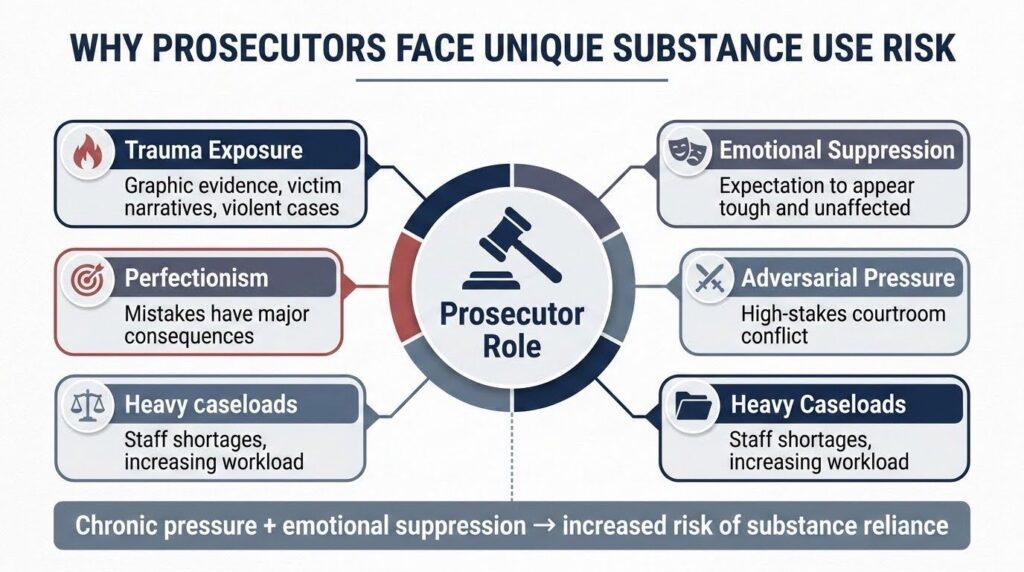
Prosecutors work in the same criminal-court environment saturated with trauma, but their stress profile centers more on adversarial pressure, victim contact, moral responsibility, and cultural expectations of toughness.
Trauma Exposure and Emotional Suppression
A Texas prosecutor-focused article explains that prosecutors face a “double-whammy” of legal-profession stress plus repeated secondary trauma from victims’ experiences.
Prosecutors routinely hear “the worst or most horrifying thing” that has happened to victims, review graphic evidence of rape, homicide, child abuse, and violence, and must remain analytical and objective while carrying expectations of bringing justice.
One Georgia prosecutor quoted in recent reporting described the work bluntly: “Everything we see is terrible, especially at the felony level.”
Prosecutors also operate in a professional culture that often treats emotional vulnerability as weakness. The expectation to be “tough-minded and strong” can suppress help-seeking and normalize hidden reliance on alcohol or drugs to manage anxiety, sleep disruption, or emotional overload.
This cultural dynamic is especially hazardous because it delays treatment and increases the likelihood that substance use will escalate before anyone intervenes.
Workload and Perfectionism
Like public defenders, prosecutors face staffing shortages and mounting caseloads. Remaining attorneys inherit more work and struggle to maintain work-life balance. The adversarial nature of prosecution also fosters perfectionism and chronic vigilance, as mistakes can dramatically alter case outcomes.
This combination of high stakes, emotional suppression, and throughput pressure creates conditions conducive to substance misuse, particularly when alcohol becomes the default tool for decompression after intense courtroom days.
Comparison With Public Defenders
Prosecutors likely face somewhat lower overall substance use risk than public defenders because they typically have more hierarchical institutional structure, regularized employment benefits, and formal supervision.
They also may experience less of the helplessness and ethical overload common in under-resourced indigent defense systems. However, the difference is not trivial.
Prosecutors remain a high-risk group requiring tailored support, especially around trauma exposure, adversarial culture, and the burden of repeated contact with victims’ suffering.
Private Practice Attorneys Show the Widest Internal Variation
Private practice attorneys in Georgia are the most heterogeneous group. Some face substance use risk equal to or exceeding public defenders and prosecutors, while others work in lower-stress environments with greater autonomy and support. The key is that “private practice” is not one uniform exposure category.
High-Risk Private Practice Niches
Certain private practice settings carry serious burnout and substance use risk. Younger attorneys and those in small firms show especially high distress symptoms nationally, often due to professional isolation, cash-flow pressure, lack of mentoring, and high responsibility without institutional support.
Private criminal defense attorneys may share many of the same trauma and stress exposures as public defenders, especially when handling high-volume or emotionally intense cases.
Family law attorneys, personal injury lawyers handling catastrophic cases, and immigration practitioners also face meaningful vicarious trauma and compassion fatigue.
A review of vicarious trauma among legal professionals notes that lawyers working with trauma-exposed clients can experience significant emotional reactions and that repeated exposure may create ethical responsibilities for employers to monitor and address the harm.
Even law firms offering pro bono trauma work recognize the need for secondary trauma guidance, underscoring that trauma exposure is not limited to public-sector criminal practice.
Protective Factors and Variability
Many private attorneys have access to protective factors that public defenders and prosecutors often lack. These include greater autonomy over caseload and scheduling, ability to change practice areas or firms, higher compensation supporting access to private treatment, and in some cases, workplace cultures that prioritize well-being.
However, these advantages are unevenly distributed. Solo practitioners, small-firm lawyers, and attorneys in high-billing, alcohol-centered firm cultures may face risks comparable to or exceeding some public-sector lawyers.
The most accurate conclusion is that private practice contains both the most resourced and the most precarious attorneys. While the average private practitioner may not face the same cumulative trauma-and-caseload burden as a public defender, some private practice segments plainly face very high risk.
How Burnout and Stress Translate Into Substance Use?
Understanding the comparative risk requires understanding the pathways from occupational stress to substance misuse.
Burnout and job stress do not increase substance use risk simply by making work unpleasant. They do so through several linked mechanisms.
Chronic Overload and Decompression Drinking
Heavy caseloads, nights, weekends, impossible deadlines, and digital discovery demands produce emotional and physical exhaustion.
Alcohol becomes a fast, socially accepted means of sedation and decompression. This pathway affects all lawyer sectors but is magnified in understaffed defender and prosecutor offices where recovery time is minimal.
Trauma-Related Dysregulation
Repeated exposure to traumatic client or victim material can cause sleep disruption, intrusive imagery, and bodily tension. Lawyers may use alcohol, benzodiazepines, or other substances to sleep or blunt physiological arousal.
The trauma literature strongly supports this mechanism for criminal practitioners, who often lack the trauma training and supervision available to mental health professionals.
Moral Injury and Numbing
Public defenders who cannot provide what justice requires, and prosecutors carrying impossible burdens inside flawed systems, may feel guilt, anger, cynicism, or hopelessness.
Substances may function as numbing agents against these self-conscious emotions. This pathway is especially visible in the public defense “stress of injustice” literature.
Stigma-Driven Treatment Delay
The legal profession’s stigma around mental health and addiction is well documented. If public defenders and prosecutors also face role-specific stigma, such as being asked “How could you defend that person?” or being expected to “be tough-minded”, they may delay treatment even longer than other lawyers. Untreated distress then increases the likelihood of escalating substance use.
Comparative Risk Summary
| Risk Dimension | Public Defenders | Prosecutors | Private Attorneys |
|---|---|---|---|
| Profession-wide baseline | High | High | High |
| Trauma exposure | Very high | Very high | Variable |
| Caseload pressure | Very high | High | Variable |
| Moral injury | Very high | Moderate to high | Variable |
| Autonomy and control | Low | Low to moderate | Variable, often higher |
| Compensation | Often low | Often lower than private market | Variable, often higher |
| Help-seeking barriers | High | High | High but less role-specific |
| Overall substance use risk | Highest | Very high | High but heterogeneous |
What Georgia Can Do?
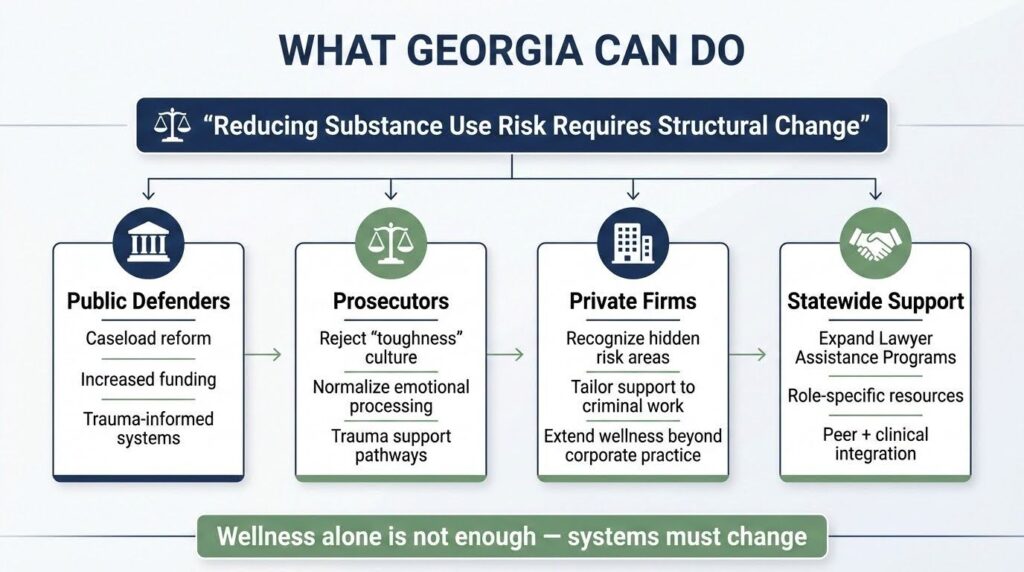
Reducing substance use risk in public criminal practice requires structural interventions, not merely individual wellness advice. For public defenders especially, addiction prevention cannot be separated from caseload reform, adequate funding, and trauma-informed organizational culture.
Prosecutors need explicit rejection of toughness norms and formal pathways for processing traumatic exposure. Private firms should not assume lower risk in pro bono or criminal-adjacent work and should tailor support to high-risk niches.
Georgia’s Lawyer Assistance Program and peer support structures are valuable foundations, but they must be supplemented with role-specific resources.
Criminal practitioners need clinicians and peer supporters who understand defending unpopular clients, repeated victim contact, secondary trauma from evidence review, and moral injury from structural injustice. Offices should normalize trauma education, confidential debriefing, reflective supervision, mental health leave, and manager training.
Why Does This Matter for Georgia Lawyers?
The evidence shows that burnout and job stress raise substance use risk across the legal profession, but they do so more intensely and more predictably for public defenders and prosecutors than for private attorneys as a group.
Public defenders appear to bear the heaviest overall burden because they face extreme caseloads, underfunding, constitutional responsibility, and the “stress of injustice” in serving poor and marginalized clients in punitive systems.
Prosecutors face a parallel but somewhat different burden rooted in secondary trauma, emotional suppression, and responsibility for victims and public safety. Private attorneys remain at meaningful risk, especially in high-pressure or trauma-adjacent fields, but their risk profile is more varied and, on average, less densely concentrated.
If you or a colleague is struggling with substance use, stress, or burnout, confidential support is available. Reach out to explore Thoroughbred Wellness and Recovery’s dual diagnosis treatment that addresses both addiction and the underlying occupational trauma driving it.


 Give Us A Call


