
 info@thoroughbredbhc.com
Pink cocaine is not cocaine. Despite the name, modern tusi, the street term for this pink powder, usually contains ketamine and MDMA rather than cocaine, and drug-checking studies show that up to 94.7% of tested samples contain ketamine as the main ingredient. This article breaks down what pink cocaine actually is, how it differs from cocaine, and why that difference matters for your safety.
Pink Cocaine vs. Cocaine: A Misleading Name
The phrase “pink cocaine” sounds like a variant of cocaine. It is not. Cocaine is a specific stimulant drug extracted from coca leaves. Pink cocaine, also called tusi, tucibi, or cocaína rosada, is a branded polydrug powder whose identity comes from its color and nightlife marketing, not from a stable chemical formula.
Palamar’s 2023 review in The American Journal of Drug and Alcohol Abusedescribes tusi as a “ketamine concoction” that confuses users and researchers alike because people assume it is cocaine or 2C-B when it is usually neither. The name “tusi” or “tucibi” comes from a phonetic reading of “2C” or “2C-B,” a family of psychedelic compounds, but modern samples rarely contain those either.
So what is pink cocaine made of? The short answer is: it depends on the batch.
What Is Pink Cocaine Made Of?
The most consistent finding across drug-checking programs in multiple countries is that tusi usually contains ketamine and MDMA, often with caffeine, and sometimes with methamphetamine, synthetic cathinones, opioids, benzodiazepines, or local anesthetics.
A U.S. dataset of pink powder submissions labeled tusi or 2C-B from 2019 to 2022 found that 94.7% of samples contained ketamine as the main ingredient, 84.2% contained a ketamine precursor, and 2C-series compounds were not detected at all. A Chilean drug-checking study found that 99% of submissions said to contain 2C contained ketamine, while fewer than 1% contained actual 2C-series drugs.
In the United States, DEA-related seizure data show that of 960 pink powder exhibits seized since 2020, only four contained 2C-B. The rest contained other substances entirely.
Here is a summary of what has been detected in pink cocaine samples:
- Ketamine (dissociative anesthetic, most commonly found ingredient)
- MDMA (empathogen and stimulant, frequently detected alongside ketamine)
- Caffeine (stimulant, often used as a cutting agent)
- Methamphetamine (potent stimulant, sometimes present)
- Cocaine (stimulant, occasionally detected but not the defining ingredient)
- Synthetic cathinones (stimulants with unpredictable toxicity)
- Opioids such as oxycodone or tramadol (sometimes detected, raising overdose risk)
- Benzodiazepines (sedatives, sometimes present)
- Fentanyl (reported as a concern in some co-use contexts)
The pink color itself is a branding feature, created with dyes or food coloring. Fitzgerald et al. note that tusi is typically made by mixing drugs such as ketamine, MDMA, and caffeine with dyes to create a distinctive colored appearance. Sweet smells are sometimes added to increase appeal in club settings.
Pink Cocaine Effects: What Users Actually Experience
Because the composition changes from batch to batch, pink cocaine effects are far less predictable than cocaine effects.
Cocaine produces stimulant effects: euphoria, increased energy, alertness, confidence, and sociability. Those same stimulant properties also drive its dangers, including increased heart rate, high blood pressure, anxiety, agitation, and cardiovascular strain.
Pink cocaine effects depend entirely on what is in a given batch. A batch heavy in ketamine may produce dissociation, impaired coordination, confusion, and sedation. A batch with more MDMA or methamphetamine may produce stimulation, emotional openness, hyperthermia, and tachycardia. A batch with opioids may cause respiratory depression. A batch with benzodiazepines may cause sedation and memory loss.
The 2025 epidemiology review by Abukahok, Fitzgerald, and Palamar in Current Addiction Reportsreports that people who use tusi describe effects ranging from euphoria and disinhibition to dizziness, confusion, hallucinations, vomiting, loss of reflexes, and short periods of unconsciousness. That range is far wider than the typical cocaine effect profile
Side Effects of Pink Cocaine
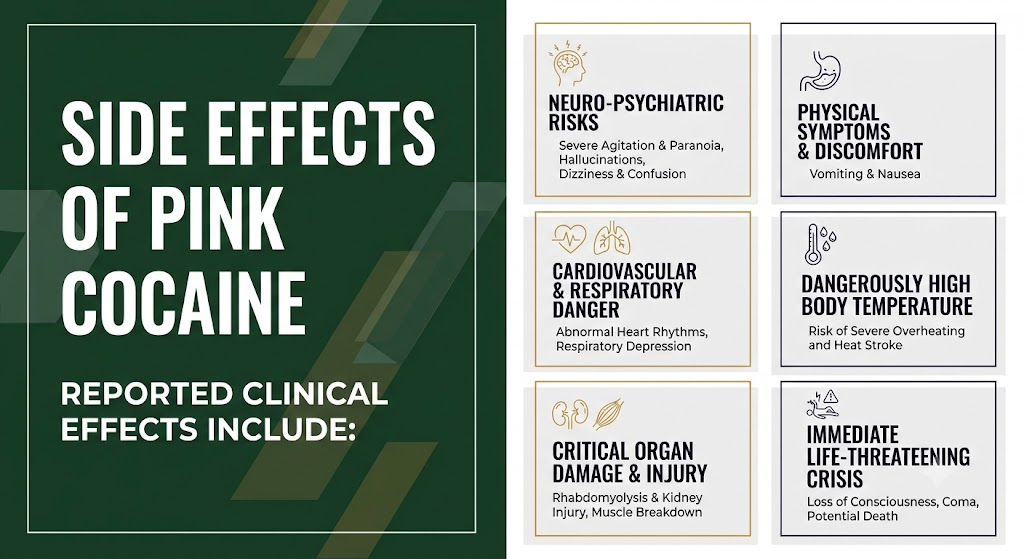
The side effects of pink cocaine reflect its mixed pharmacology. Reported clinical effects include:
- Vomiting and nausea
- Severe agitation and paranoia
- Hallucinations
- Dizziness and confusion
- Loss of consciousness
- Dangerously high body temperature
- Seizures
- Abnormal heart rhythms
- Respiratory depression
- Rhabdomyolysis and kidney injury
The American College of Medical Toxicology lists respiratory depression, sedation, seizures, agitation, hypertension, tachycardia, rhabdomyolysis, kidney injury, and deaths among reported clinical effects of tusi use.
America’s Poison Centers documented 18 pink cocaine exposures across four U.S. states in the first months of 2024, with 83% of patients needing medical treatment, seven hospitalizations, and three life-threatening cases.
Why Pink Cocaine Is More Unpredictable Than Cocaine
Cocaine is dangerous because of what it is. Pink cocaine is dangerous because users often do not know what it is.
A person who takes cocaine expects a stimulant. A person who takes pink cocaine may believe they are getting a stimulant or a psychedelic experience, but may instead ingest a dissociative anesthetic, an opioid, a sedative, or some combination of all of these. That gap between expectation and reality is one of the defining risks.
Poison Control states plainly that while pink cocaine is pink, it often does not contain cocaine and instead contains mixtures such as 2C-B, MDMA, ketamine, and caffeine in varying amounts.
The UNODC World Drug Report 2026 places tusi within a broader category of emerging drug mixtures and notes that evidence on chemical composition and health impacts remains limited because users may not know what they consumed and laboratory analysis is not always available.
The Alcohol Problem
Cocaine is already more dangerous when combined with alcohol. Pink cocaine creates an additional layer of risk. Palamar warns that people may use pink cocaine as if it were cocaine while drinking, but if the product contains ketamine, alcohol can intensify adverse reactions including sedation, vomiting, impaired coordination, and unconsciousness. A person who expects a stimulant buzz may instead become unresponsive.
Where Did Pink Cocaine Come From?
Tusi first appeared in Colombia’s nightlife scene in the late 2000s, where it was associated with elite clubs, high-status social circles, and early connections to 2C-B. InSight Crime’s reporting describes how media attention and police coverage of “cocaína rosada” helped transform an inaccurate label into a powerful marketing term.
As demand grew and 2C-B supply remained limited, sellers began replacing it with cheaper, more available substances like ketamine, MDMA, and caffeine. The name stayed. The chemistry changed. Over time, tusi spread across Latin America, into Spain and the United Kingdom, and later into the United States.
The key insight from InSight Crime is that tusi functions like a brand. Its value comes from appearance, reputation, and the promise of a party-drug experience, not from a standardized chemical formula. Sellers in new markets could copy the concept by mixing locally available drugs, dyeing them pink, and selling them under the same name. That is why InSight Crime notes that some of the U.S. spread may reflect local dealers copying the Colombian formula rather than a single coordinated trafficking network.
Can Cocaine Be Pink? And Does Pink Cocaine Contain Cocaine?
These are two of the most common questions people ask, and both deserve a direct answer.
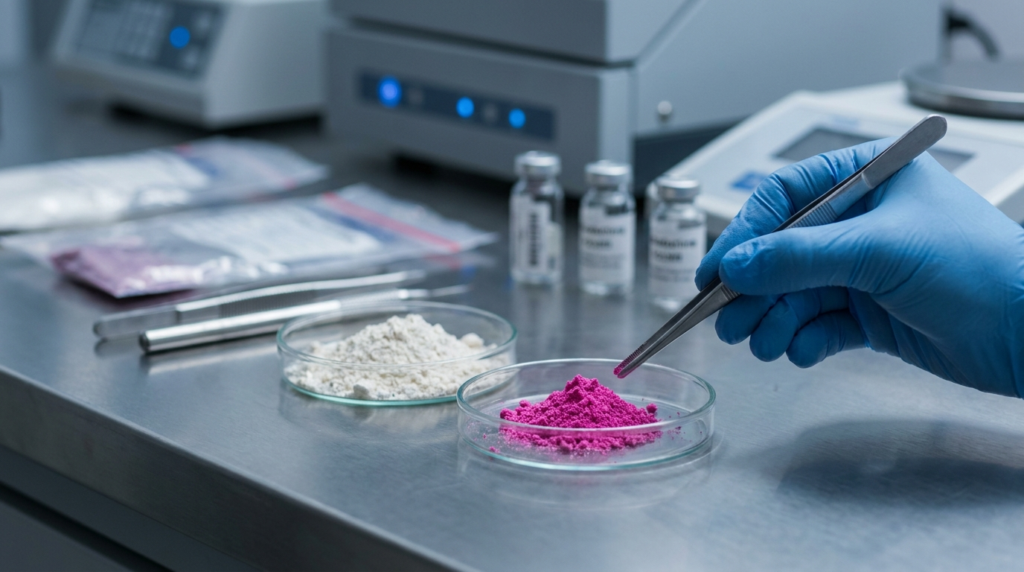
Can cocaine be pink? Cocaine in its natural form is white or off-white. It can appear pink if dyes or colored additives are mixed in, but that would make it an adulterated product, not a naturally occurring pink cocaine.
Does pink cocaine contain cocaine? Sometimes, but rarely as the main ingredient. Drug-checking data consistently show that cocaine is not the defining component of tusi. It may appear in some batches, but ketamine and MDMA are far more common. Calling it “pink cocaine” is a branding choice, not a chemical description.
Why This Distinction Matters Clinically
Treating pink cocaine as cocaine can mislead emergency response. A patient may present with stimulant-like symptoms, dissociation, sedation, serotonin toxicity, opioid toxicity, or a mixed picture. If clinicians assume cocaine alone, they may miss ketamine intoxication, MDMA-related hyperthermia, opioid respiratory depression, or benzodiazepine sedation.
America’s Poison Centers advises calling 911 if a person is unresponsive, not breathing, or seizing, starting CPR while waiting for help, and giving naloxone if available when a person is unresponsive or not breathing, because opioid involvement cannot be ruled out. You can also contact Poison Help at 1-800-222-1222 when pink cocaine exposure is suspected.
Fentanyl test strips alone are not enough. A tusi sample may test negative for fentanyl and still contain ketamine, MDMA, methamphetamine, synthetic cathinones, or benzodiazepines. Full drug checking is more informative than testing for a single adulterant.
The Bigger Picture: A Drug Market Built on Branding
The deeper research finding is that tusi shows how illicit markets can create new products by recombining existing drugs under a strong brand identity. Abukahok et al. argue that tusi represents a novel trend: novelty through mixtures rather than through entirely new molecules. That makes it harder to track through traditional drug-control frameworks and harder to warn people about accurately.
The most accurate public message is this: pink cocaine is usually not cocaine and rarely 2C-B. It is a dyed polydrug powder that commonly contains ketamine and MDMA and may contain stimulants, opioids, sedatives, or other substances. Its danger comes from unpredictable composition and unknown dose. Prior experience with one batch tells you very little about the next one.
If you or someone you care about is struggling with substance use involving pink cocaine, cocaine, or any other drug, reaching out for professional support is the most important step you can take. Our team at Thoroughbred Wellness and Recovery is here to help. Start your recovery today with a confidential conversation.


 Give Us A Call


