
 info@thoroughbredbhc.com
Greening out is an unpleasant cannabis overconsumption episode that can make you feel sick, panicked, dizzy, too high, or out of control. For many adults, inhaled cannabis eases over 3 to 5 hours, while edibles can peak around 3 to 4 hours and may last much longer. This guide explains what is happening, what helps, and when to get medical care.
Greening Out Meaning and First Steps
Greening out means you took more THC than your body or mind could comfortably handle. It is not a formal diagnosis, but people use the phrase to describe acute cannabis intoxication that feels scary, overwhelming, or physically miserable.
If you are asking, “what does greening out mean,” the plain answer is this: your cannabis dose, product strength, route, or mix with alcohol or other drugs was more than you could tolerate at that time.
A green out can happen to someone who uses cannabis for the first time, someone who rarely uses it, or someone who usually feels fine but took a stronger product than expected. It can also happen after edibles because the delay can trick people into taking more too soon.
The first move is simple. Stop using cannabis. Do not take another hit, another edible, or another product to “balance it out.” Move to a quiet place, stay with a sober person if you can, avoid driving, and focus on staying safe while the effects pass.
What It Feels Like
What does greening out feel like? It can feel different from person to person, but most people describe some mix of body symptoms and mental symptoms.
You might feel nauseated, dizzy, sweaty, shaky, weak, unsteady, or too sleepy. Your mouth may feel dry. Your heart may feel like it is racing. Some people vomit. Others feel like they might faint or cannot coordinate their body well.
The mental side can be just as intense. You may feel anxious, panicked, paranoid, confused, unreal, or trapped in a loop of worrying thoughts. Higher doses can bring hallucinations or psychosis like symptoms in some people, especially when other substances are involved or when a person has a psychiatric risk.
Greening out symptoms can be especially frightening because cannabis can change time perception. A few minutes may feel much longer. That does not mean you are stuck that way. It means you need calm support, time, and a low risk setting until your body clears the acute effects.
Why Edibles Can Hit So Hard
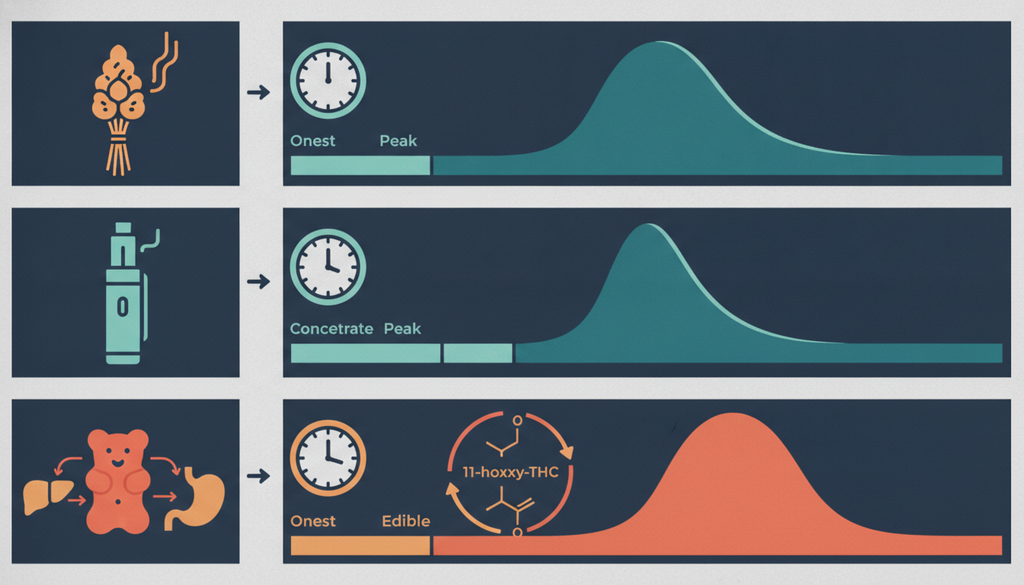
Edibles are a common reason for a green out because they do not act right away. The American Academy of Pediatrics says edible effects often begin 30 to 60 minutes after ingestion and peak around 3 to 4 hours.
That delay matters. Someone may eat a gummy, wait 45 minutes, feel almost nothing, and take more. The first dose may still be building. A second dose can stack on top of it, creating a much stronger high later.
Oral cannabis also goes through the digestive tract and liver. That process creates more 11 hydroxy THC, a psychoactive metabolite. A small 2026 route study found that vaporized THC reached peak blood levels at about 3 minutes, while oral THC peaked much later, around 60 to 90 minutes.
That is why comparing edibles and smoking by THC milligrams alone can be misleading. The same number on a label does not always mean the same onset, peak, or duration.
How Long Does Greening Out Last?
How long does greening out last? The answer depends most on the route: inhaled cannabis usually comes on fast and fades sooner, while edibles come on later and can last much longer.
For smoked or vaporized cannabis, effects can begin within seconds to minutes. In a controlled study, blood THC and heart rate peaked within 30 minutes, and many measures moved toward baseline by 3 to 4 hours.
That does not mean you are fully safe after a few hours. The same study found that some subjective, cognitive, and movement related effects lasted up to about 6 hours on average. You may feel less high before your reaction time, judgment, and coordination are back to normal.
For edibles, the timeline is slower. You may not feel the full peak until 3 to 4 hours after eating the product. Some edible intoxication can last into the next day, especially after a large dose.
Children are a different situation. A pediatric review reported that edible intoxication in children may resolve over 24 to 48 hours and can last up to 72 hours in some cases. Any suspected child exposure should be treated as urgent, even if the child looks fine at first.
| Cannabis route | Onset | Peak | Common duration pattern |
|---|---|---|---|
| Smoked flower | Seconds to minutes | Early, often within the first hour | Often improves over several hours, but impairment can last longer |
| Vaporized flower | Seconds to minutes | Early, similar to smoking | Similar to smoking, sometimes stronger at the same dose |
| Concentrates | Seconds to minutes | Early | Variable, with higher risk when the dose is large |
| Edibles | Often 30 to 60 minutes, sometimes longer | Often around 3 to 4 hours | Can last much of the day or into the next day |
What To Do While It Passes
The safest response for a stable adult is supportive care. That means you are not trying to “detox” the THC out of your body. You are reducing risk while time does the work.
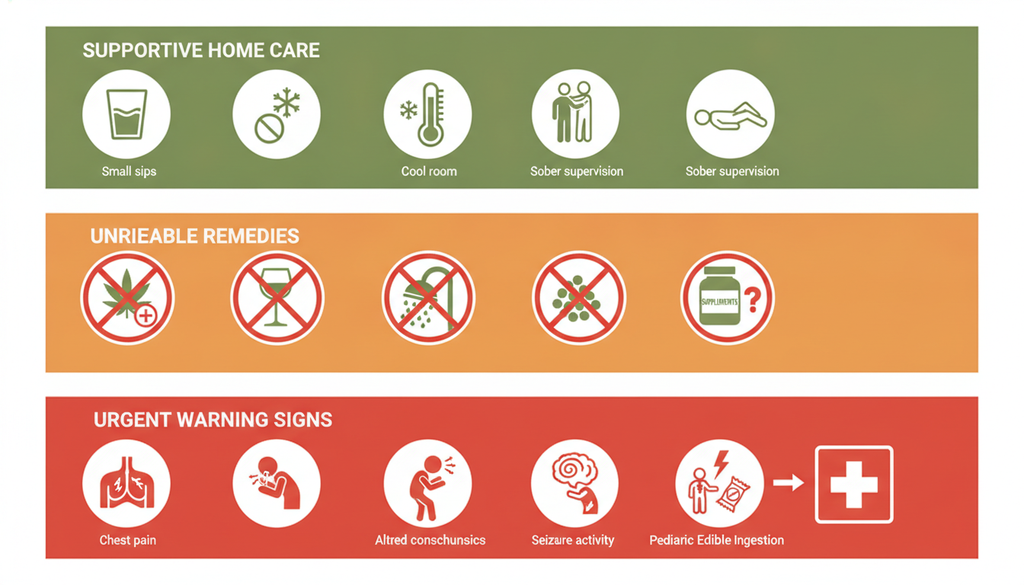
Move to a calm, quiet space. Sit or lie down where you cannot fall. Have a sober person stay nearby if possible. Keep lights, noise, and social pressure low. Remind yourself or the person you are helping that the feeling is uncomfortable, but it usually passes.
Small sips of water can help if the person is awake, able to swallow, and not repeatedly vomiting. Water does not flush THC out faster. It only helps with thirst or mild dehydration. Do not force fluids.
Food is not an antidote either. It may be fine if the person is alert, hungry, not vomiting, and can swallow safely. Do not give food or drink to someone who is very drowsy, unconscious, choking, or unable to sit up and swallow.
Sleep can be okay if the person is breathing normally, can be awakened, and has someone sober nearby. If someone is vomiting or very sleepy, a side lying position is safer than lying flat on the back because it may lower the risk of choking if vomiting happens.
Do not use alcohol, sedatives, opioids, stimulants, or more cannabis to manage the episode. Mixing substances can make sedation, confusion, panic, breathing problems, or unsafe behavior worse.
What Does Not Reliably Stop It
People often ask how to stop greening out fast. The honest answer is that there is no proven home antidote for acute THC intoxication.
CBD is often suggested as a rescue. The research provided does not show that taking CBD after a green out begins reverses established intoxication. A CBD trial looked at acute effects of THC and CBD in a controlled setting, but that is not the same as proving CBD can rescue someone who is already too intoxicated.
Black pepper is another common online claim. Some people may find a familiar smell grounding, but the supplied research does not show that black pepper lowers THC levels, reverses impairment, or prevents medical problems.
Cold showers are also risky when someone is dizzy, confused, or unsteady. A cool room can feel better, but a shower can lead to falls. If someone is very impaired, vomiting, or nearly asleep, they should not be left alone in a bathroom.
The goal is not to find a trick. The goal is to stop taking more THC, stay safe, avoid other substances, and watch for warning signs.
When To Get Medical Help
Most mild green out episodes in stable adults improve with time and support. Still, some symptoms need urgent care.
Call emergency services or go to an emergency department if there is chest pain, trouble breathing, loss of consciousness, inability to wake the person, seizure, severe confusion, dangerous behavior, suicidal thoughts, hallucinations, severe paranoia, or symptoms that keep getting worse.
Repeated vomiting also deserves caution. Vomiting during a single overconsumption episode can happen, but persistent vomiting can lead to dehydration or may point to another condition. The emergency review describes acute cannabis care as mainly supportive, with quiet observation and medical treatment based on symptoms.
Children need a lower threshold. If a child may have eaten a cannabis edible, contact Poison Control right away in the United States through webPOISONCONTROL or 1 800 222 1222. Do this even if the child seems normal, because edible effects can be delayed.
Also get help sooner if cannabis was mixed with alcohol, opioids, benzodiazepines, stimulants, unknown pills, or synthetic cannabinoids. A mixed exposure can look very different from cannabis alone.
Driving And Safety After A Green Out
Do not drive during or soon after greening out. Feeling calmer is not the same as being safe to drive.
THC can affect reaction time, attention, coordination, and lane control. A review of driving research found cannabis related impairment in driving performance, especially lane position and reaction time.
This matters because you may feel like the worst part is over while your brain and body are still slower than usual. That is especially true after edibles, high doses, concentrates, or any cannabis mixed with alcohol or sedating medication.
The safer choice is to wait until you are fully clear, steady, alert, and rested. If there is any doubt, do not drive. Use a ride, stay where you are, or ask a sober person for help.
Is It Different From CHS?
Greening out is usually tied to a recent dose that was too strong for you. Cannabinoid hyperemesis syndrome, or CHS, is different.
CHS is linked with chronic cannabis use and repeated cycles of severe nausea, vomiting, and often belly pain. People with CHS may have periods of feeling better between attacks. Hot showers may bring temporary relief, though that alone does not prove CHS.
The key pattern is recurrence. If you vomit every time you take too much edible THC, that sounds more like dose related overconsumption. If you use cannabis daily or near daily and have repeated vomiting attacks over months, CHS should be considered by a clinician.
CHS can overlap with cannabis use disorder. If you keep using cannabis despite vomiting, panic, emergency visits, missed work, or failed efforts to cut down, it may be time for a more serious look at your relationship with cannabis.
Why It Matters
A green out can be embarrassing, but it is not a character flaw. It is a sign that the dose, timing, product, or setting overwhelmed you.
For a one time mild episode, the lesson may be simple: avoid redosing too soon, be careful with edibles, avoid concentrates if they hit too hard, and do not mix cannabis with alcohol or other drugs. For repeated episodes, the lesson is bigger. Your body may be telling you that cannabis is no longer working for you in a safe or predictable way.
If greening out keeps happening, or if cannabis is tied to panic, vomiting, unsafe choices, or trouble cutting back, support can help you sort it out without shame.
If cannabis is starting to feel hard to control, Thoroughbred Wellness & Recovery offers outpatient support that can help you take the next step.


 Give Us A Call


