
 info@thoroughbredbhc.com
If you are trying to sober up fast, the hard truth is that coffee, showers, food, and sleep will not clear alcohol from your body. The only real answer is time: after absorption, alcohol metabolism often averages about 0.015 percent BAC per hour, so a high BAC can still matter the next morning. This guide explains how to sober up, how long to sober up, and when driving or being alone is not safe.
How to Sober Up: The Plain Answer
The direct answer is this: you sober up when your body has had enough time to metabolize the alcohol, not when you feel awake.
That answer can feel frustrating, especially if you need to get to work, pick up a car, fly home, or care for someone else. Still, it is the safest answer. Your liver does the work, and you cannot force it to work much faster with common tricks.
The phrase how to sober up fast gets searched a lot because people want a quick fix. I get why. No one wants to sit with nausea, anxiety, regret, or the worry that they may still be over a legal limit. But how to sober up quickly and how to feel a little better are not the same question.
You may feel more alert after coffee. You may feel cleaner after a shower. You may feel steadier after food or water. None of those prove your BAC is low enough to drive, work safely, or make clear choices.
Why Alcohol Takes Time to Leave
Alcohol moves through your body in stages. First, it is absorbed from the stomach and intestines into the bloodstream. Then BAC rises to a peak. After that, the body clears alcohol, mostly through liver metabolism.
The tricky part is that BAC can keep rising after the last drink. Food can delay alcohol absorption and may lower the peak, but it does not make alcohol vanish once it is in the bloodstream. This is why the timing of alcohol absorption matters before anyone tries to estimate when they may be sober.
So if you stop drinking at midnight, that does not always mean your BAC starts falling at midnight. If you had food, drank quickly, or had several strong drinks late in the night, your peak may happen after you stop drinking.
That is one reason the next morning can be risky. You may wake up feeling different from how you felt at 1 a.m., but different does not always mean sober.
Alcohol metabolism is also variable. A commonly used average is about 0.015 percent BAC per hour, but the reported range is much wider. Some estimates use 0.010 percent to 0.012 percent per hour when the stakes are high, such as driving, because slower assumptions leave a wider safety margin.
How Long Does It Take to Sober Up?
How long does it take to sober up? It depends on your peak BAC, when your BAC actually peaked, how much you drank, how strong the drinks were, and how fast your body is clearing alcohol.
A useful example starts with a known BAC, not a guess from drink count. If a person has a known post absorption BAC of 0.15 percent, conservative math suggests it may take about 5.8 to 7 hours to fall below 0.08 percent, 8.3 to 10 hours to fall below 0.05 percent, and 10.8 to 13 hours to fall below 0.02 percent. Those estimates come from a known BAC calculation, not from how the person feels.
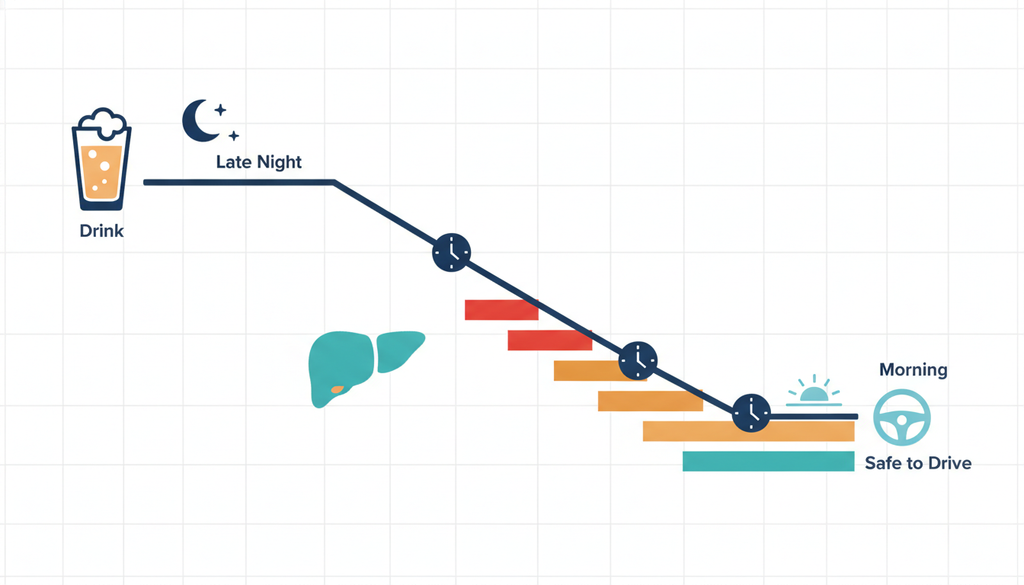
That means someone who peaks at 0.15 percent around 1 a.m. may still have alcohol in their system at breakfast. They may even be near or above some legal limits during a morning commute.
Drink counts are weaker than BAC math because casual drink names hide the real dose. A large glass of wine, a strong beer, a double pour, or a canned cocktail can contain more alcohol than people think. The National Institute on Alcohol Abuse and Alcoholism shows that drink size can change the total number of standard drinks, and its drink size examples include containers that hold several standard drinks.
This is why “I only had three drinks” may not mean much unless you know the serving size, alcohol percentage, and timing. Three strong pints are not the same as three small light beers. A bottle of wine is not one standard drink.
What Helps and What Does Not
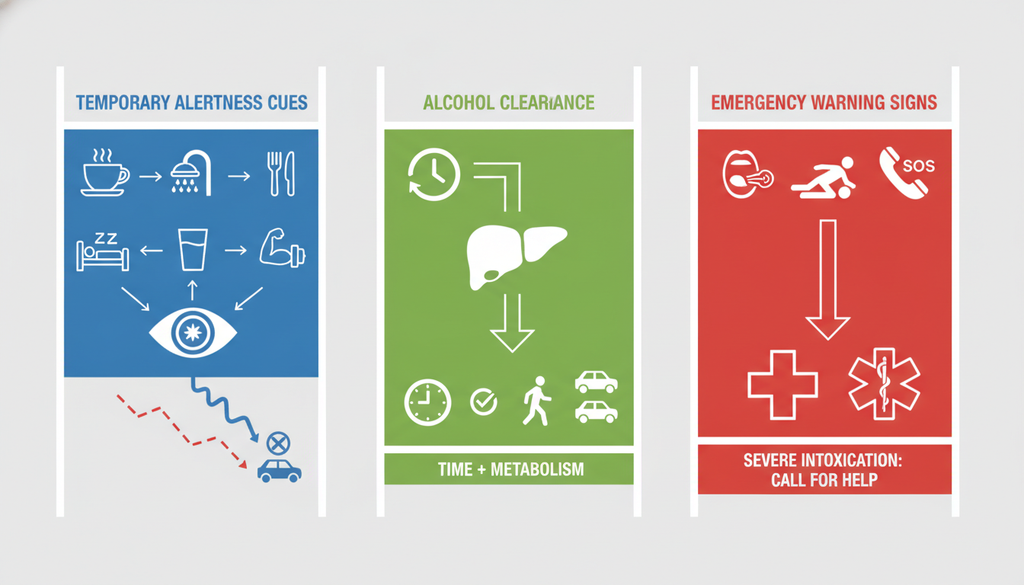
Some things can help you feel safer and more comfortable while you wait. Water may help thirst. Food may help nausea. Sleep may give your body time to clear alcohol. A calm room and a trusted person nearby can reduce risk.
But none of those speed alcohol metabolism in a way you can count on. If you are searching how to sober up fast from alcohol, the safest answer is still to stop drinking, wait, avoid driving, and get help if symptoms are severe.
| Common idea | What it may do | What it cannot do |
| Coffee | May make you feel more awake | Does not lower BAC |
| Cold shower | May make you feel shocked or alert | Does not clear alcohol |
| Food after drinking | May settle your stomach | Does not remove alcohol from blood |
| Water | May help thirst or dehydration symptoms | Does not make the liver process alcohol fast |
| Sleep | Lets time pass | Does not speed metabolism by itself |
| Exercise | May make you feel energized | Does not make driving safe |
Coffee deserves special caution. It can make people feel more capable than they are. In research on alcohol and caffeine, adding energy drinks did not reliably reverse objective alcohol related impairment, yet willingness to drive could increase.
Sleep can also mislead you. In one driving simulator study, severe sleep loss harmed driving performance, and coffee did not fix the sleep deprived driving problem. So the morning after drinking can involve two problems at once: alcohol that remains in the body and fatigue from poor or short sleep.
That combination is why feeling awake is not enough. You can be more awake and still be impaired.
Alcohol Metabolism and Driving Risk
Driving after drinking is not a vibe check. It is not about whether you can walk straight, speak clearly, or convince yourself you are fine.
BAC limits also vary. Across much of Europe, 0.5 g/L is a common general limit, but some places use lower limits, including 0.0 g/L or 0.2 g/L, and some driver groups face stricter rules. The European Transport Safety Council tracks European limits by country and driver category.
That matters because a person might be below one legal threshold but above another. Someone may also be under a legal number and still be unsafe because of fatigue, hangover symptoms, medication, or poor sleep.
A home estimate or online calculator can be useful as a warning sign. It can tell you when residual alcohol is plausible. It should not be used as permission to drive, especially when the result is near a limit.
If you are asking how to sober up quick so you can drive, the better question is whether you can avoid driving at all. If there is any real doubt, use a ride service, public transit, a sober driver, or delay the trip.
How to Sober Up From Alcohol Safely
The safest way to sober up from alcohol is simple, though not always convenient: stop drinking, give your body time, avoid more substances, and do not drive until alcohol is clearly out of the picture.
If you are with someone who has been drinking, stay alert for signs that this is no longer a normal hangover or ordinary intoxication. Alcohol can become a medical emergency, especially when a person cannot wake up, vomits while very drowsy, has slow or irregular breathing, turns blue or very pale, has a seizure, or seems unable to stay conscious. NIAAA warns that suspected alcohol overdose calls for 911 and should not be managed by letting someone sleep it off.
Do not give coffee, force food, put the person in a shower, or try to make them vomit. Those actions can be unsafe when someone is very intoxicated or not fully awake.
If the person is unresponsive but breathing normally, first aid guidance in the research supports placing them on their side and monitoring breathing while help is on the way. If breathing is absent or not normal, emergency instructions and CPR guidance matter right away.
For your own drinking, a safer plan starts before the first drink. Know how you will get home. Avoid driving your own car to drinking events if you might feel tempted to retrieve it early. Be careful with strong drinks, large pours, and drinks you did not measure. Do not mix alcohol with sedating medications or unknown pills.
If you often search how to sober up, how long to sober up, or how to sober up from alcohol after nights you did not plan to drink heavily, that may be a sign to pause and look at the pattern. Needing frequent recovery strategies is not a personal failure. It is information.
Why The Morning After Can Fool You
The morning after drinking is confusing because your body can feel partly recovered while alcohol is still present. The room may no longer spin. Your speech may sound normal. You may remember your plans for the day. You may even feel embarrassed and eager to prove you are fine.
But BAC does not care how motivated you are. It falls over time. If you drank late, drank heavily, or had strong drinks, the clock may not have had enough time to do the work.
Hangover symptoms can also affect performance even after BAC falls. Headache, nausea, anxiety, poor sleep, dehydration, and low attention can all make driving or work tasks harder. A legal limit is not the same as a safety guarantee.
This is why the only honest answer to how to sober up fast is that there is no shortcut. You can support your body, avoid more risk, and wait. You cannot rush your liver enough to make coffee, a shower, or breakfast into a sobriety tool.
Why This Matters
This matters because the wrong answer can hurt people. Believing a myth can lead to a morning drive with residual alcohol, a workplace mistake, a fall, a medical emergency, or a decision you would not make sober.
Time is not exciting advice, but it is the advice that matches the science. Alcohol metabolism has limits. Subjective alertness is unreliable. Legal thresholds vary. Severe intoxication can become dangerous after the last drink.
So if you are trying to sober up, choose the boring safe plan. Stop drinking. Wait longer than feels convenient. Do not drive on a guess. Get medical help if someone is hard to wake or breathing abnormally. And if alcohol is starting to feel hard to control, ask for support before the next crisis.
If alcohol is becoming hard to manage, our medical detox program at Thoroughbred Wellness and Recovery can help you take the next safe step.


 Give Us A Call


