
 info@thoroughbredbhc.com
Equine therapy sounds simple, but most people can’t tell if it means riding lessons, grooming, or real psychotherapy. Real equine therapy is structured psychotherapy where a licensed clinician and a trained equine specialist guide ground based work with horses, and one veteran trial found symptom drops after eight weekly sessions. This guide covers how equine therapy works, who leads it, and what the benefits really are.
What Is Equine Therapy?
Equine therapy is an umbrella term, and that’s part of why it confuses so many people looking into it. The phrase can point to a licensed psychotherapy session that happens to involve a horse, a physical rehab technique that uses a horse’s movement, a riding lesson, or a farm visit that a program simply calls “therapeutic.”
The clinical version, often called equine assisted psychotherapy or equine assisted therapy, is what most people mean when they ask what is equine therapy. It is a mental health treatment in which a licensed therapist uses planned interaction with horses, almost always from the ground rather than on horseback, to work toward a goal tied to a client’s treatment plan. A university overview from Husson University describes the process as assessment, ground interaction such as grooming or leading, and then therapist led reflection afterward.
That is different from hippotherapy, where a physical or occupational therapist uses the horse’s own movement as the treatment tool for balance, tone, or coordination. Aetna’s clinical policy bulletin classifies hippotherapy as unproven for the conditions it reviewed, including anxiety and behavioral disorders, and treats it as a separate, narrowly defined service from psychotherapy. Knowing this difference matters, because a program that offers hippotherapy is not automatically offering psychotherapy, and the reverse is also true.
How Does Equine Therapy Work?
If you’re asking how does equine therapy work, the short answer is that the horse is not the treatment. The horse creates a real, present moment experience, and the therapist helps you make sense of it afterward.
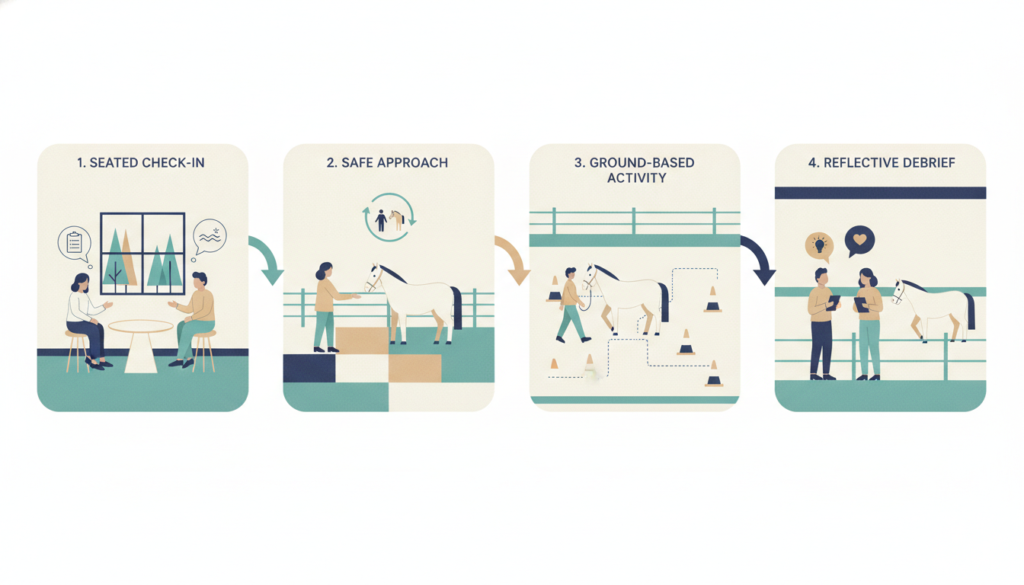
A well run session generally starts with a short check in on mood and readiness before anyone approaches a horse. Then comes a goal linked activity chosen for that person rather than a generic group task, followed by time near or with the horse under the equine specialist’s watch for safety. After that, the therapist leads a conversation where the client explores what came up during the activity, and the session closes by tying the experience back to daily life or the broader treatment plan.
The Eagala model keeps the horse’s natural behavior front and center throughout that process. A 2025 multi-site evaluation of the model across twelve military designated sites describes it as a structured framework that still leaves room for client led exploration, with the horse treated as a co-facilitator rather than a prop. Practitioners are trained to ask open questions about what a client noticed rather than telling them what a horse’s movement means, and that distinction protects against turning an animal’s ordinary behavior into an overstated diagnosis.
Research backs up the idea that these sessions vary quite a bit from program to program. A scoping review of equine work in substance use treatment, led by Diaz and colleagues, found interventions ranging from six week programs with weekly ninety minute sessions to twelve session courses, using everything from herd observation to obstacle work. There is no single fixed formula, which is one reason it helps to ask a program directly what a session actually includes and how long it runs.
Session Length and How Often You’ll Go
Most ground based programs run somewhere between forty five minutes and ninety minutes per session, though that range covers travel to and from the barn, safety orientation, the activity itself, and processing time, not just hands on horse contact. Because the studies above show so much variation in dose and format, no one can honestly claim that daily sessions or a fixed twelve week course is the proven standard. A program that schedules equine work weekly as part of a bigger treatment plan is on solid ground. A program that promises a specific number of sessions as a guaranteed cure is overselling what the evidence shows.
Who Leads an Equine Assisted Therapy Session
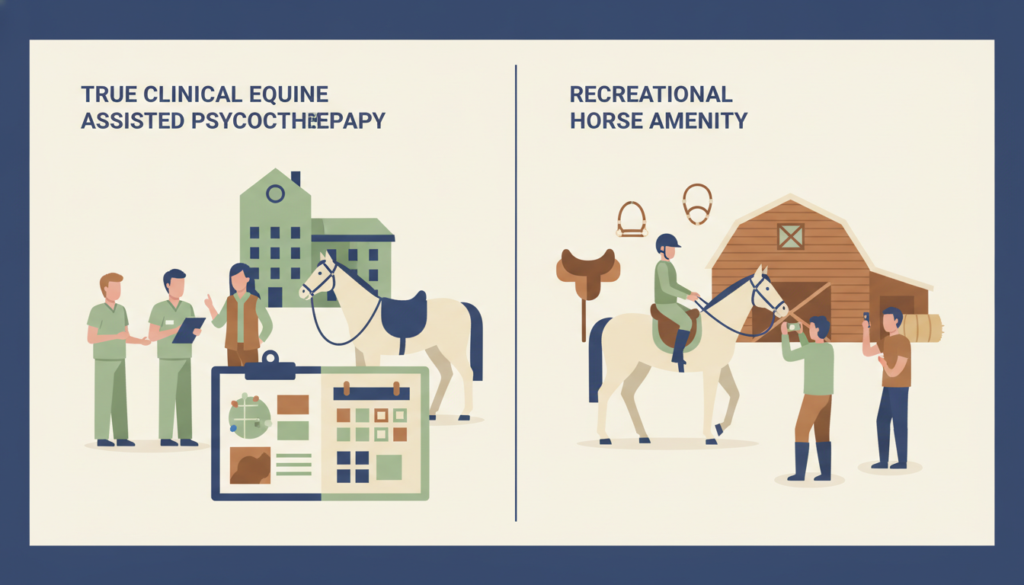
This is where families should pay close attention, because the credentials in the room decide whether you’re getting psychotherapy or just a pleasant afternoon with animals.
The Eagala model spells this out clearly: every session needs a licensed or credentialed mental health professional plus a qualified equine specialist, alongside the horse and client. The mental health professional carries clinical responsibility for the session, while the equine specialist reads horse behavior, manages safety, and protects the horse from being overworked or put in an unsafe position. That second job is not a courtesy to the animal. Veterinary research on stress in therapy horses notes that a horse’s emotional state bears directly on the safety of the people in the arena, which is why neither role substitutes for the other.
There is a related but different credential in this field, the Equine Specialist in Mental Health and Learning, which certifies someone as the equine expert who works alongside a mental health professional or educator, not as a stand in for one. A 2023 systematic review of veteran PTSD studies flagged how inconsistently programs described who was actually running their sessions, which is why this is worth checking yourself. A person can be wonderful with horses and still not be qualified to provide psychotherapy, so it is fair to ask which license the clinician holds, whether they hold that license in your state, and whether they are actually present for the whole session rather than just the barn portion.
Common Equine Therapy Activities to Expect
Ground work sits at the center of most clinical programs, since Eagala and similar models skip riding entirely. Activities are chosen to fit a person’s specific goals rather than run on autopilot, but a few show up again and again across programs.
Researchers behind the same scoping review, Diaz and colleagues, documented herd observation, grooming, leading, and obstacle work as recurring building blocks across many of the programs studied to date.
- Leading or grooming a horse while noticing your own pacing, patience, and communication style
- Watching herd behavior quietly to practice awareness without pressure to act right away
- Working through an obstacle course with a partner to see how you handle frustration
- Building a symbolic layout with cones or objects to represent triggers, supports, or choices in recovery
None of these activities are magic on their own. The value comes from what happens after, when the therapist helps you connect what you noticed to a pattern in your life, whether that pattern is trust, avoidance, or how comfortable you feel asking for help.
Benefits of Horse Therapy for Mental Health
So does any of this actually help? The honest answer is: sometimes, for some people, as a support alongside other treatment rather than a stand alone cure.
A 2023 systematic review by Li and Sánchez-García looked at ten studies on veterans with PTSD and found that six reported clear symptom improvement, two were unclear, and two saw symptoms return by around the three-month mark. A 2024 meta-analysis by Provan and colleagues reached a similarly careful but positive note, pooling thirteen studies and 344 veterans and finding that equine-assisted services were linked to lower PTSD severity overall. Only one of those thirteen studies carried a low risk of bias, which is why the authors themselves urged caution.
One open trial by Fisher and colleagues tested an eight session group protocol for veterans with PTSD and reported drops in both PTSD and depression symptoms, plus a low dropout rate near eight percent. That low dropout rate matters, since it suggests people were willing to keep showing up even during an emotionally demanding process.
Taken together, the equine therapy benefits that current research actually supports are modest but real: possible short term drops in PTSD and depression symptoms for some veterans, a structured and less verbal way to practice noticing emotions and body signals, and a format some people stick with even when they have avoided office based therapy in the past.
What the research does not support yet is any claim that horse therapy replaces trauma focused psychotherapy, medication, or addiction treatment. It looks most useful as an add on, not a swap, and any program that tells you otherwise is getting ahead of the evidence.
Is Equine Assisted Therapy Right for You?
Equine therapy is not automatically a fit for everyone, and a responsible program will screen for that before you ever meet a horse.
Who Tends to Benefit Most
This approach tends to fit people who want an active, outdoor way to work on trust, communication, or emotional regulation, especially if traditional talk therapy alone has not felt like enough. It can work well as one piece of a bigger plan that still includes individual therapy, group work, and medical care when needed, rather than as the whole plan by itself.
Reasons to Pause First
Psychology Today notes that serious fear of horses is one reason to pause and talk it through with a mental health professional first, since forcing exposure without consent works against the point of trauma informed care. Allergies, certain mobility limits, and being intoxicated or in active withdrawal are also good reasons to skip a session on that particular day rather than push through it. A trustworthy program treats these as reasons to adjust or wait, not reasons to shame someone out of treatment altogether.
Why It Matters
The gap between a real clinical session and a nice afternoon at a barn is bigger than it looks from the outside. A program that can name its licensed clinician, describe its equine specialist’s background, and explain the specific goal behind an activity is offering something close to genuine psychotherapy. A program that just says “we have horses” is offering something else. That something else might still feel good, but it is not the same service, and it should not be priced or promised as one.
If you are weighing equine therapy for yourself or someone you love, ask direct questions about who is in the room, what a session actually includes, and how it connects to the rest of the treatment plan. That question alone will tell you more than any brochure, and it is the difference between a good story and a solid piece of your care.
If equine therapy sounds like a piece of the puzzle you are considering alongside treatment for trauma or substance use, reach out to Thoroughbred Wellness and Recovery and explore treatment programs to see how it fits into a fuller plan built around you.


 Give Us A Call


